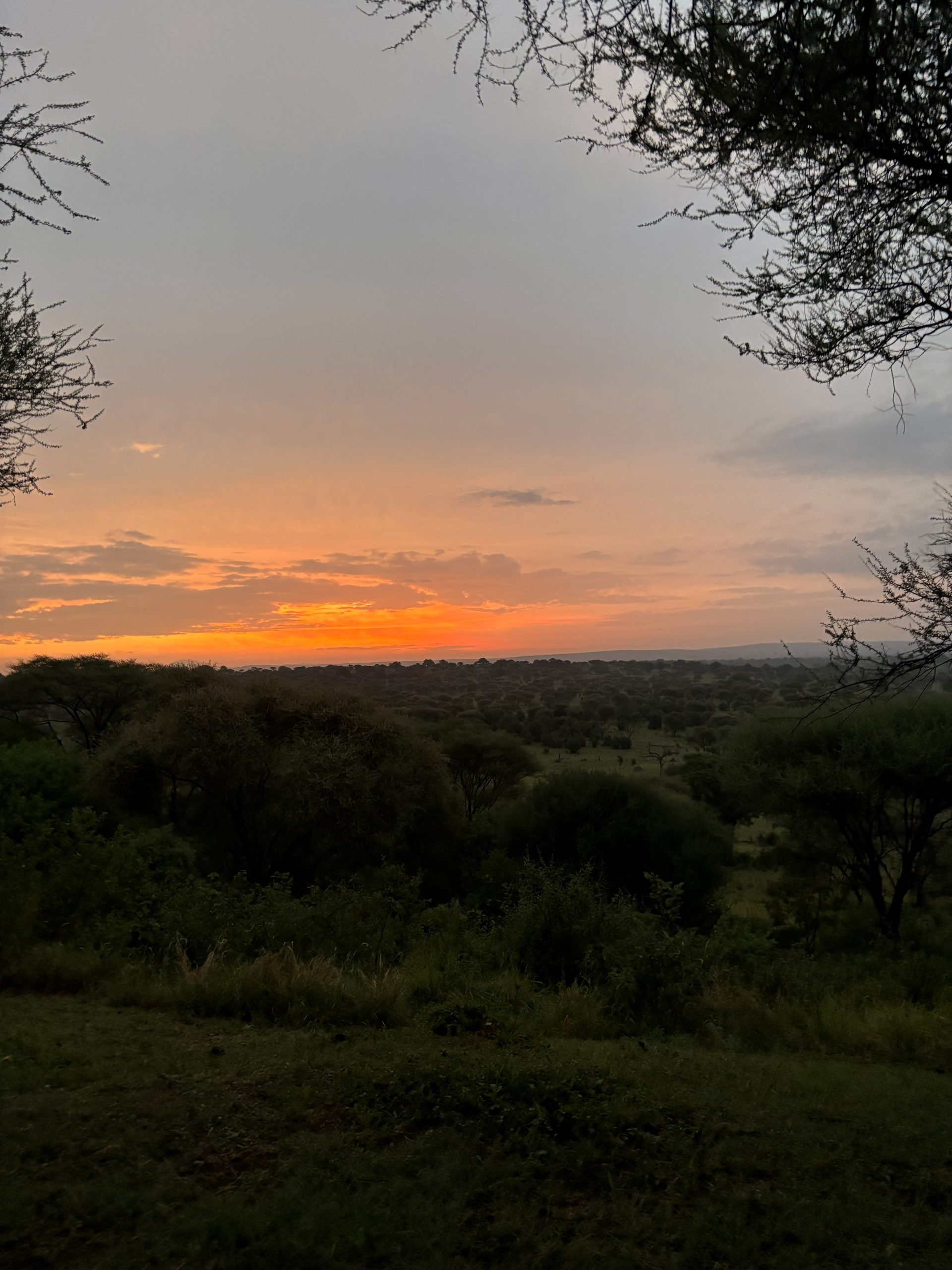
Beyond the Office
Tanzania: A Safari
in Four Acts
Two weeks. Four national parks. One unforgettable journey across East Africa.
Two weeks. Four national parks. One unforgettable journey across East Africa.
Every great adventure begins long before you arrive.
Every great adventure begins long before you arrive. Ours began somewhere over the Pacific, settled into a Delta One suite for the first time, wondering how we'd ever fly any other way again.
Jo and I departed Sacramento with Tanzania on our minds and business class under our feet — a first for both of us. The private suite, the Missoni amenity kit, the José Andrés curated dinner menu, the little remote control that adjusted the lighting and reclined the seat into a fully flat bed — it was the kind of travel experience that makes you feel like the trip has already begun before you've left American airspace. We flew Sacramento to Seattle, then pointed the nose of a Delta 767 toward Amsterdam, somewhere over Greenland as we slept.
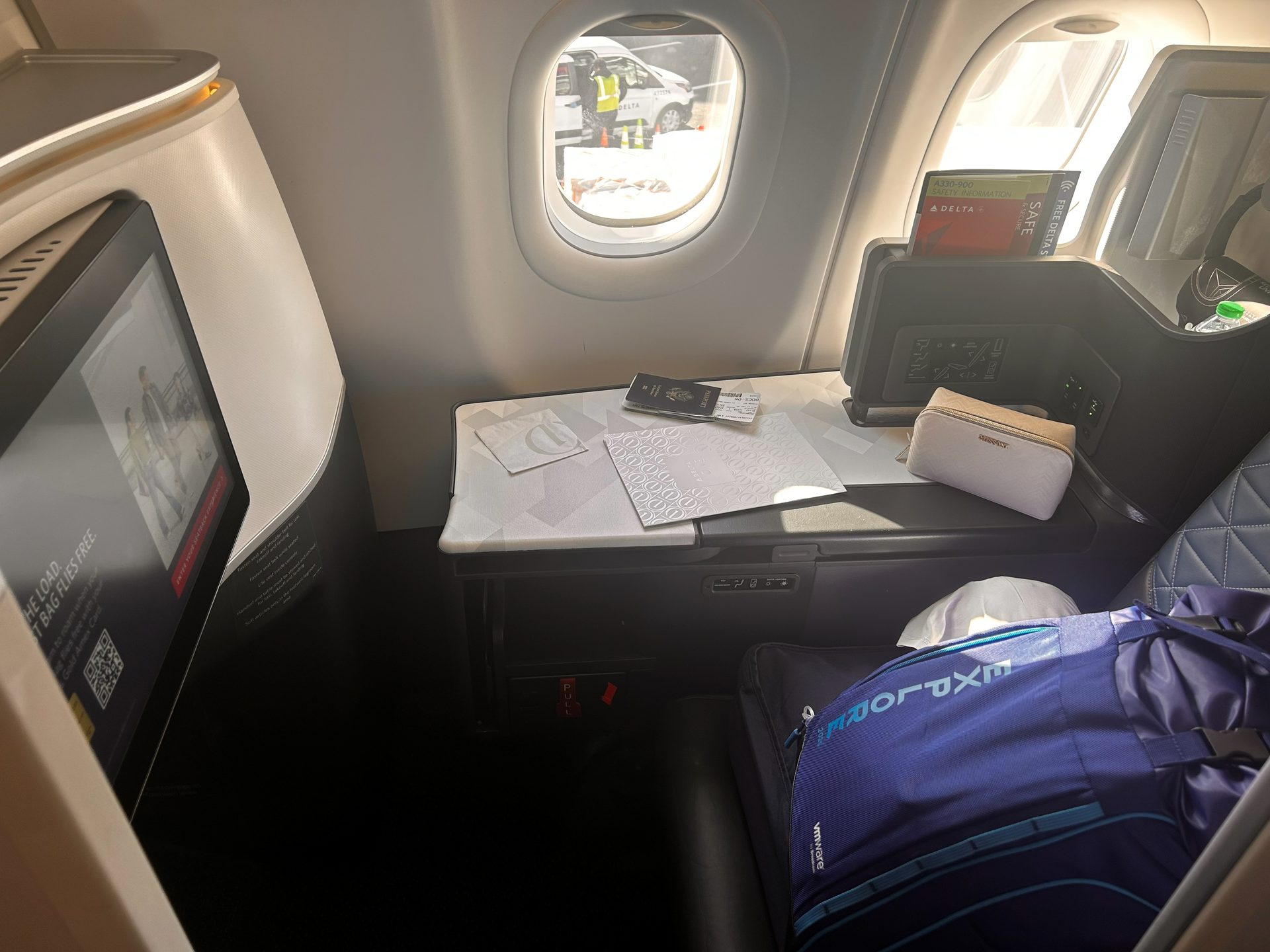
The Delta One private suite — passport on the desk, Tanzania on the mind
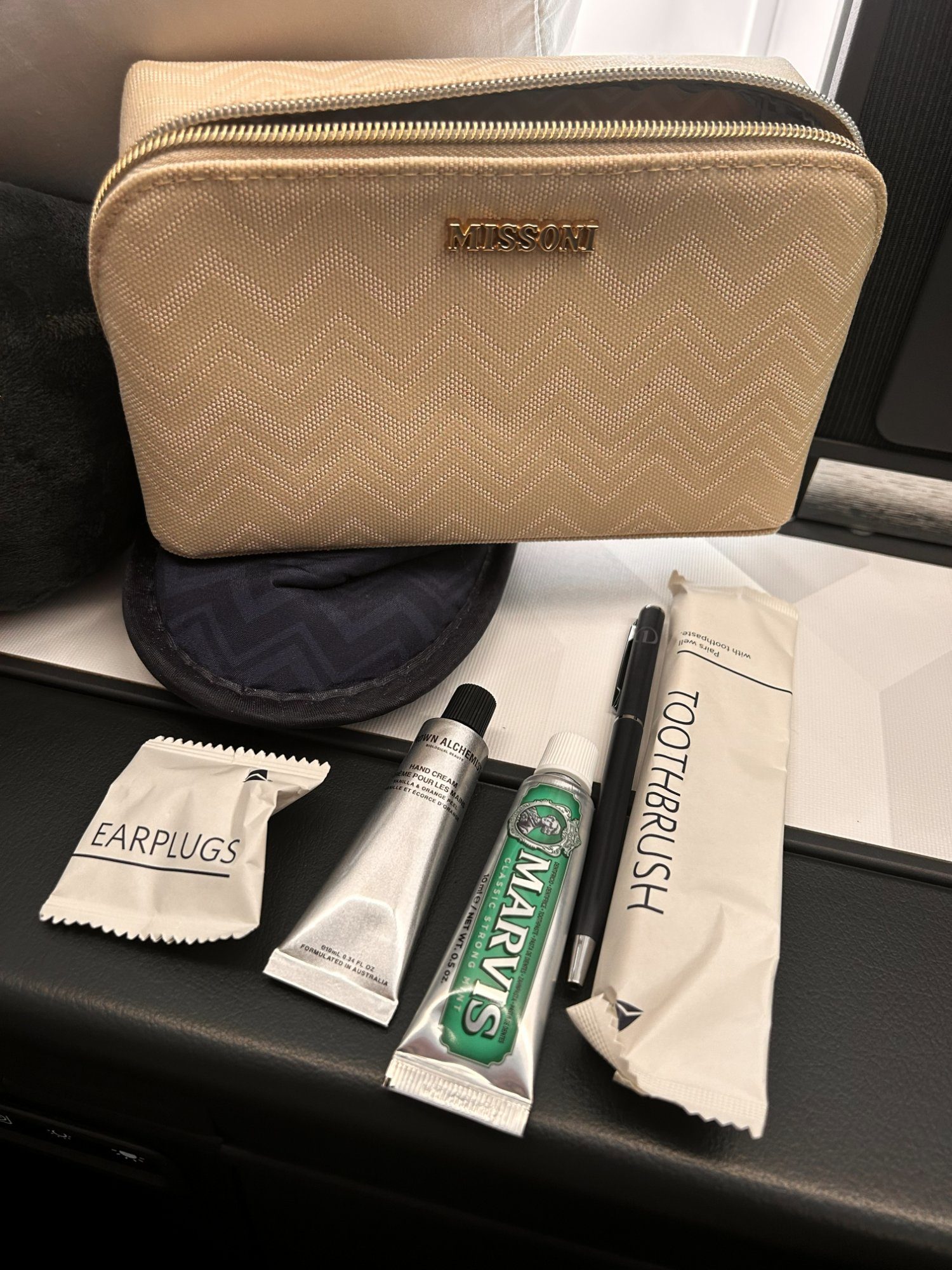
The Missoni amenity kit — Marvis toothpaste, Dawn Alchemy hand cream, and slippers
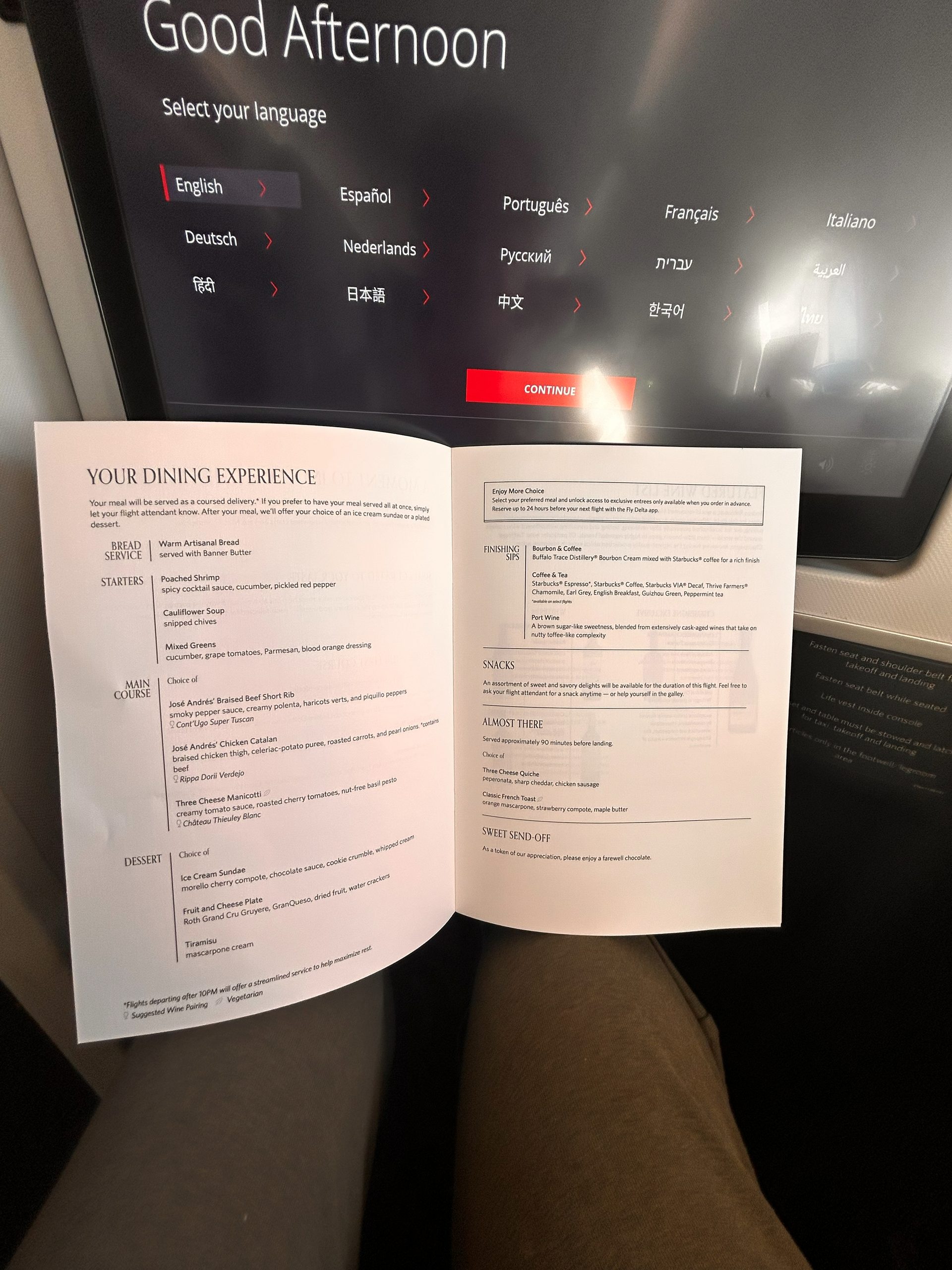
The dining menu — a José Andrés curated experience at 35,000 feet
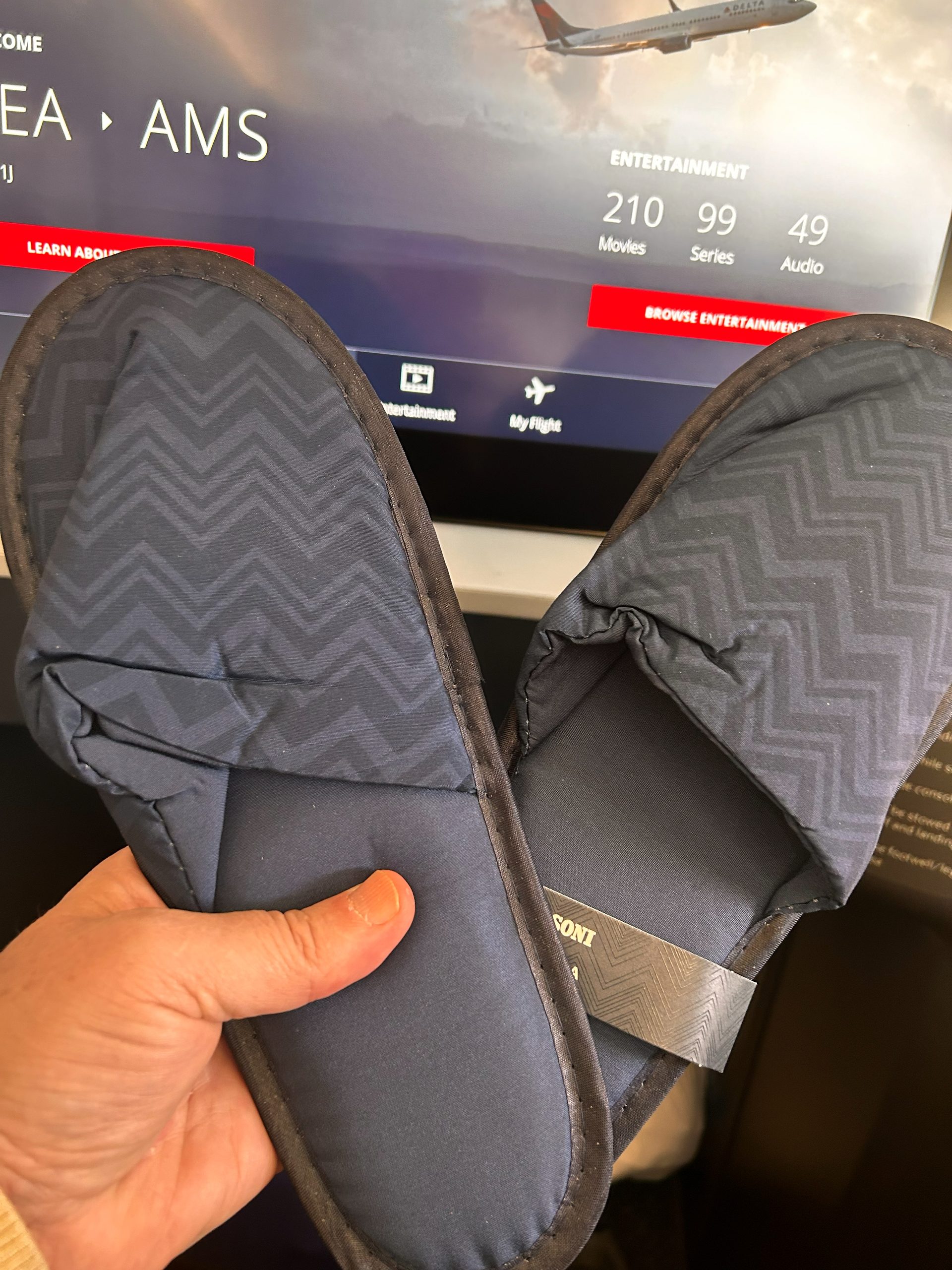
Missoni slippers and the route display — Seattle to Amsterdam
Delta One business class — the suite, the seat, the start of something
Seattle to Amsterdam — the overnight crossing, somewhere above the North Atlantic
We didn't need to go to Amsterdam. It was a layover, a practical stop to reset our body clocks before the long push south into Africa. But we went anyway — jet-lagged, a little dazed, and armed with exactly one free evening in one of Europe's most fascinating cities.
It was cold. My Apple Watch confirmed what my bones already knew — 36°F on a Thursday evening in February, with a fine drizzle that turned the cobblestones into mirrors. We checked into the Park Victoria Hotel, dropped our bags, and walked straight out into the night.
Amsterdam at night is something else entirely. The canals reflect the city back at you in shimmering gold and amber. The De Oude Kerk — a Gothic church that has stood in the heart of the city since the 1300s — loomed out of the dark, its tower illuminated against a black sky. A block away, the red neon of the Moulin Rouge cast everything in crimson, a reminder that Amsterdam has always done things its own way and made no apologies for it.
Dinner was at Haven van Texel, a narrow, wood-paneled pub tucked into a side street near the old church. We ordered the stamppot — a traditional Dutch dish of mashed potatoes and vegetables topped with sausage — and washed it down with Texels Speciaalbier, a local island brew. The receipt came to €60.70 — roughly $65 USD. The warmth of that room, after the cold of the canals, was worth every euro.
We took different paths that evening. Jo, ever the adventurer, booked a canal boat tour with Flagship Amsterdam — gliding through the dark water as the city slid past on both sides. Her guide — cheerful in her bright orange jacket despite the cold — pointed out landmarks and told stories as the illuminated facade of Amsterdam Centraal Station floated into view. It was the kind of thing I wish I'd stayed awake for. But after the long transatlantic flight, I made the more sensible choice and went straight to bed.
We were in bed by ten. Africa was waiting.
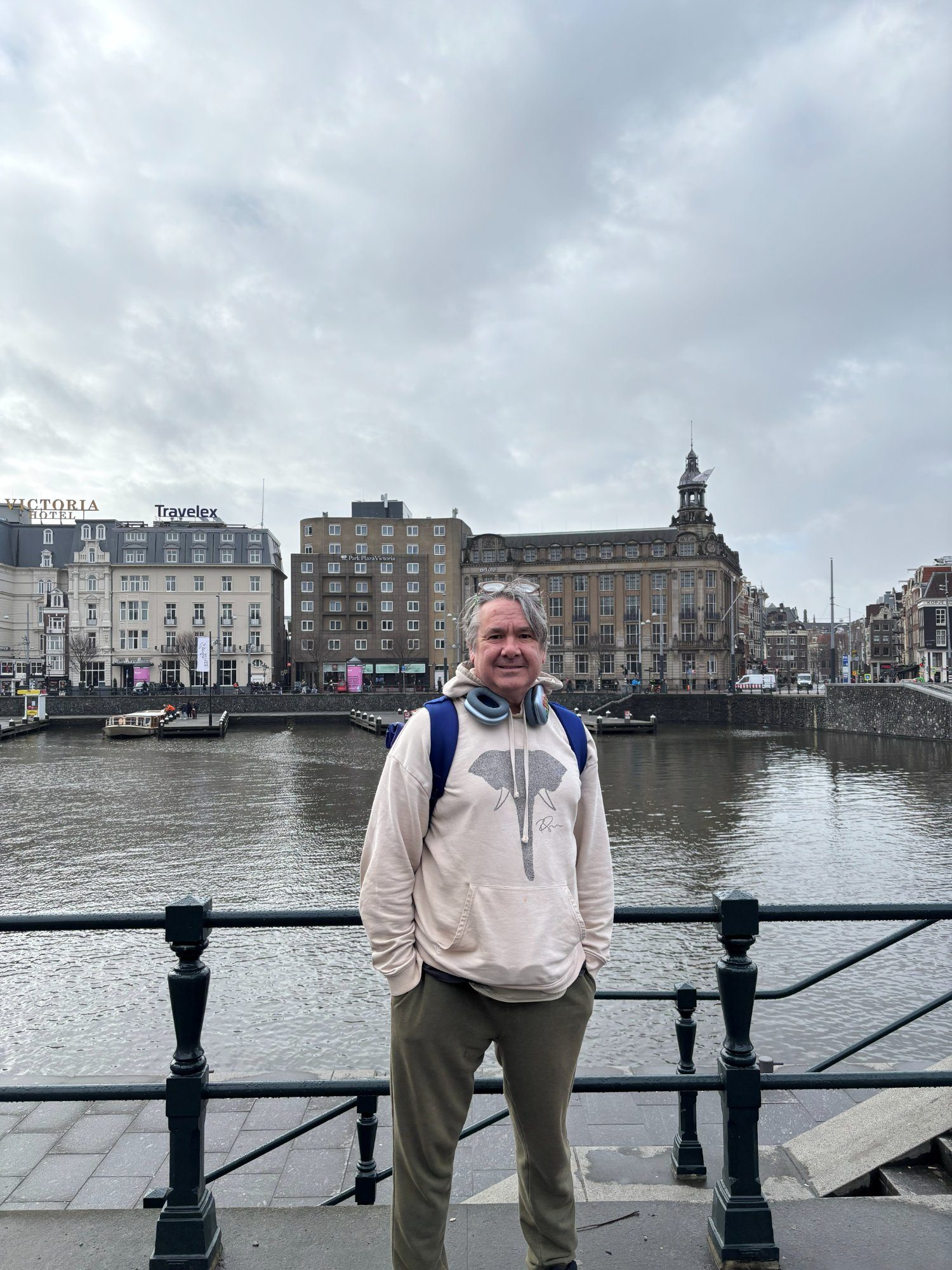
At the Amsterdam canals — the Park Victoria Hotel visible behind
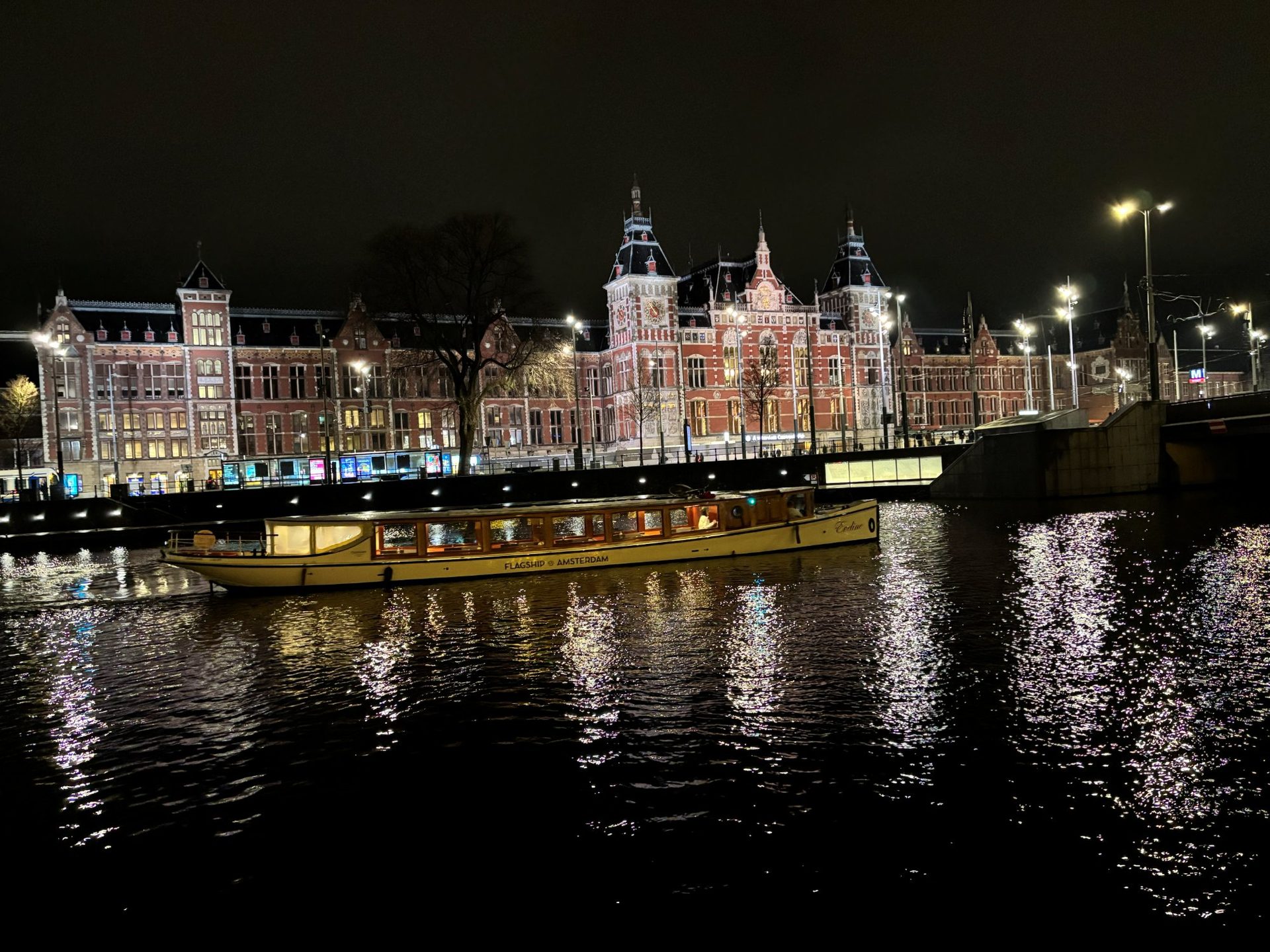
The Flagship Amsterdam canal boat passing the illuminated Centraal Station
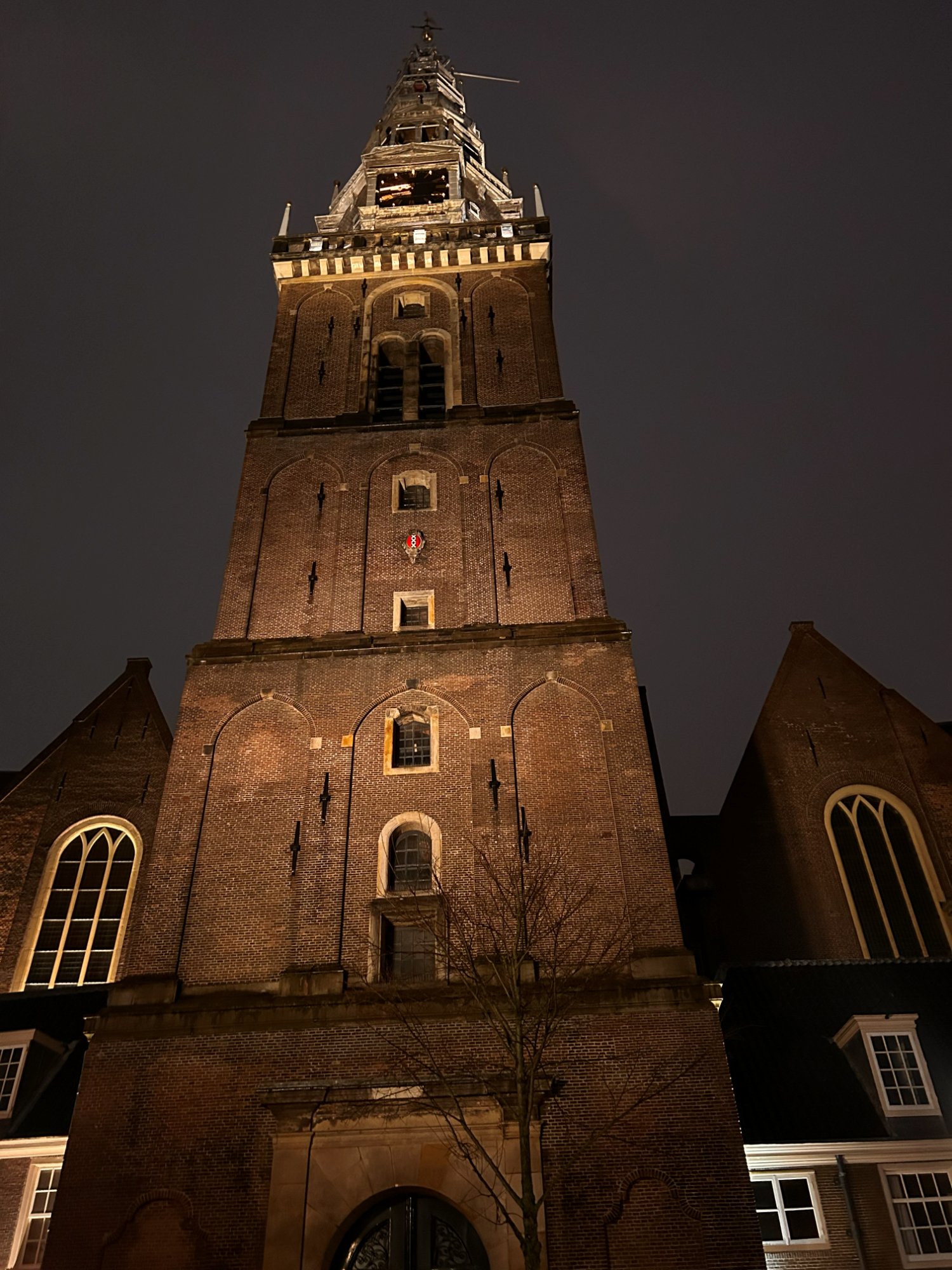
De Oude Kerk — standing since the 1300s
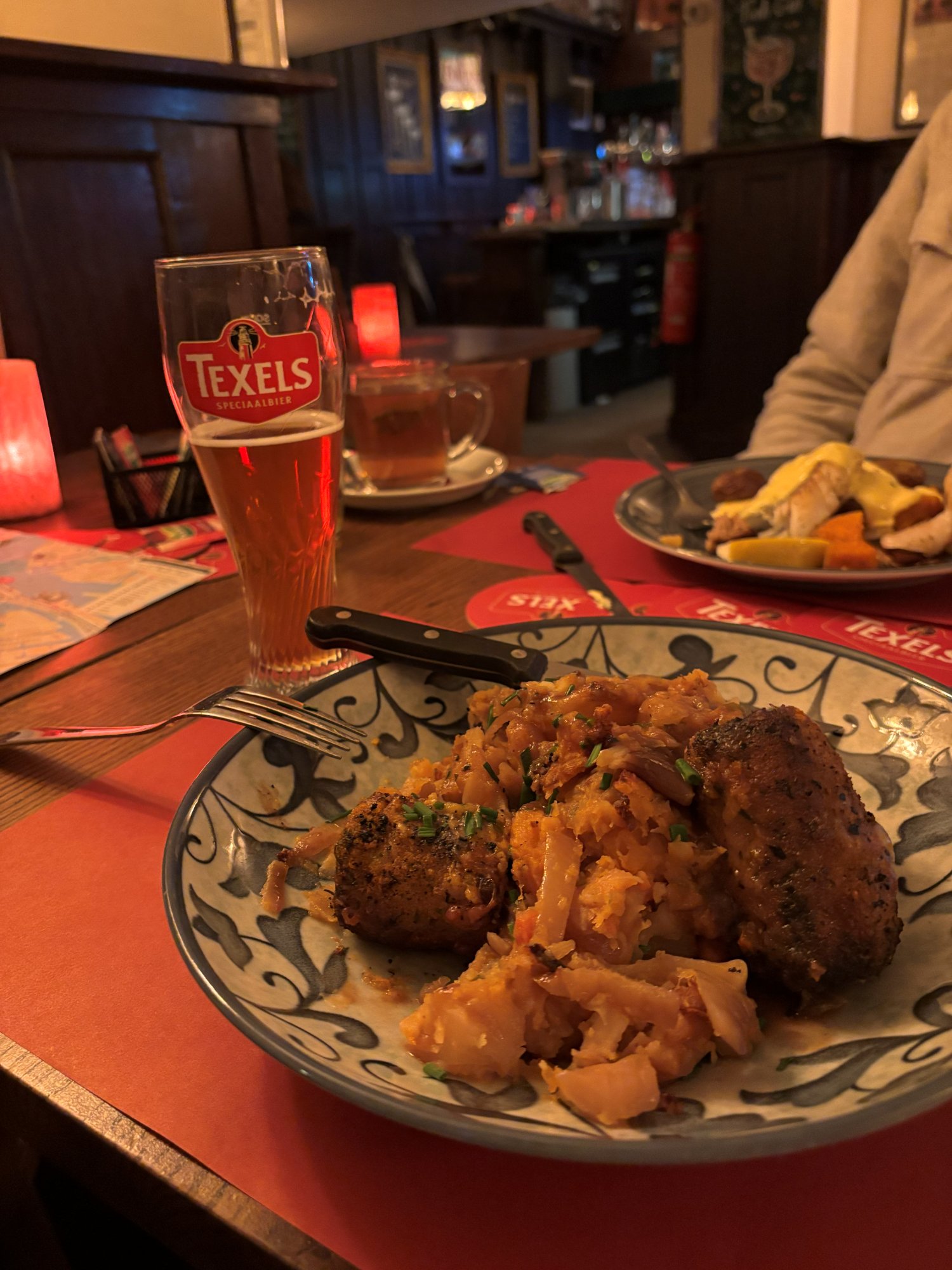
Stamppot and Texels Speciaalbier — the perfect Amsterdam night
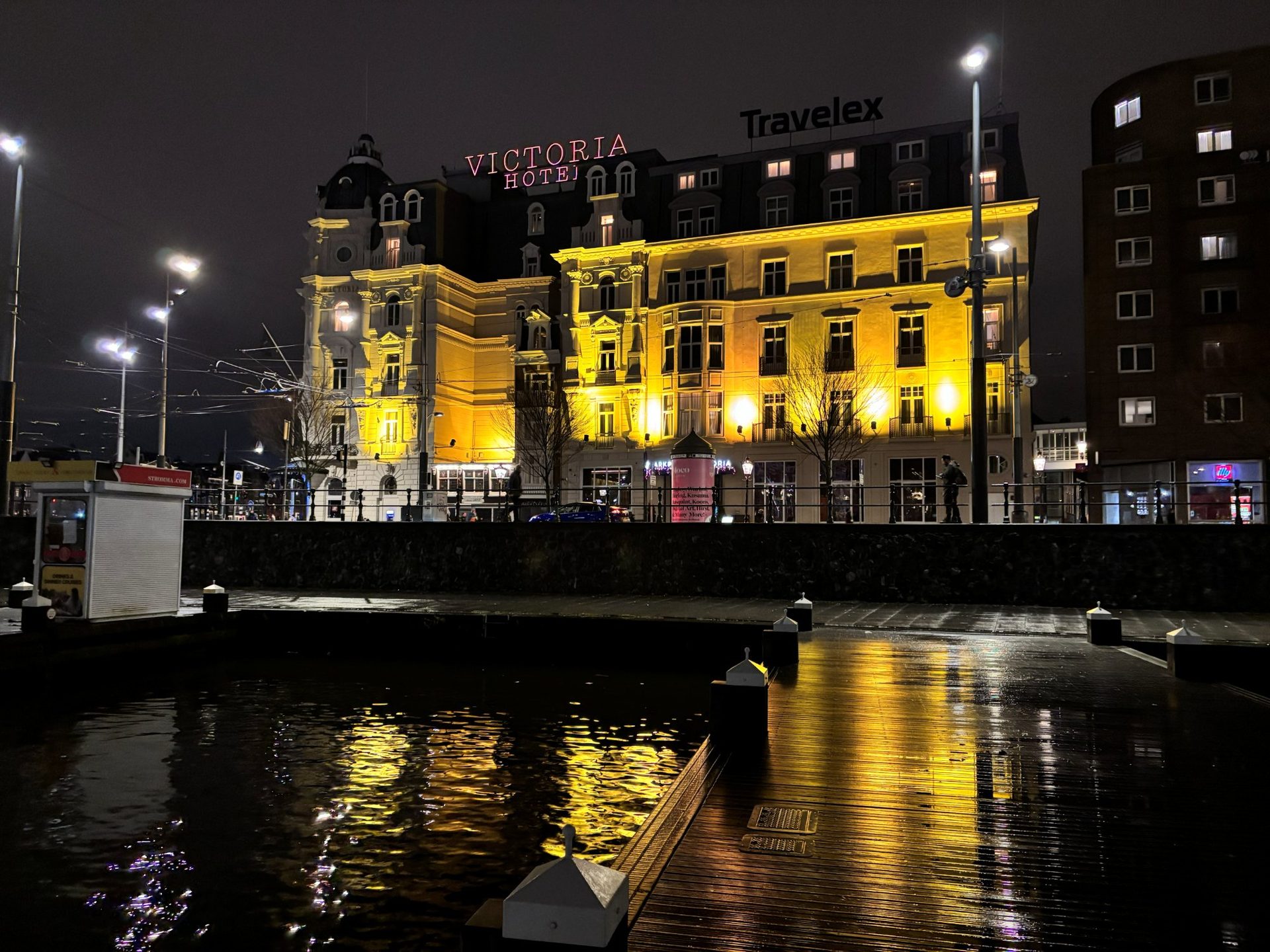
The Park Victoria Hotel — golden in the Amsterdam night
The KLM flight from Amsterdam to Kilimanjaro International Airport takes roughly nine hours. We landed in the dark, the way most safari journeys begin — the plane rolling to a stop on the tarmac, the door opening, and then that first breath of African air. Warm. Different. Real.
There are no jet bridges at Kilimanjaro. You descend the stairs onto the tarmac and walk — a loose crowd of silhouettes moving toward the glow of the terminal sign, backpacks and excitement and exhaustion all mixed together.
Inside, the Visa on Arrival queue was long and slow and packed with travelers from a dozen countries, all of us shuffling forward in the warm air, passports in hand. It took the better part of an hour. Nobody complained. Everyone was smiling.
We had made it to Tanzania. The safari hadn't started yet — but Africa had already begun.
Deplaning the KLM flight at Kilimanjaro International Airport — stairs to the tarmac, warm African air, and the adventure finally beginning
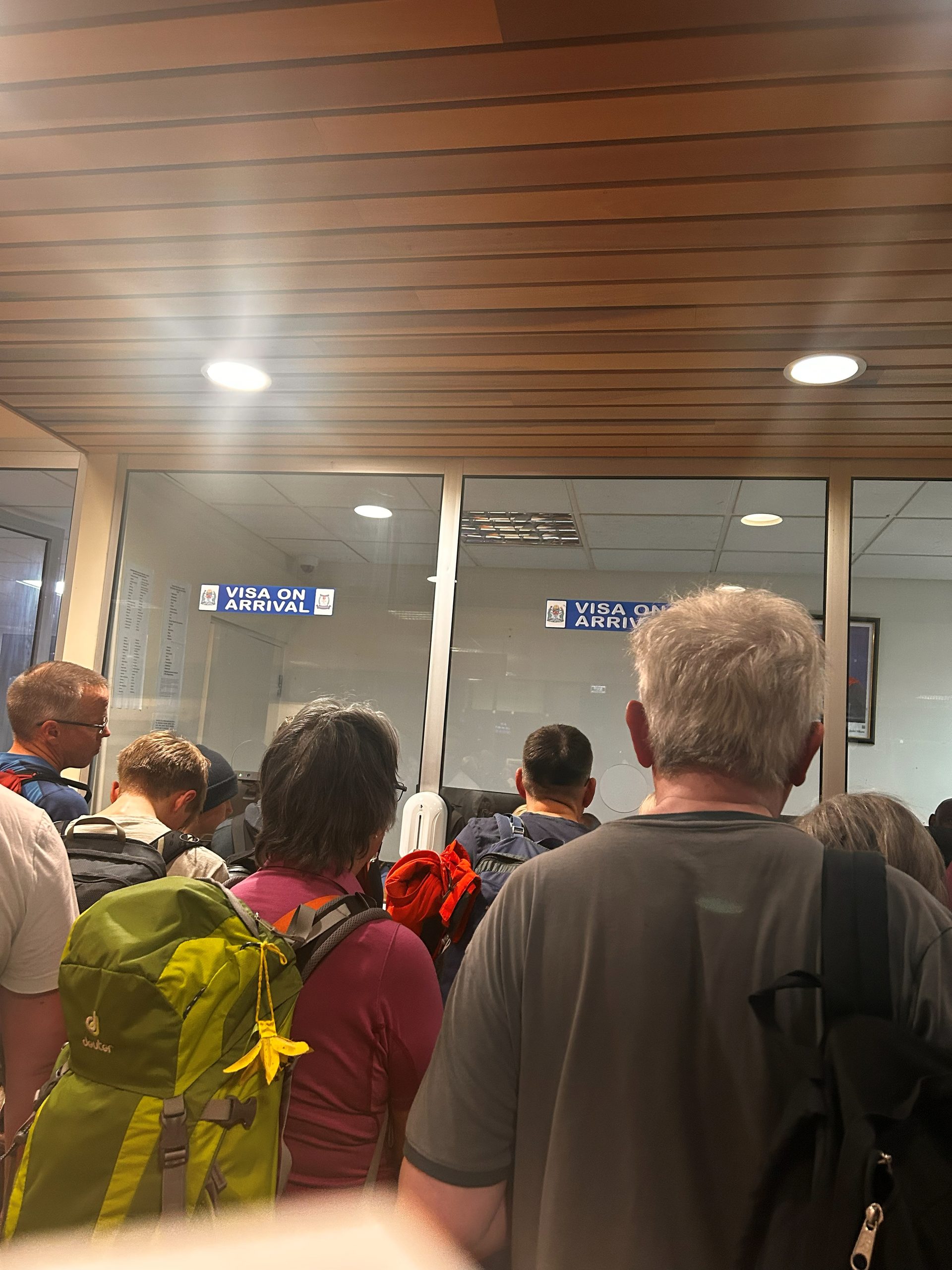
The Visa on Arrival queue — backpacks, exhaustion, and everyone smiling anyway
Two nights in Arusha — and the first taste of what was coming.
The drive from Kilimanjaro International Airport to Rivertrees Country Inn takes about an hour. We made it in the dark, the bus cutting through the warm Tanzanian night, headlights picking out the road ahead while everything else remained invisible. It didn't matter. After the long visa queue, the exhaustion of the journey, and the strange electricity of finally being on African soil, none of us were looking out the window anyway. We were talking.
Our Thomson Safaris guide, Mike Ellis — an American, calm and immediately likable — was waiting for us at the airport with cold bottled water and a warm welcome. So was Harry, our Tanzanian bus driver, whose easy smile and friendly manner set the tone for everything that followed. The sixteen of us settled in, introductions were made, and somewhere between the airport and the lodge, a group of strangers began the slow process of becoming travel companions.
"The formal welcome happened in a round thatched hut — hibiscus tea served in ceramic cups while the sounds of the forest settled around us."
Rivertrees announced itself quietly. The bus turned off the main road, and suddenly there were trees — enormous, old trees — closing in around us, their canopies blocking out what little light remained. A gravel path. Warm lights ahead. And then we were there.
The formal welcome happened in a round thatched hut at the heart of the property. Staff greeted us with hibiscus tea — deep red, floral, slightly sweet — served in ceramic cups while the sounds of the forest settled around us. After the cold of Amsterdam and the long hours of transit, it was exactly what the moment needed. A pause. A breath. A signal that the journey had truly begun.

Cottage 9 at Rivertrees Country Inn — thatched roof, terracotta porch, and the forest pressing in from every side
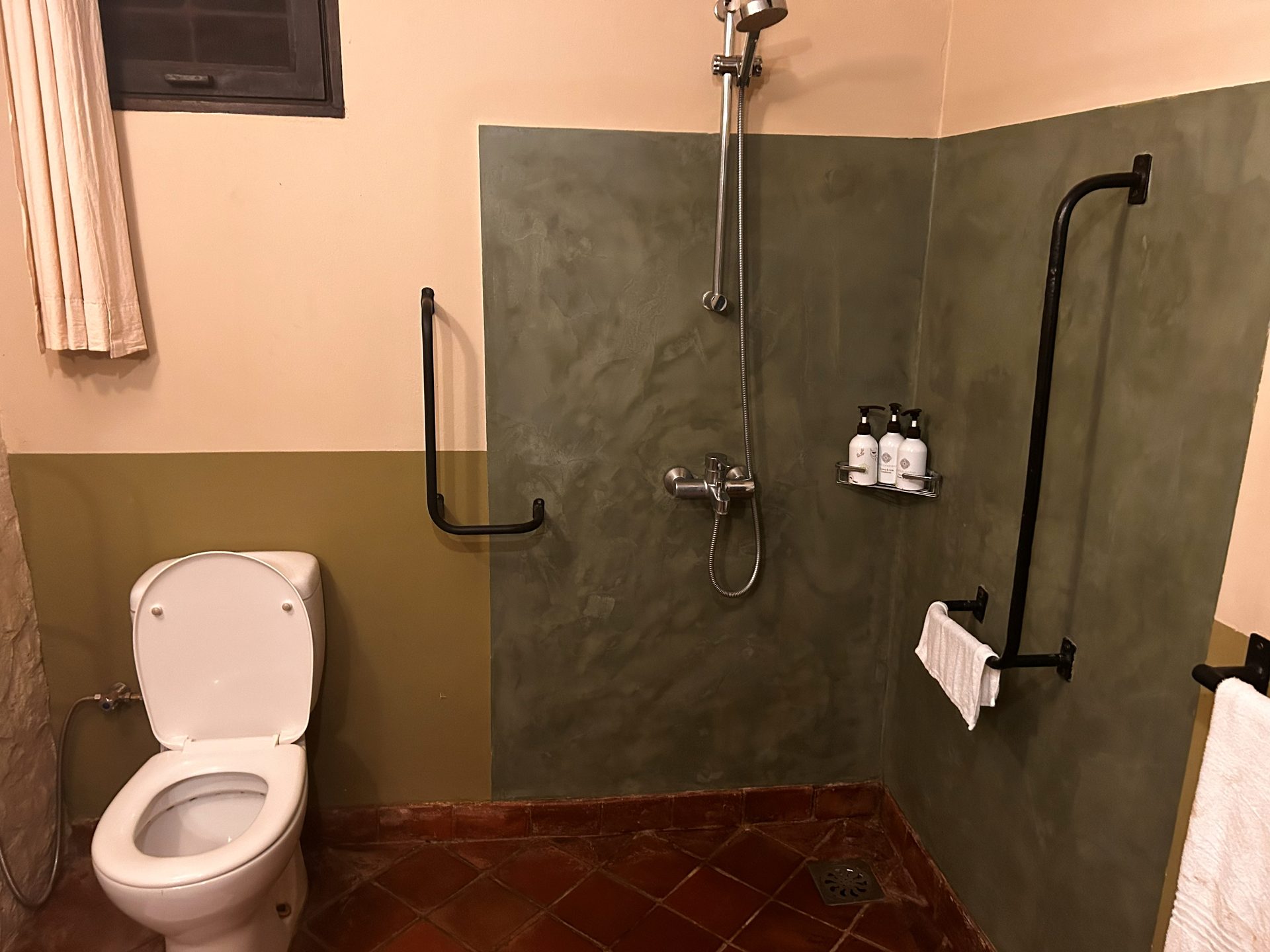
The Rivertrees bathroom — polished sage-green concrete walls, terracotta tile, and a proper rainfall shower after a long day
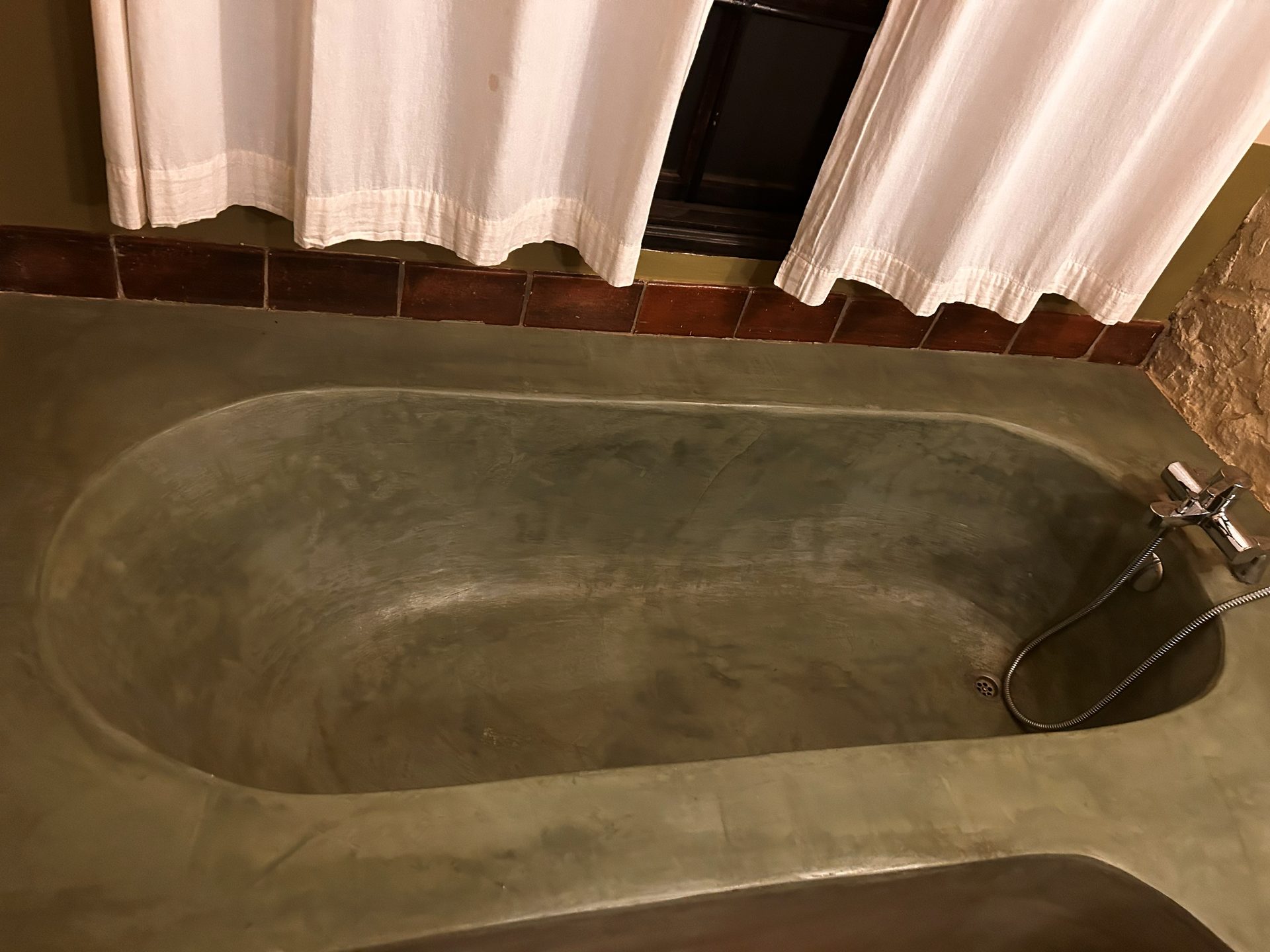
The soaking tub — hand-formed concrete, terracotta tile, and the kind of bathroom that makes you stay in longer than planned
Morning at Rivertrees is something I won't forget quickly. Coffee in hand, the forest waking up around you, and above — movement in the canopy. The Colobus monkeys came out with the light, swinging between the trees and scrambling across the thatched rooftops of the lodge with casual confidence, their jet-black bodies and white beards flashing between the leaves. They paid us no attention. We couldn't stop watching them.
Breakfast was served in the open-air thatched pavilion — and it was, unexpectedly, thoroughly American. Egg omelettes made to order, fresh fruit, yogurt, banana bread, proper coffee and tea. It was delicious, and slightly surreal, and nobody complained. We sat together as a group for the first time — sixteen travelers drawn from across the globe, with representation from Tanzania, Europe, and North America, plus Mike and four highly educated Tanzanian game drivers and guides who would become our eyes, our teachers, and our connection to this landscape over the days ahead.
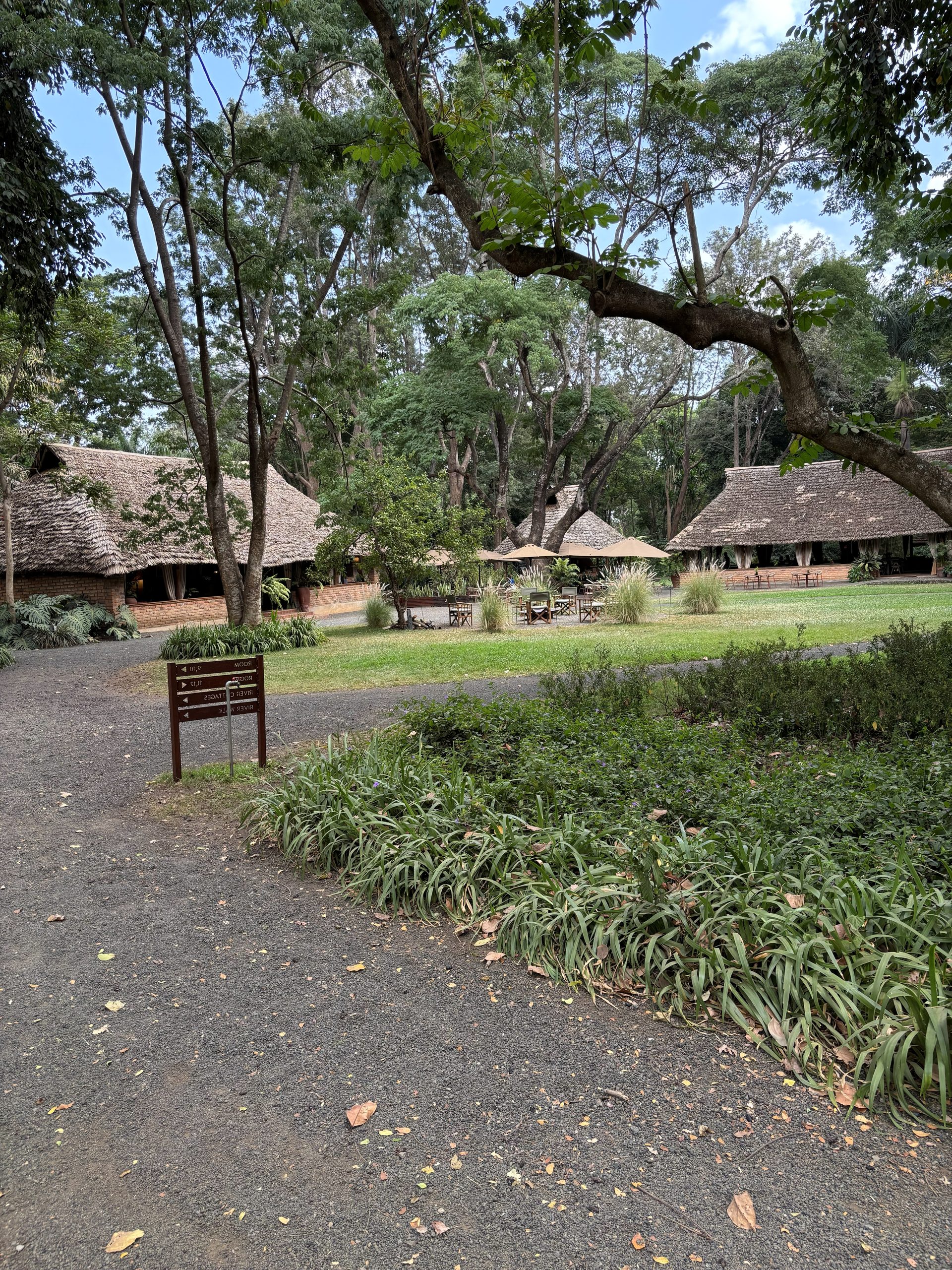
The open-air breakfast pavilion at Rivertrees — thatched roof, towering trees, and a surprisingly American breakfast
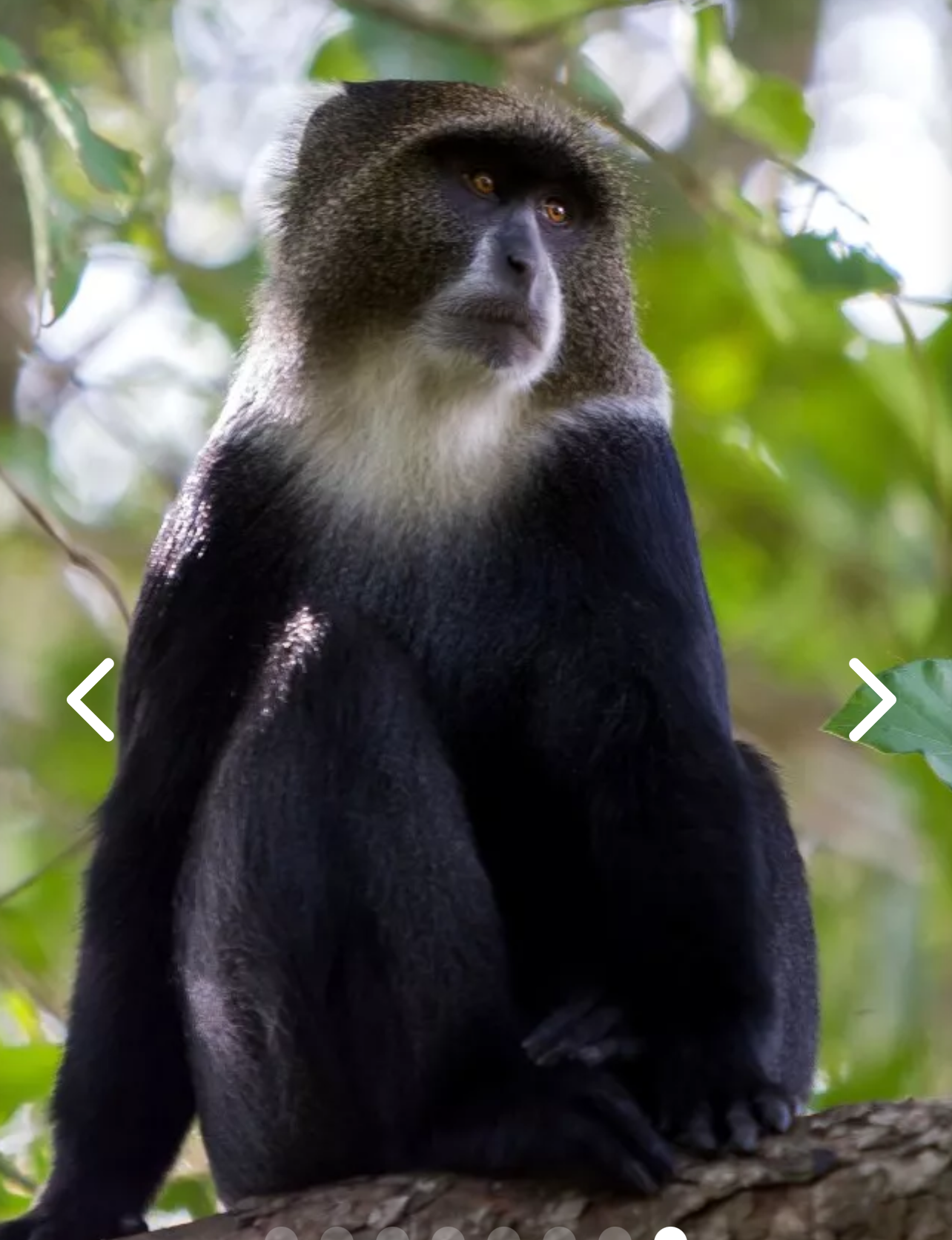
One of the lodge's resident monkeys in the canopy above — jet-black coat, white chin, amber eyes regarding us with complete composure
On our first full day, the group set out for a two-mile walking safari in Arusha National Park — accompanied by an armed park ranger, the first any of us had ever seen carrying a rifle in a wildlife setting. It was a quiet reminder that we were walking through wild Africa, not a managed reserve.
The walk took us through forest and open meadow to Tululusia Waterfall — peaceful, tucked away, the sound of it arriving before the sight. Along the route, we encountered the first animals of the trip: giraffe grazing at a respectful distance, warthogs trotting through the grass, zebra standing alert, and the diminutive dik-dik — Africa's smallest antelope, barely knee-height, with eyes that seem too large for its delicate face — picking its way through the undergrowth close enough to observe in real detail.
These were appetizers. We didn't know it yet, but they were setting a very high bar.
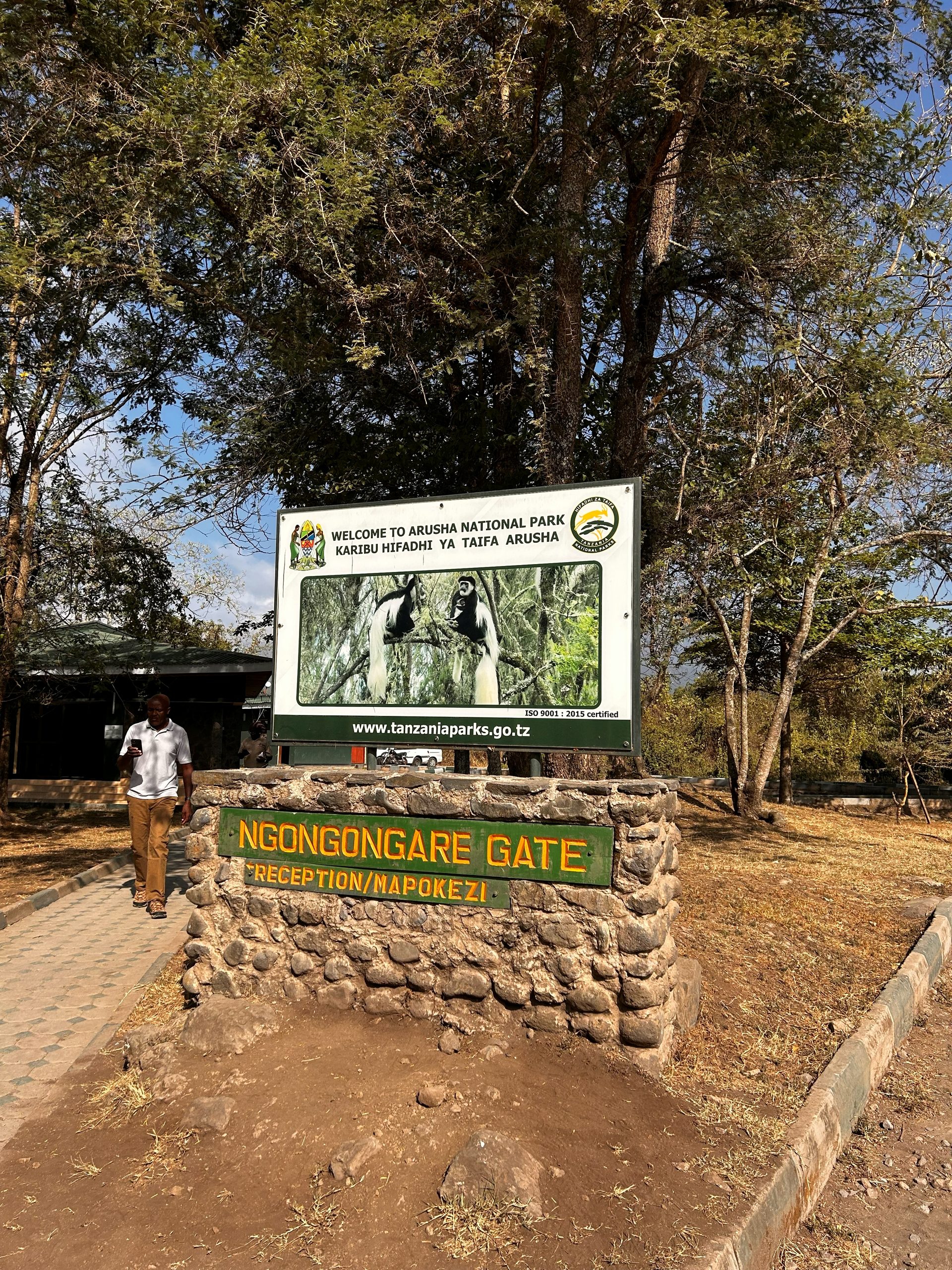
Ngongongare Gate — the official welcome to Arusha National Park
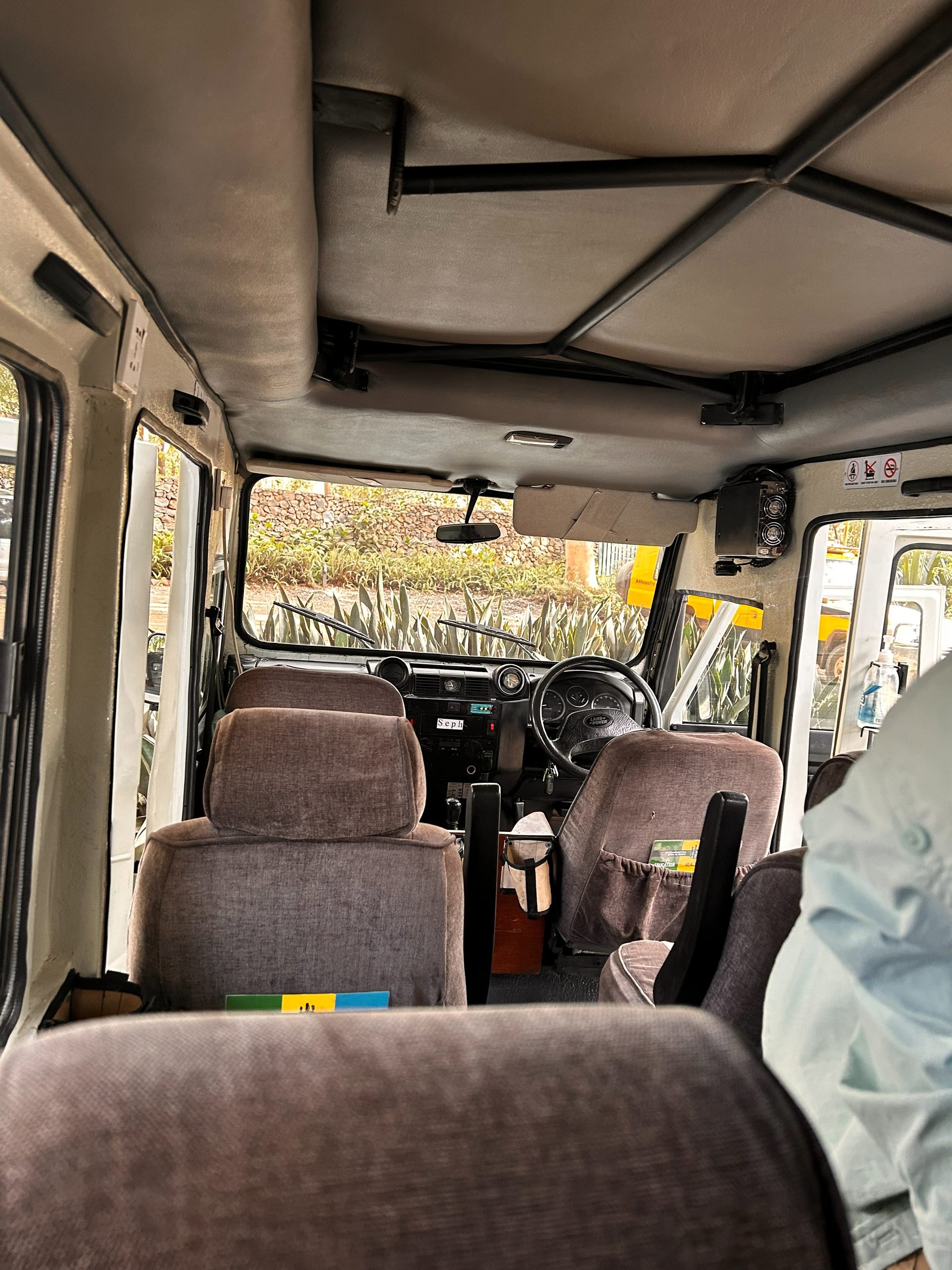
Our Land Rover — the view from the back seat, heading into the park for the first time
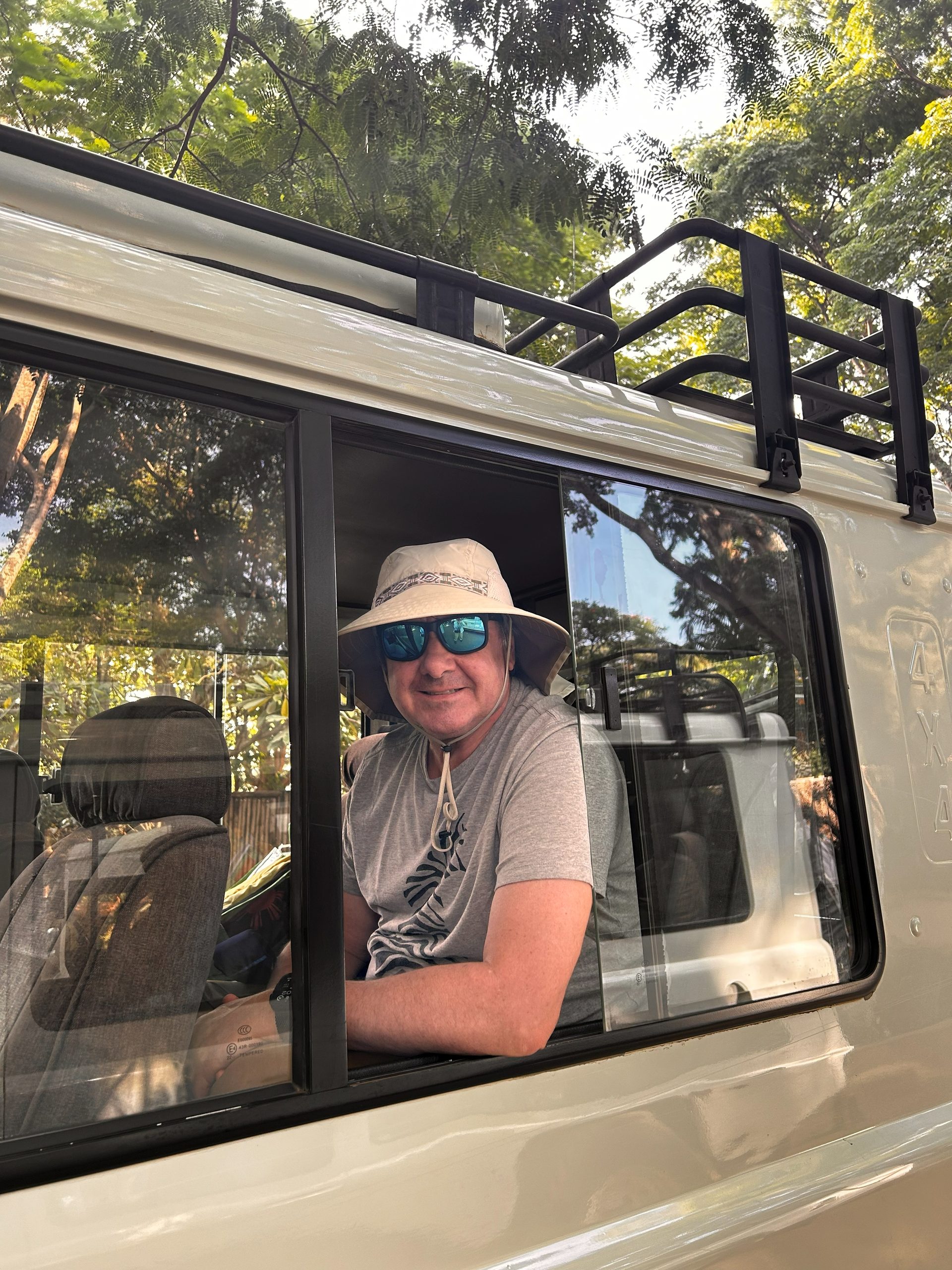
Ready for the first game drive — safari hat on, sunglasses up, camera ready

Warthog and giraffe sharing a golden meadow — the first wildlife of the trip
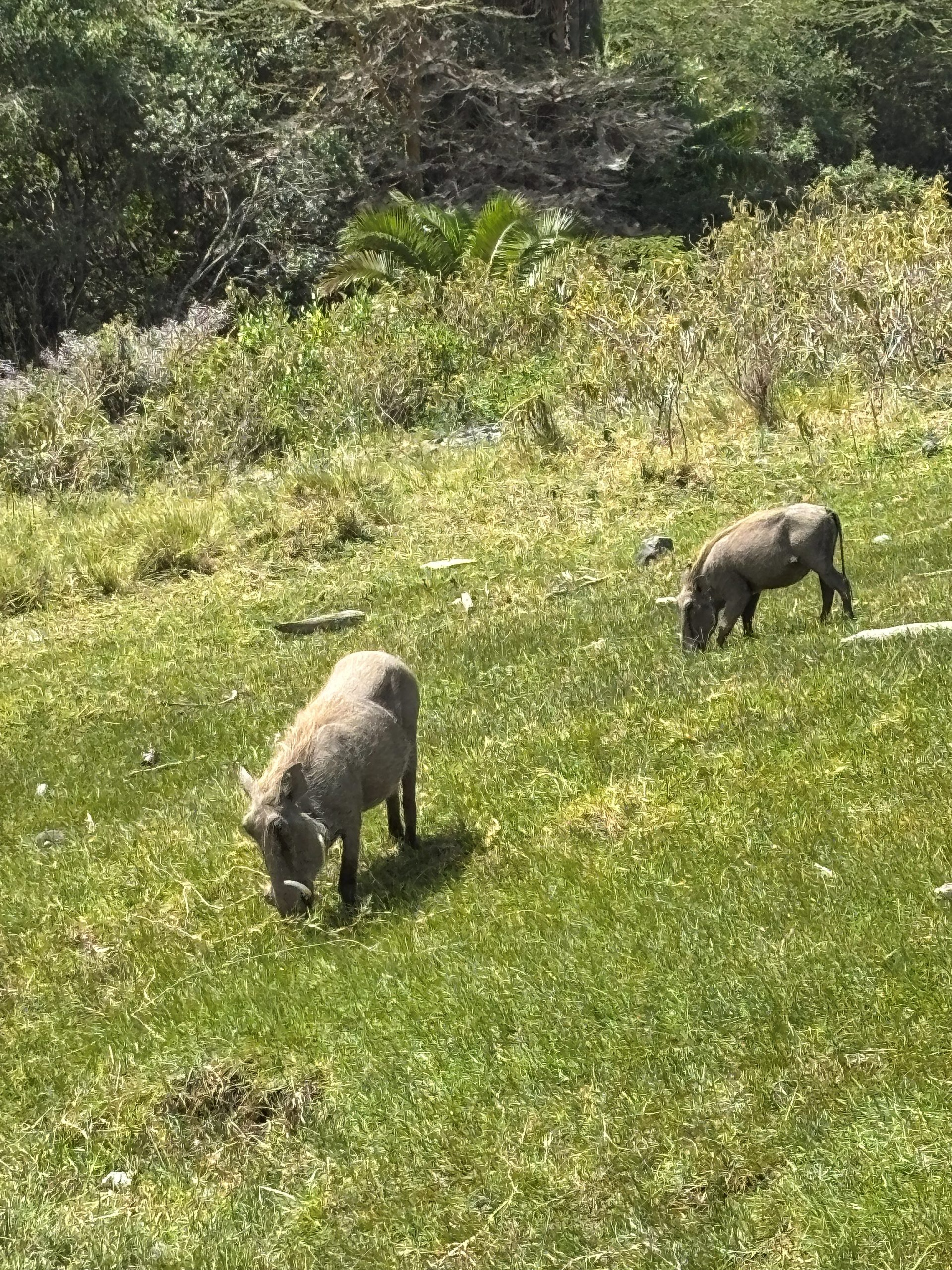
Warthogs on their knees — they drop to their front knees to graze, a peculiar and endearing habit
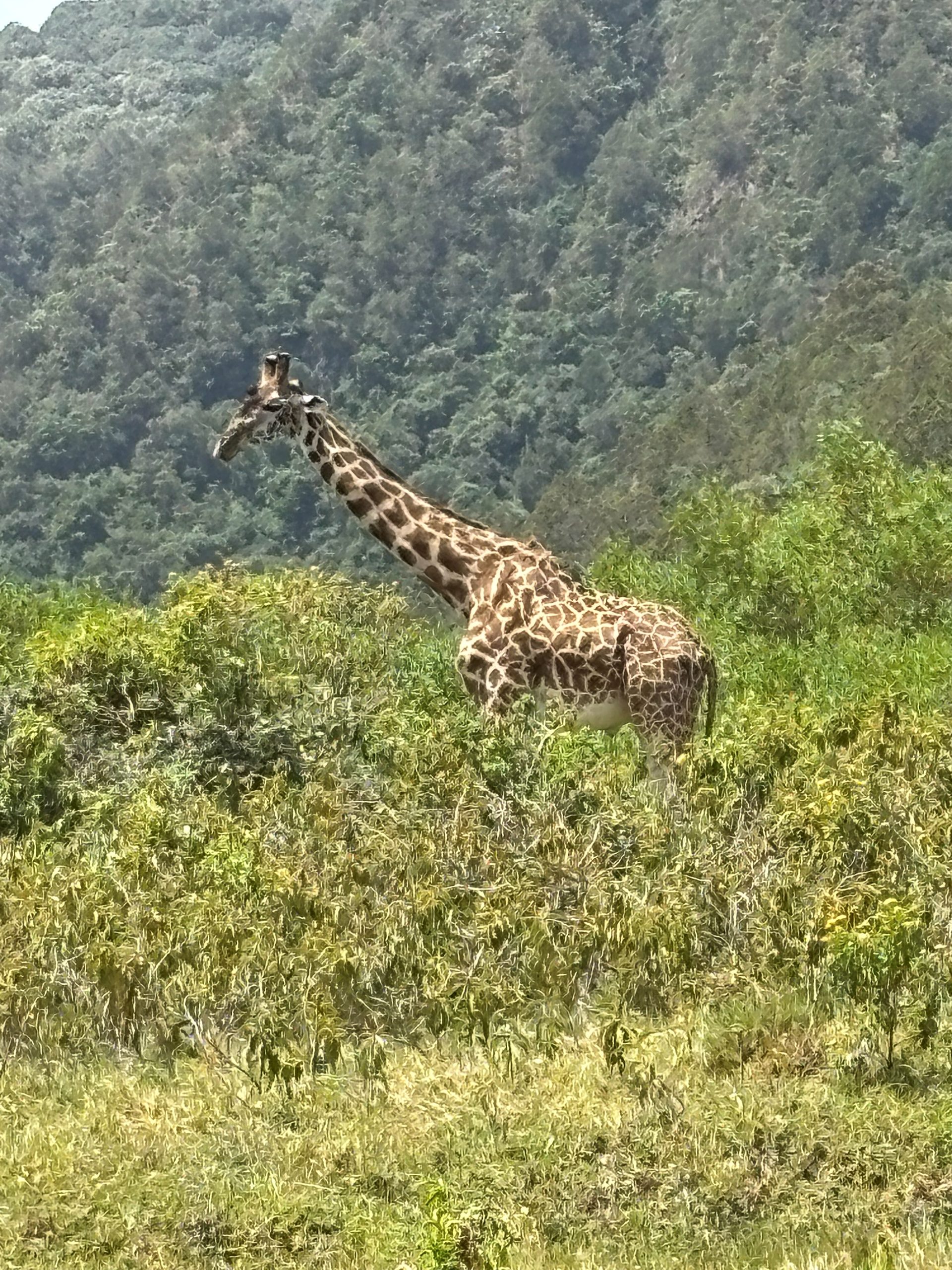
A Masai giraffe browsing at the treeline — Mount Meru's forested slopes rising behind
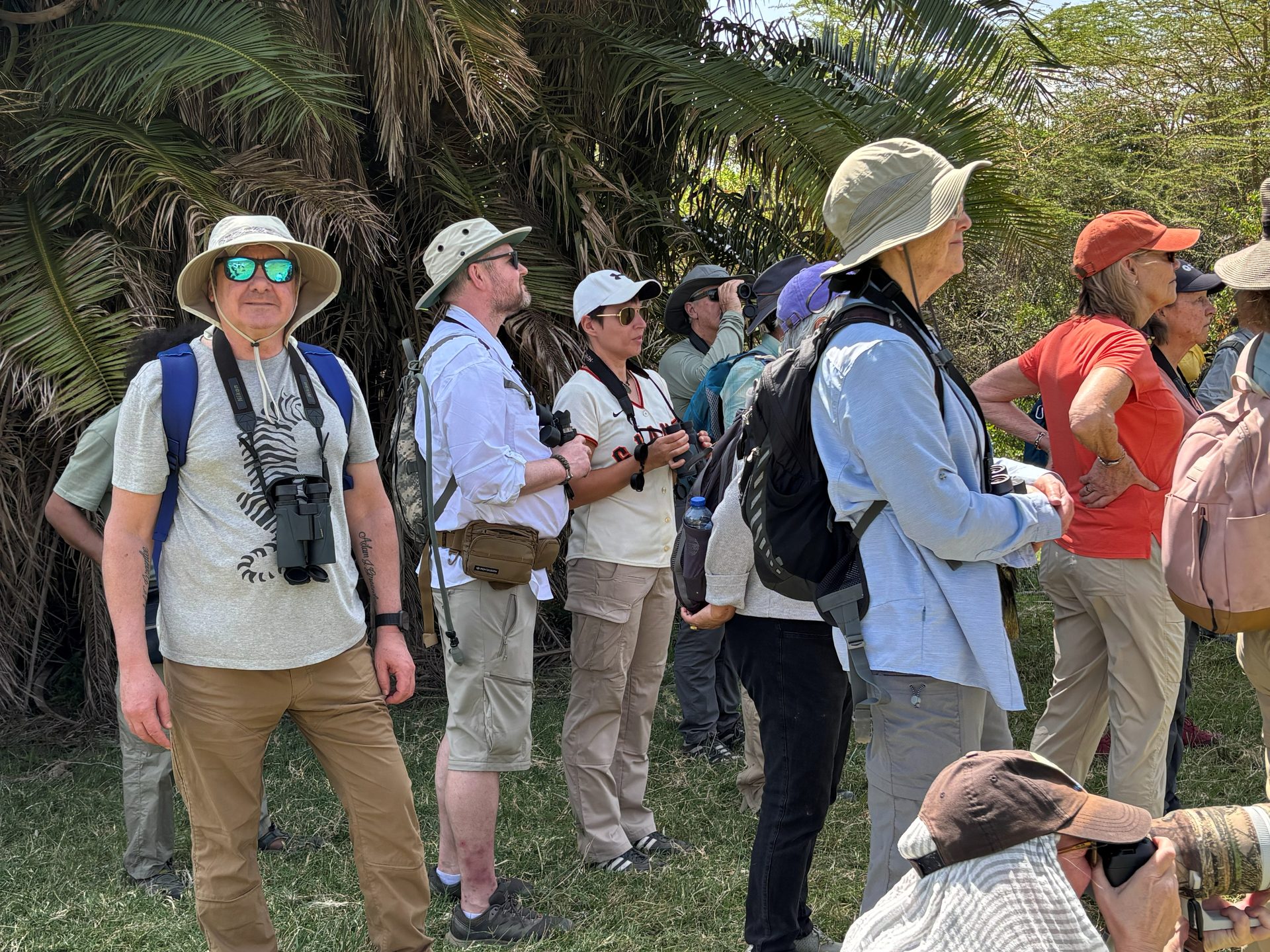
The group on alert — binoculars raised, something worth stopping for just off the trail
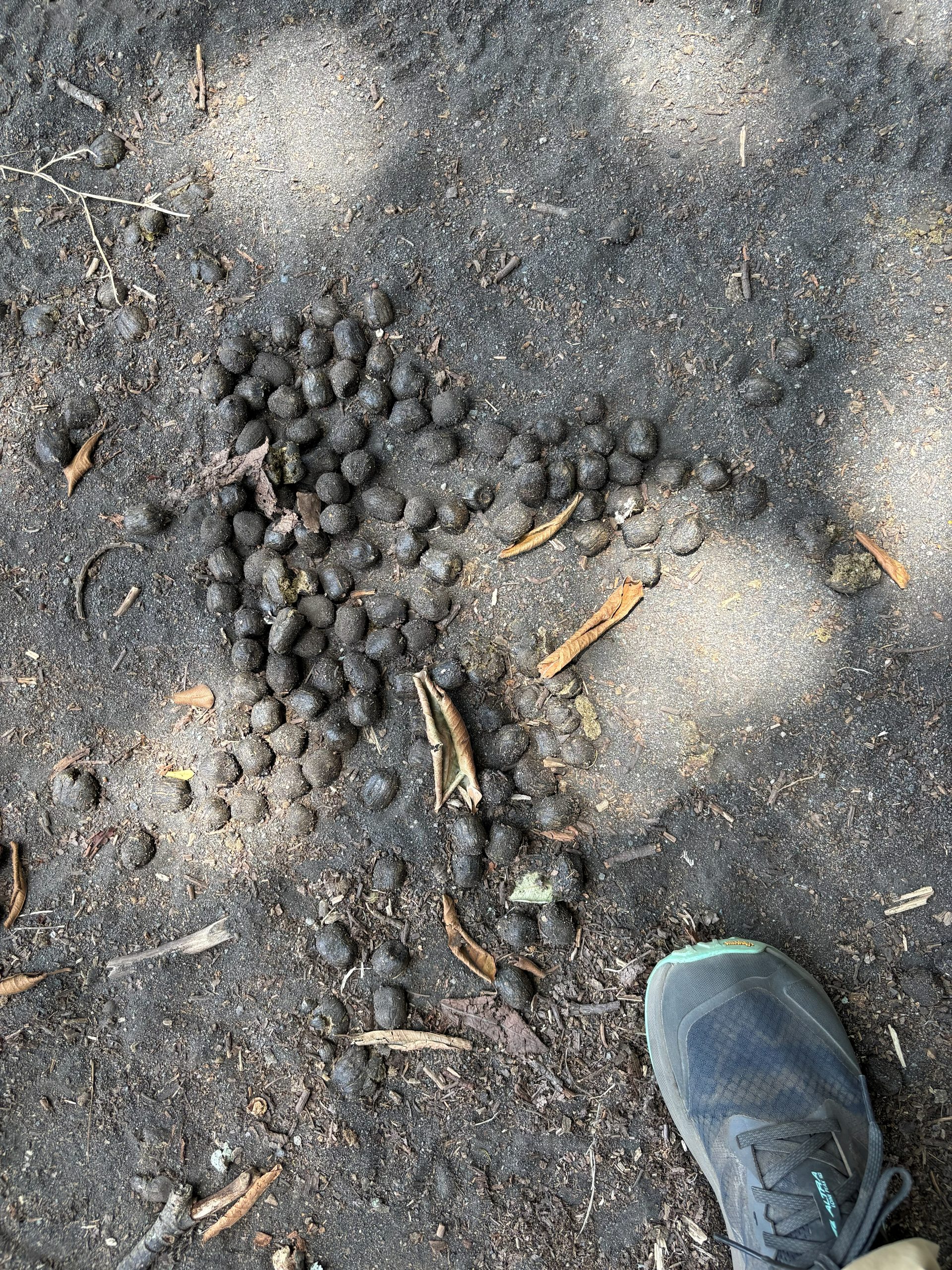
Proof of giraffe — the guides could identify every animal from its tracks and droppings. This one needed no introduction.
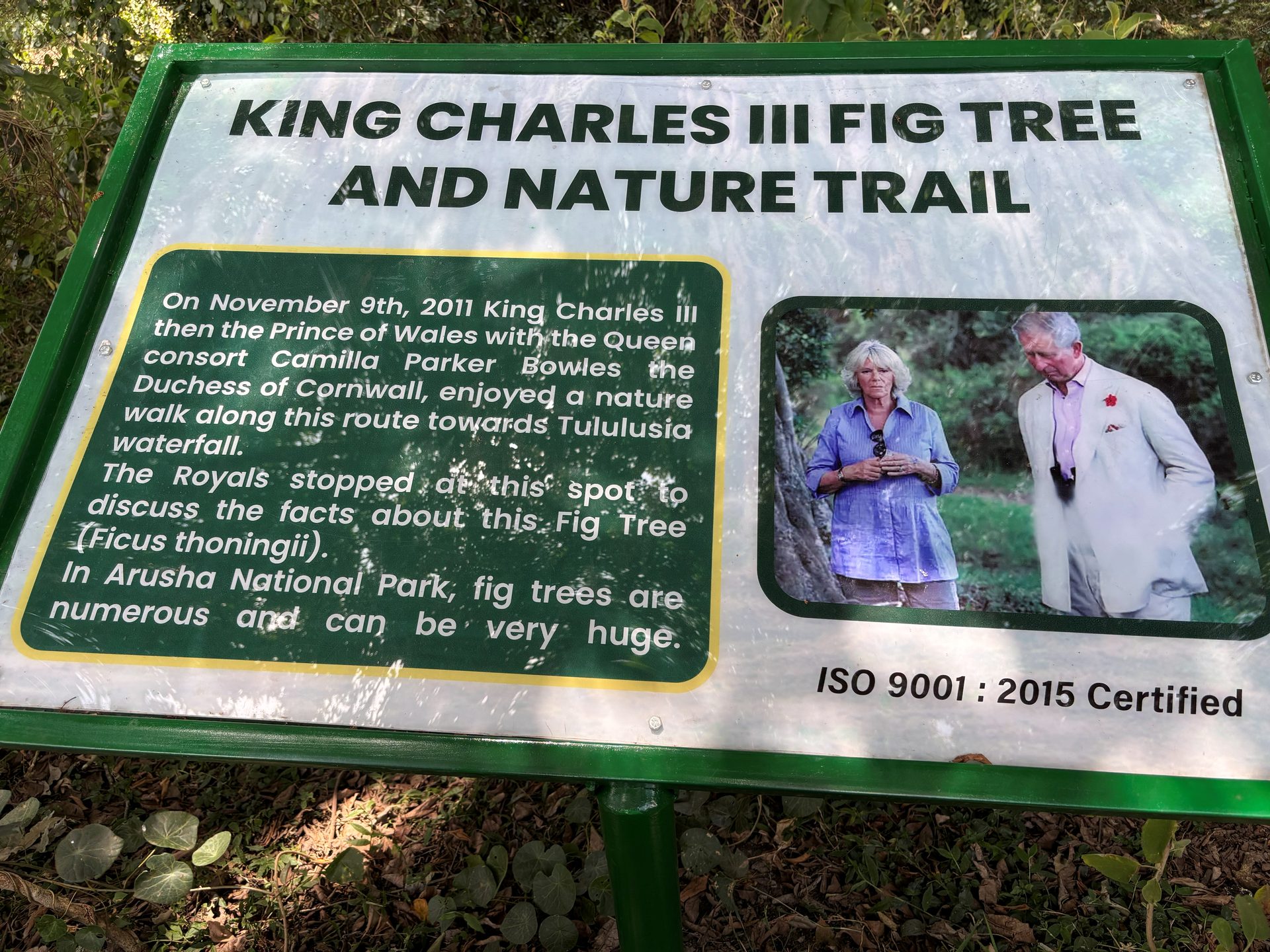
The King Charles III Fig Tree Nature Trail — where then-Prince Charles and Camilla walked in 2011 on the very same path to Tululusia Waterfall
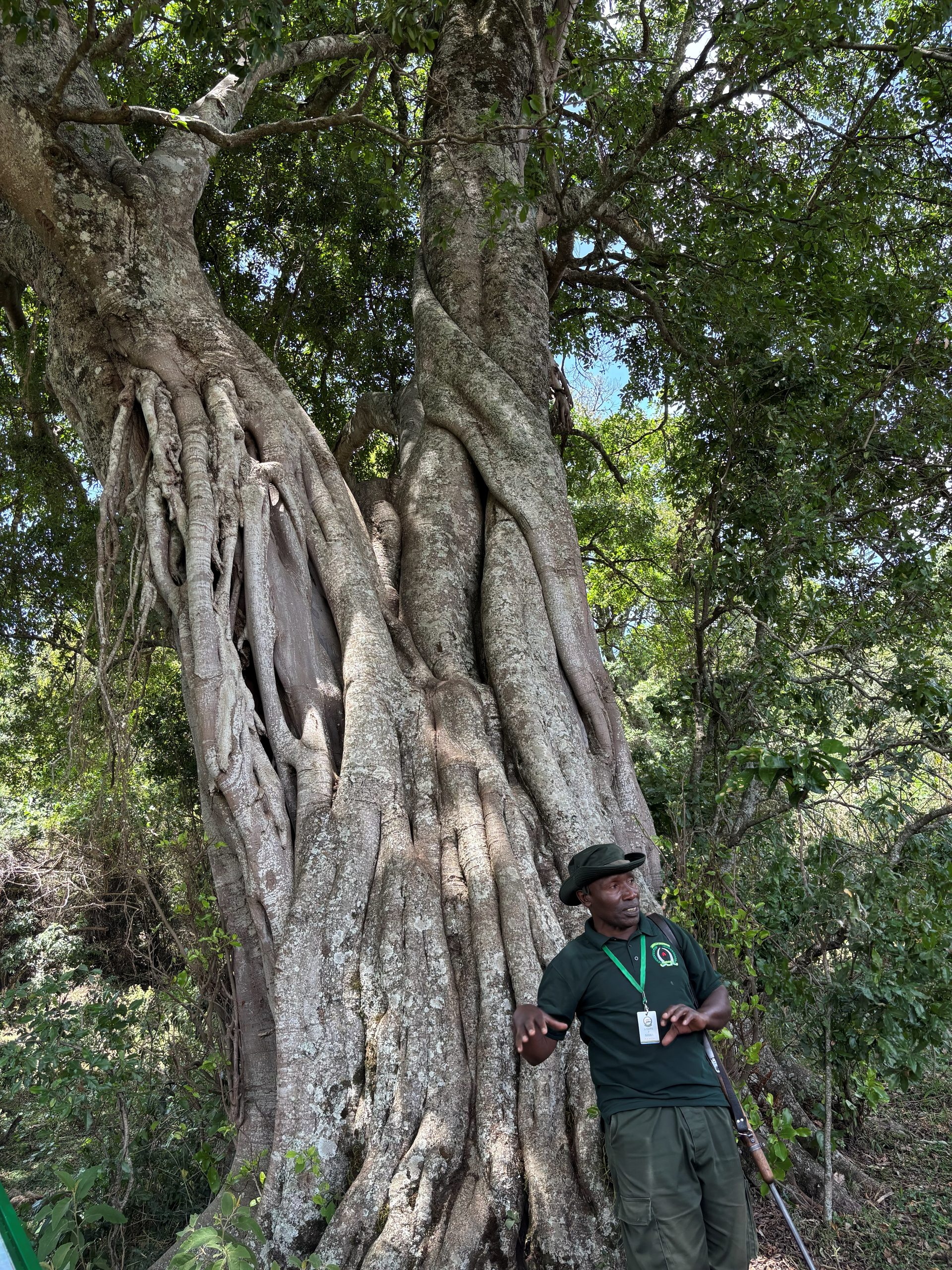
Our guide at the base of the royal fig tree — the roots alone dwarfed him, the canopy lost somewhere above
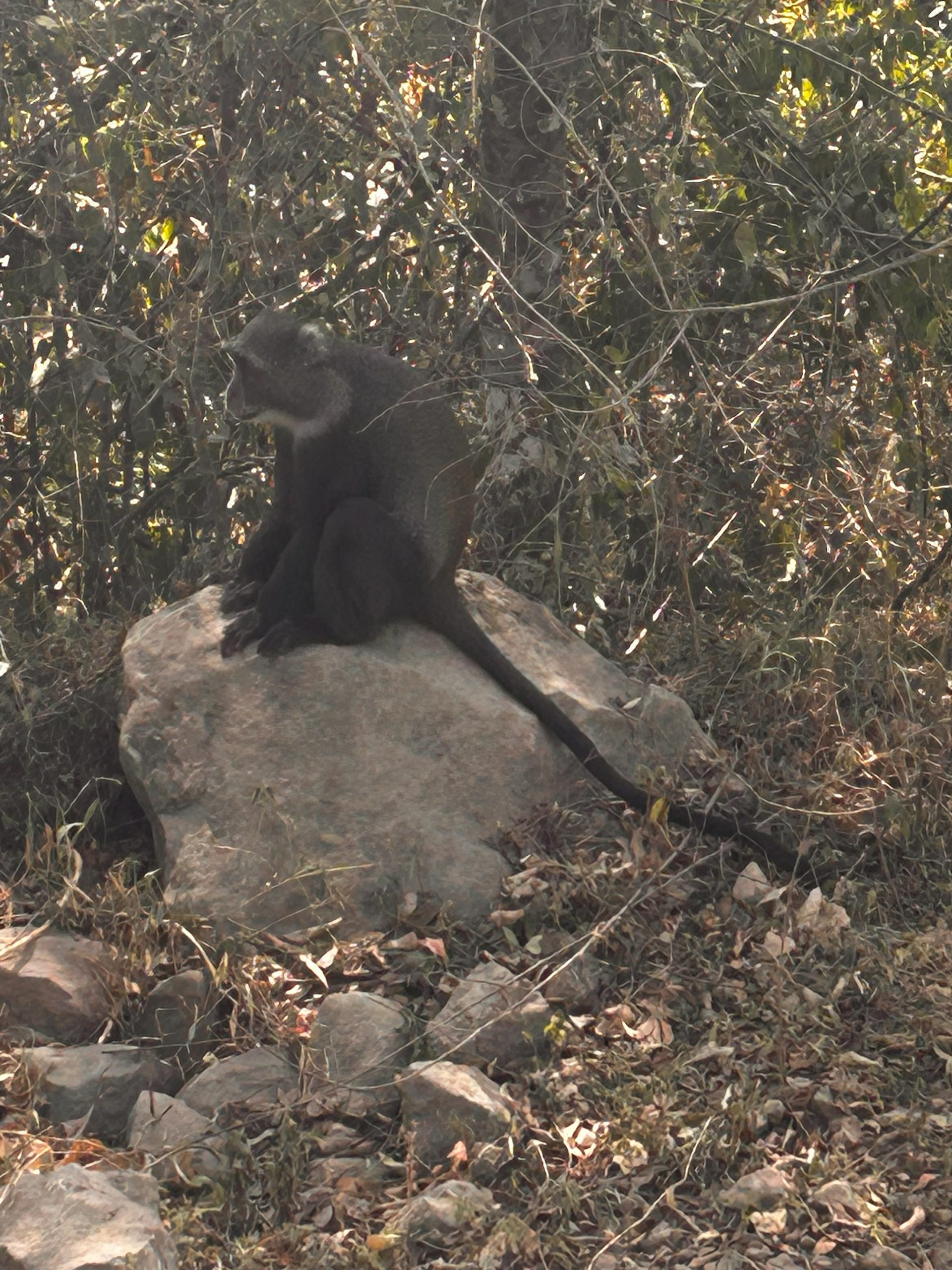
A black-faced monkey on a rock — watching us as carefully as we watched it
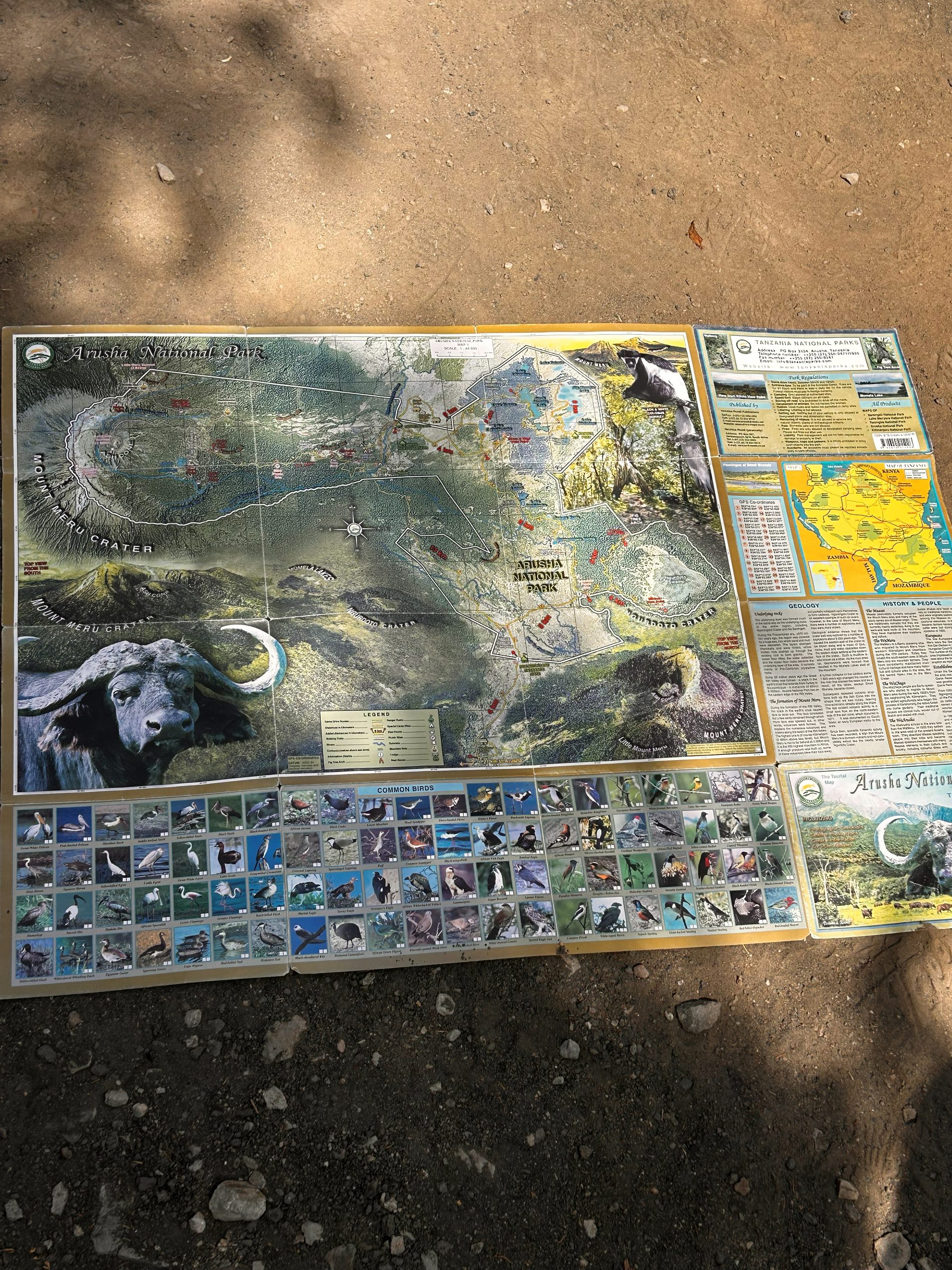
The Arusha National Park map — spread out at the trailhead, Mount Meru Crater to the west, our route penciled through the middle
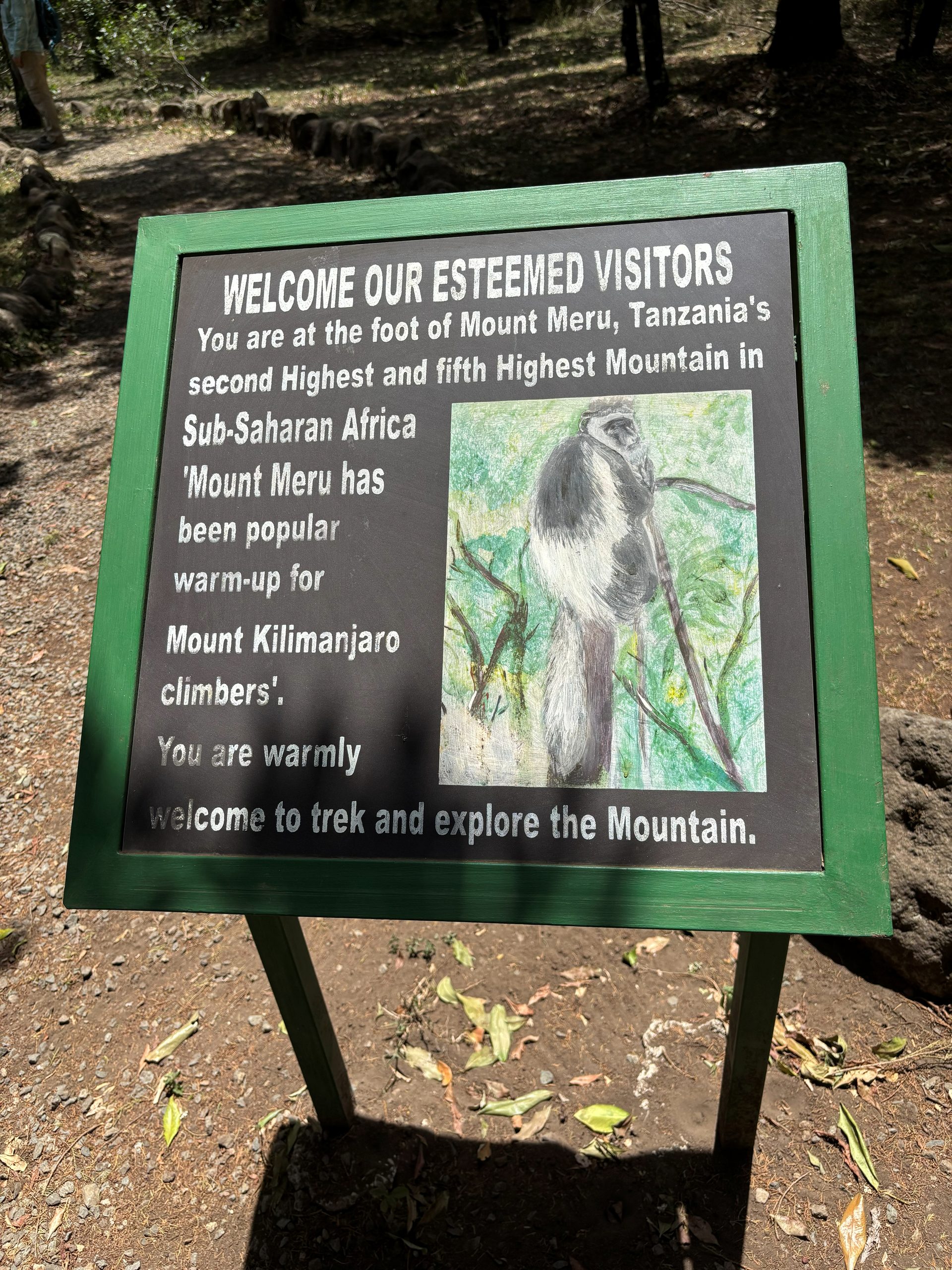
At the base of Mount Meru — Tanzania's second highest peak. We were just walking to the waterfall.
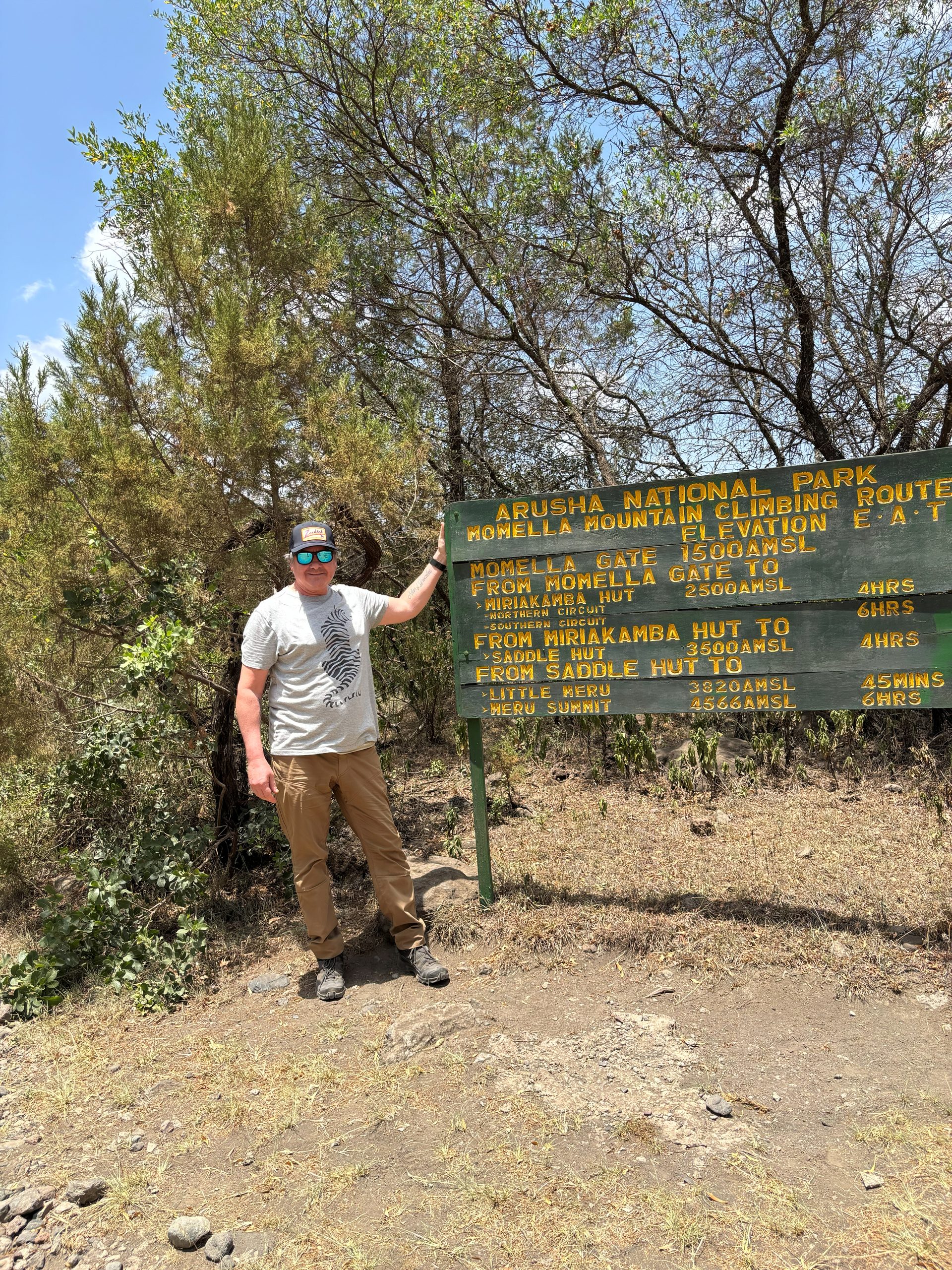
Momella Gate — Meru Summit 4,566m, 6 hours. We had a different schedule.
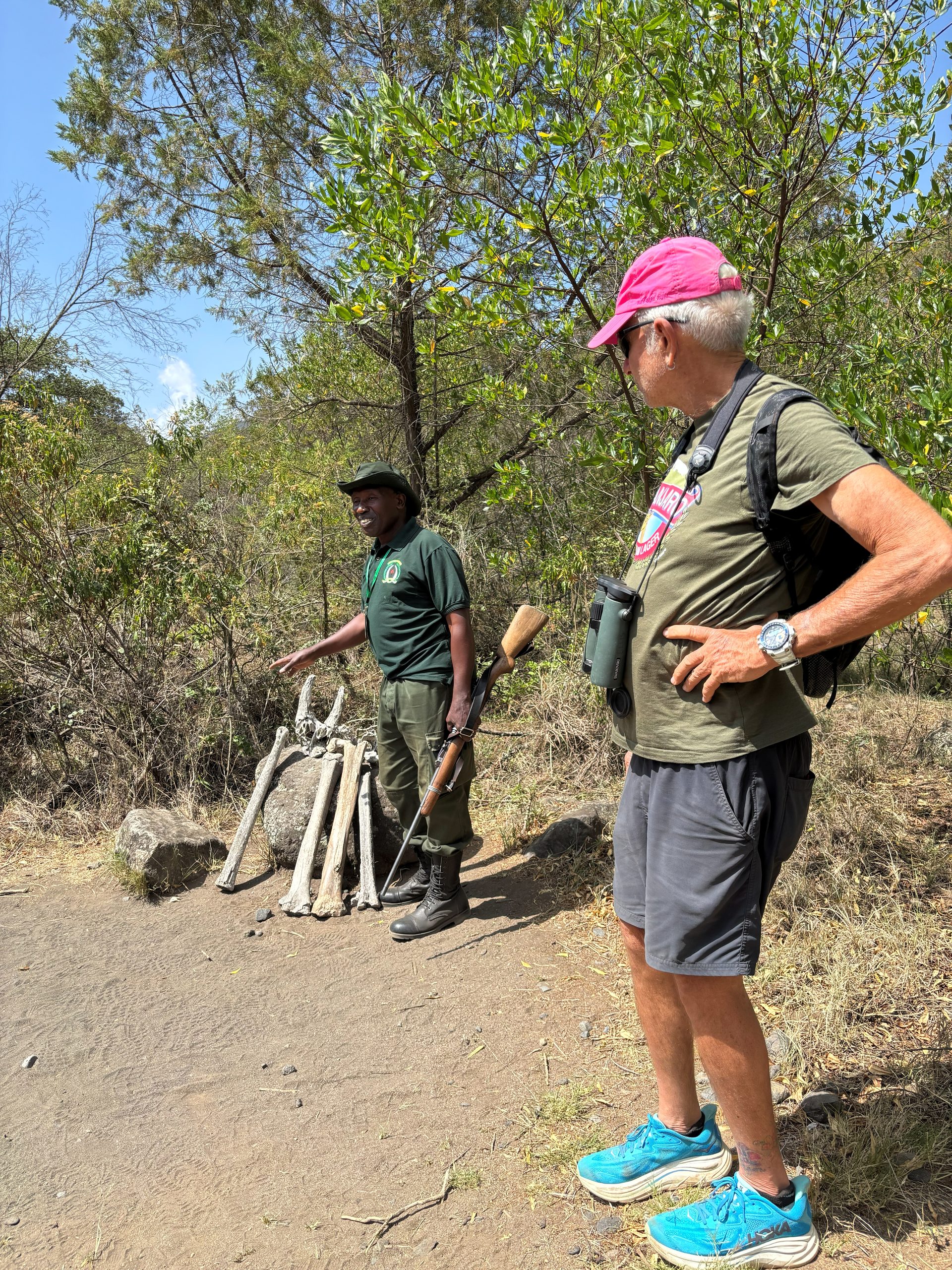
Our armed park ranger — a quiet reminder that we were walking through real, wild Africa
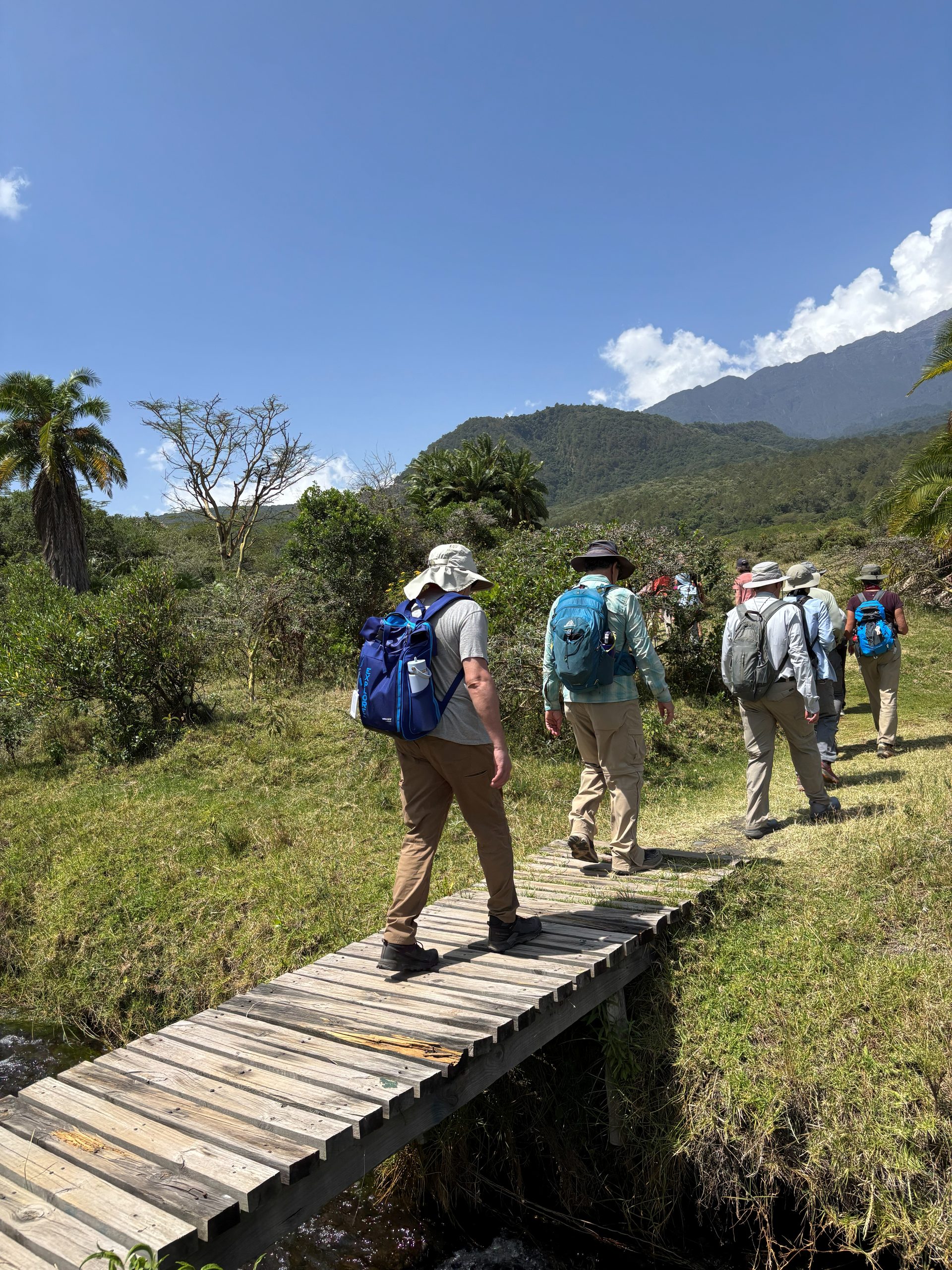
The group crossing a wooden bridge — Mount Meru rising behind, the forest alive all around us
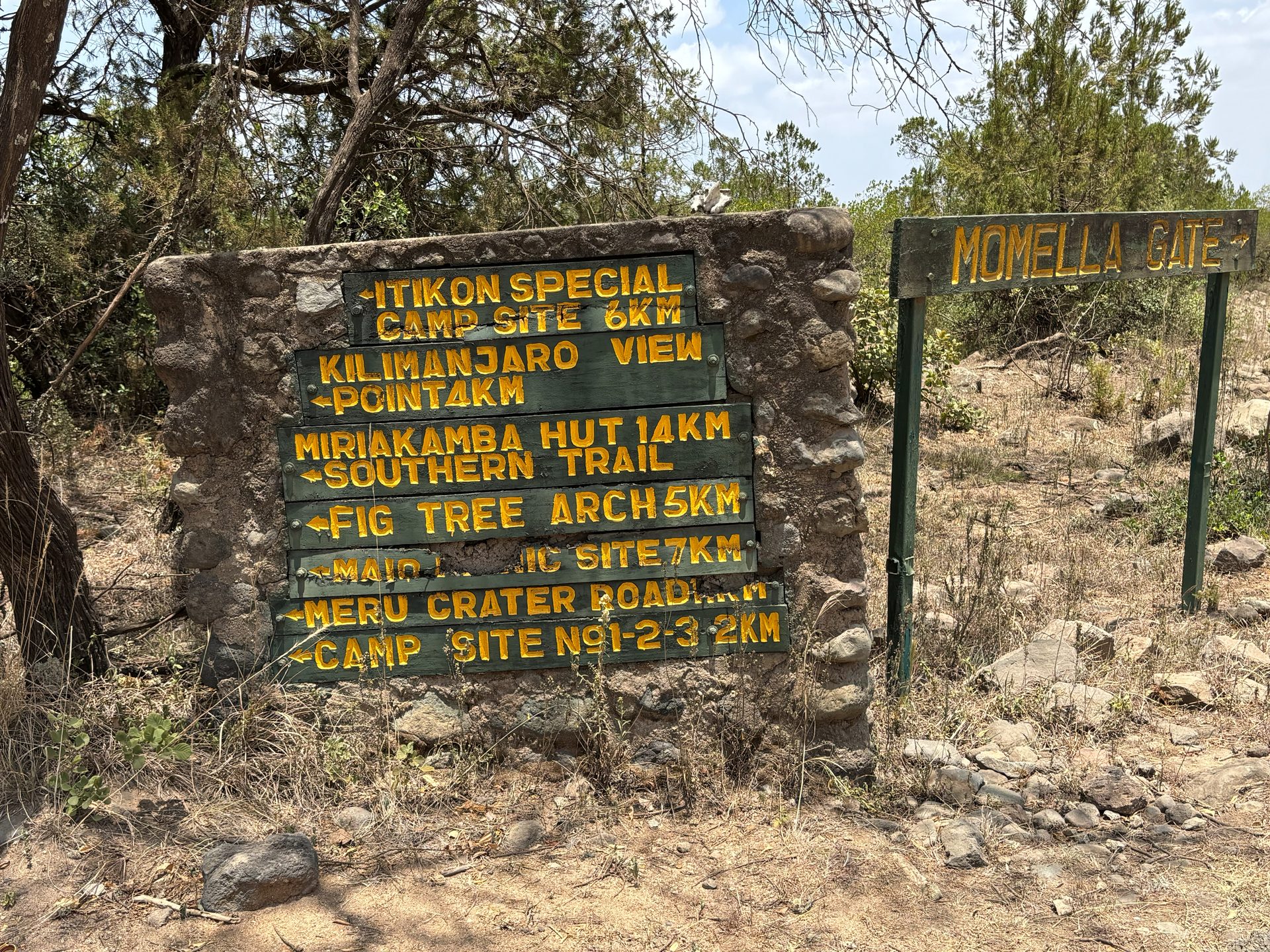
Momella Gate distances — Kilimanjaro View Point 4km, Fig Tree Arch 5km, Meru Crater Road just ahead
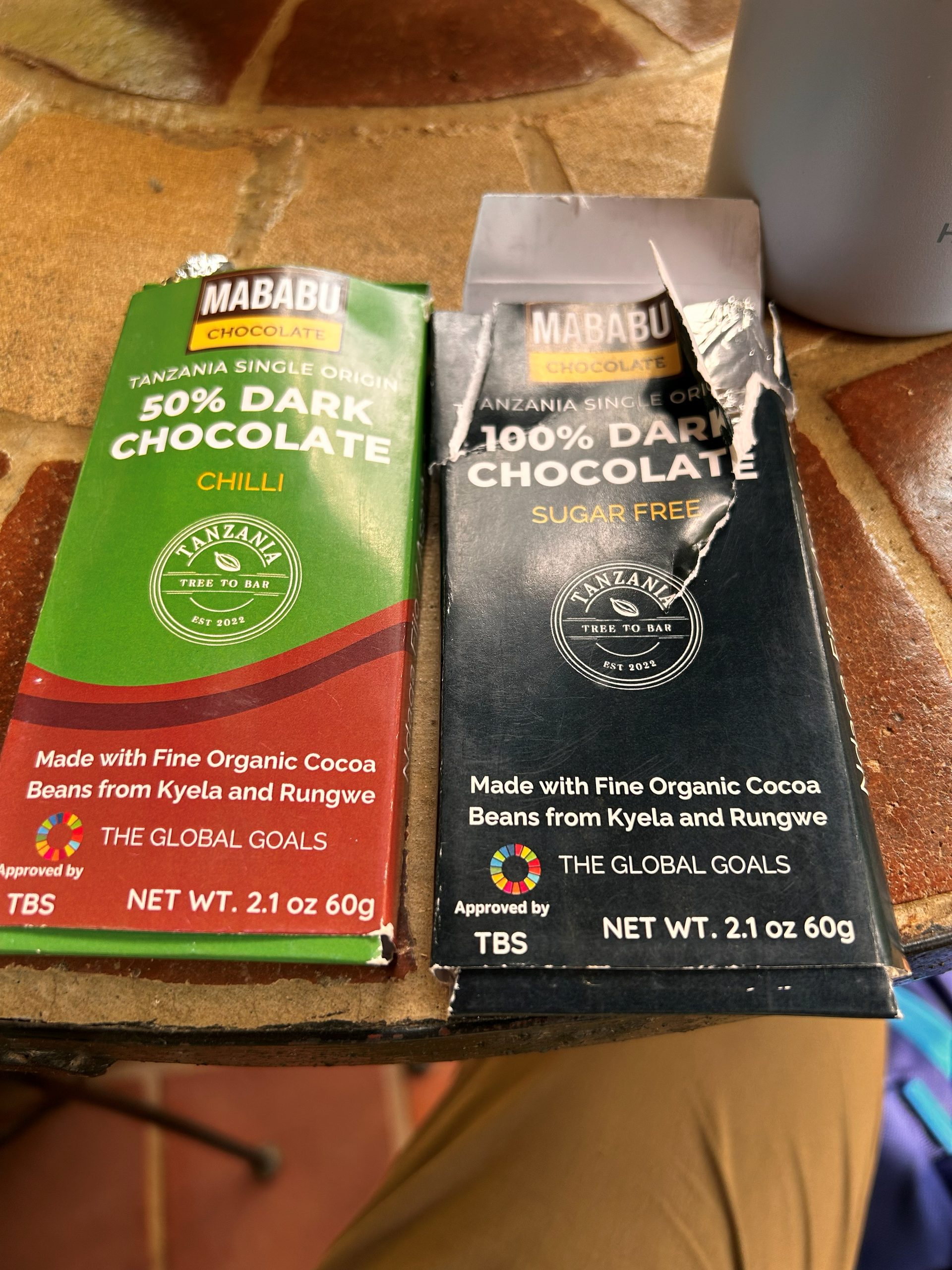
Mababu chocolate — Tanzania tree-to-bar, single-origin from Kyela and Rungwe. The 50% chilli was interesting. The 100% sugar-free was… an experience best gifted to others.
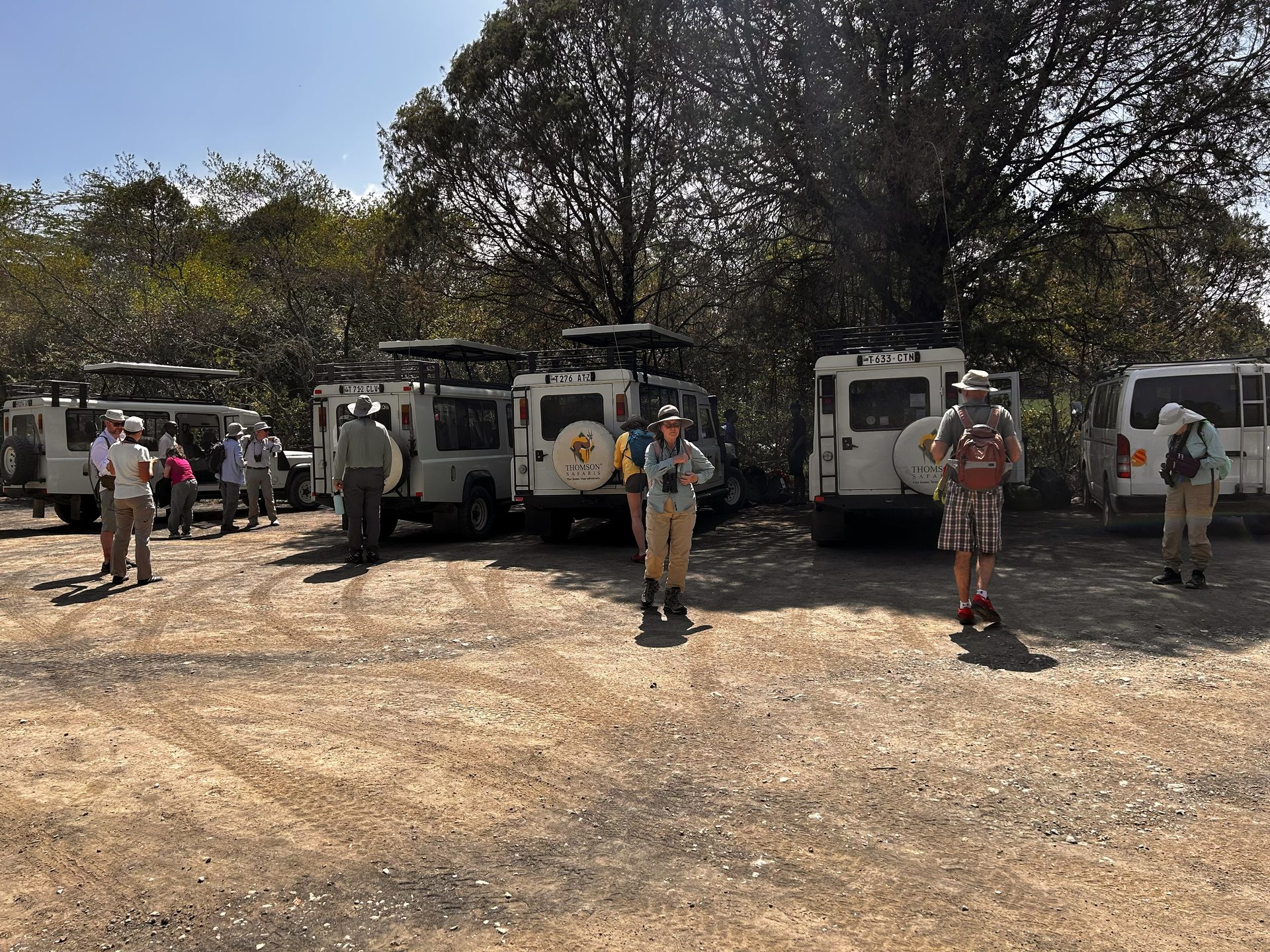
The Thomson Safaris fleet — our Land Rovers at the trailhead, ready for the drive back to Rivertrees

6:25am, Saturday the 14th — Tanzania, 63°F, high of 87° ahead. The watch confirming what the air already knew.
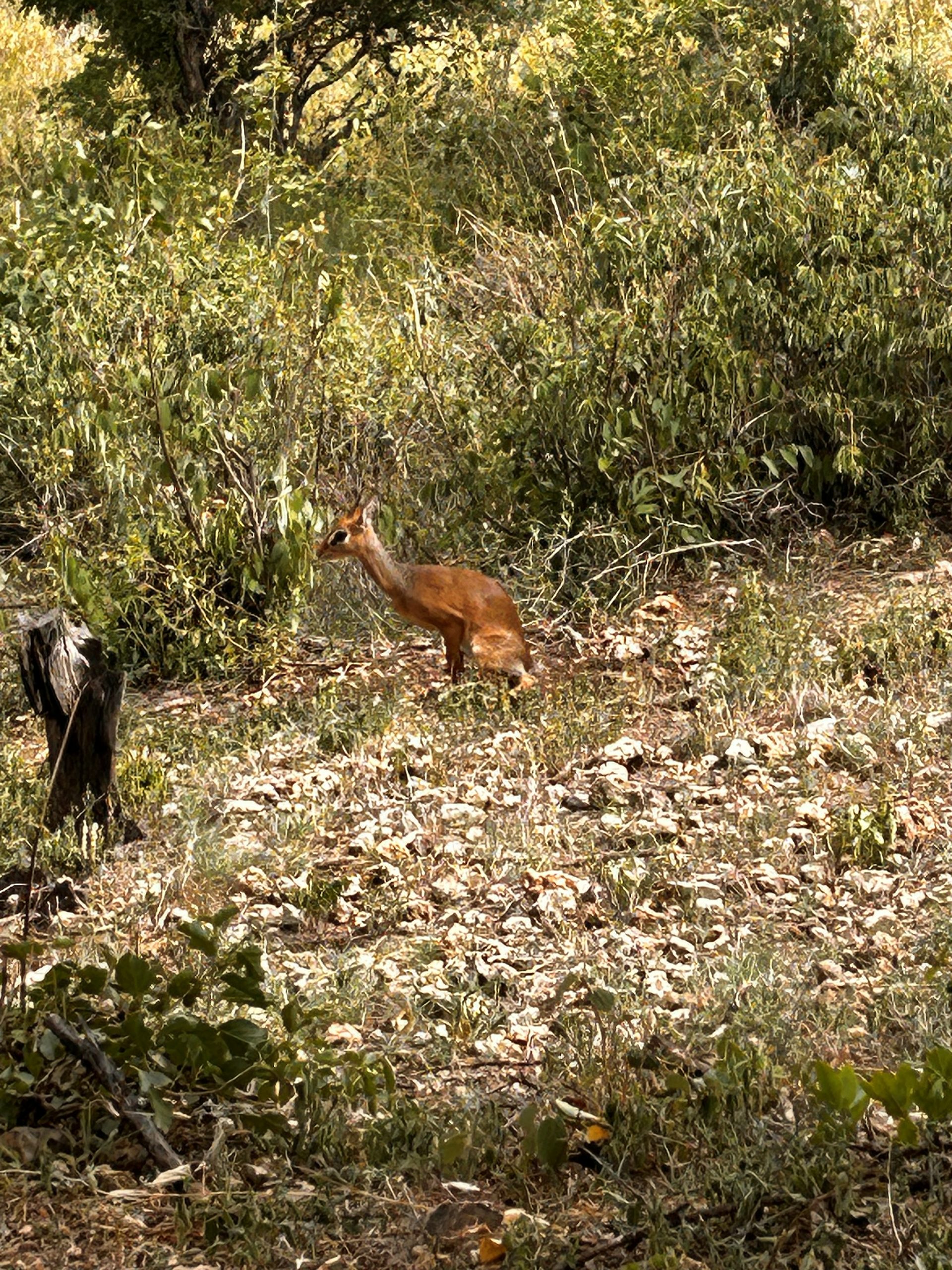
A dik-dik — Africa's smallest antelope, barely knee-high, picking its way through the undergrowth with enormous alert eyes
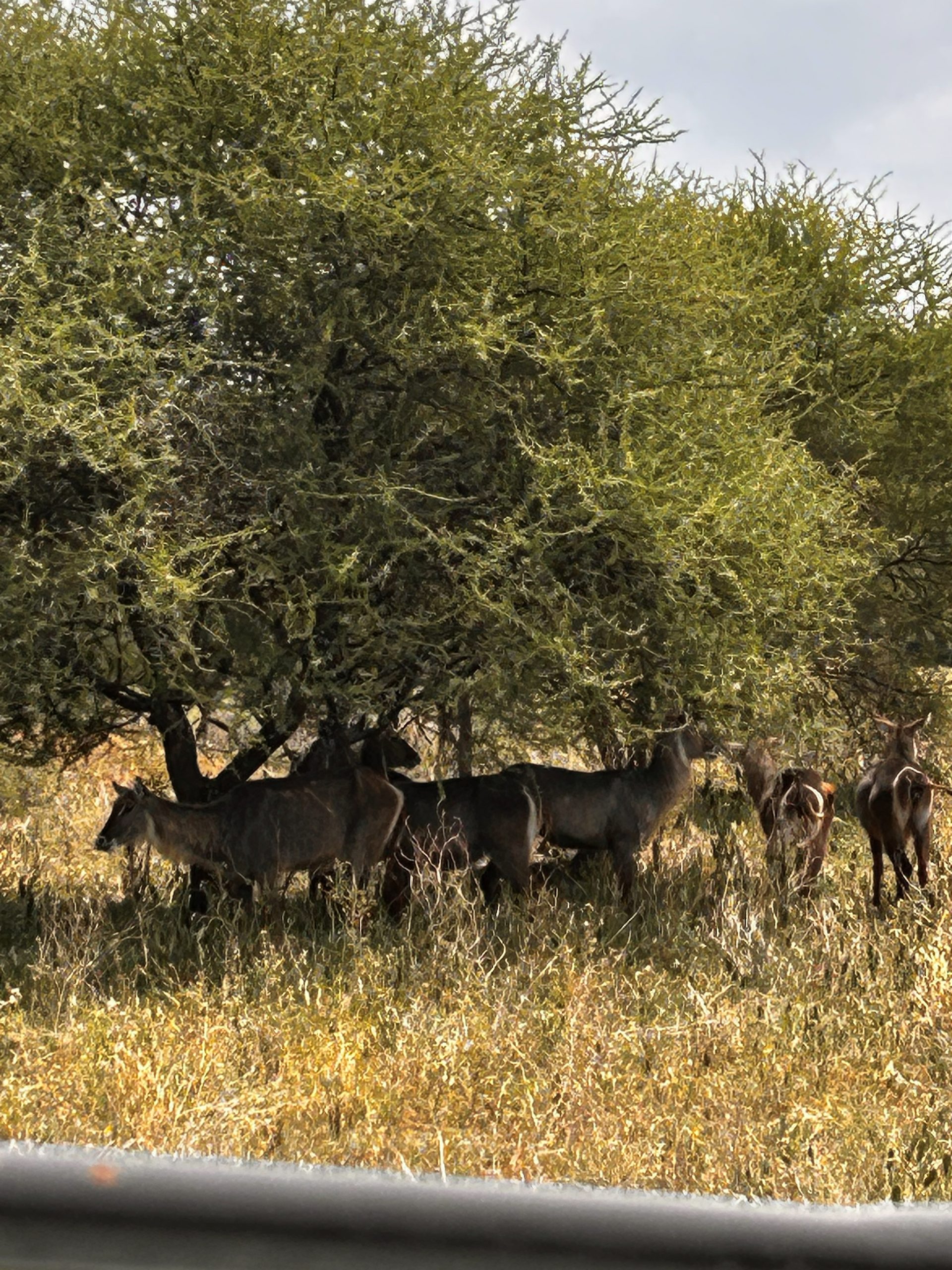
A herd of waterbuck moving through the dry bush — dark, heavy-bodied antelope, barely visible in the shadow of the acacias
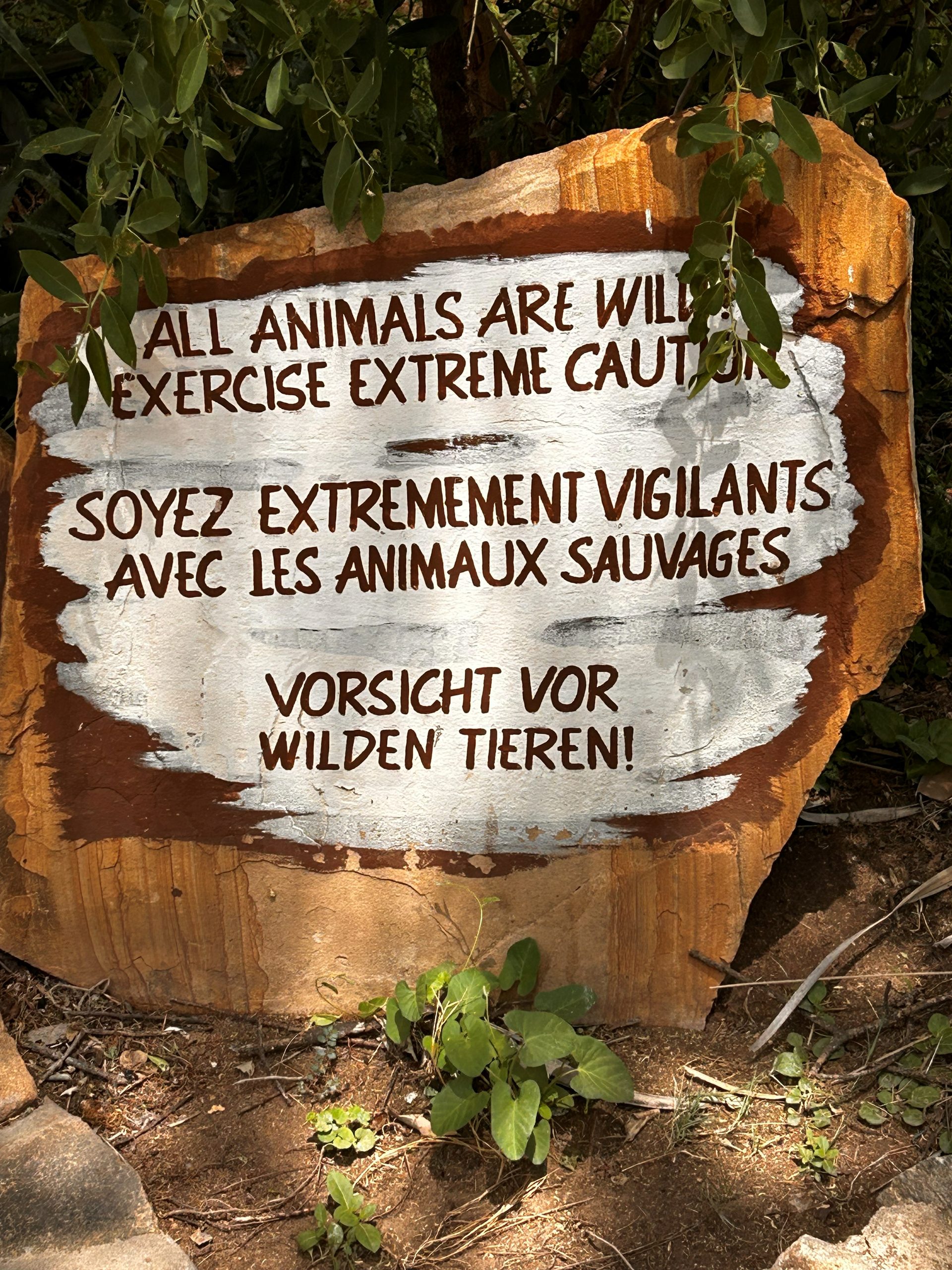
"All Animals Are Wild — Exercise Extreme Caution." In English, French, and German. They wanted to be sure everyone understood.

43,400 TZS for two chocolate bars at the Village Supermarket Mall in Arusha. Roughly $16 USD. The Mababu wasn't even good.
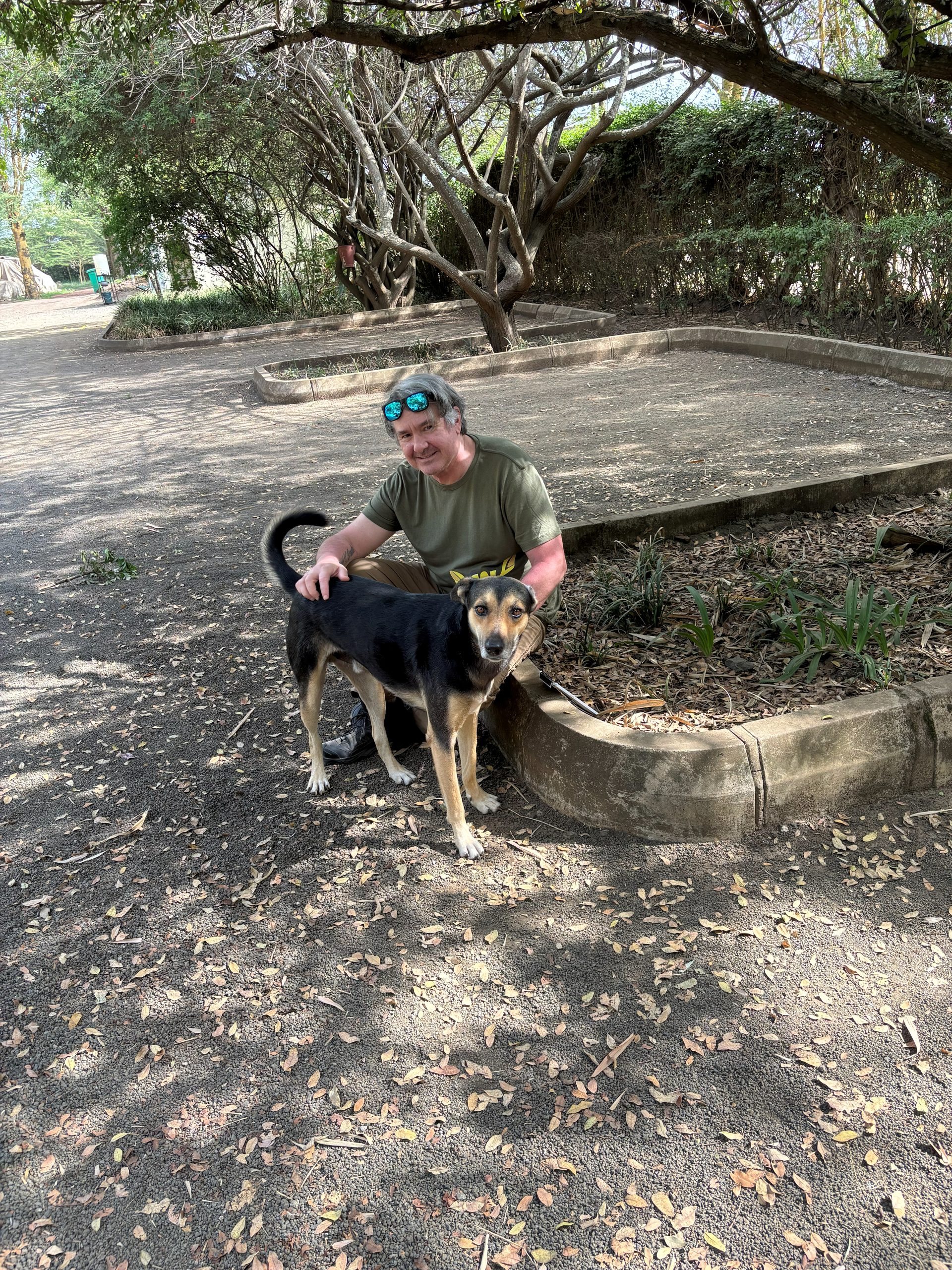
The real security at Thomson Safaris HQ — made a new friend during our stop in Arusha before heading south
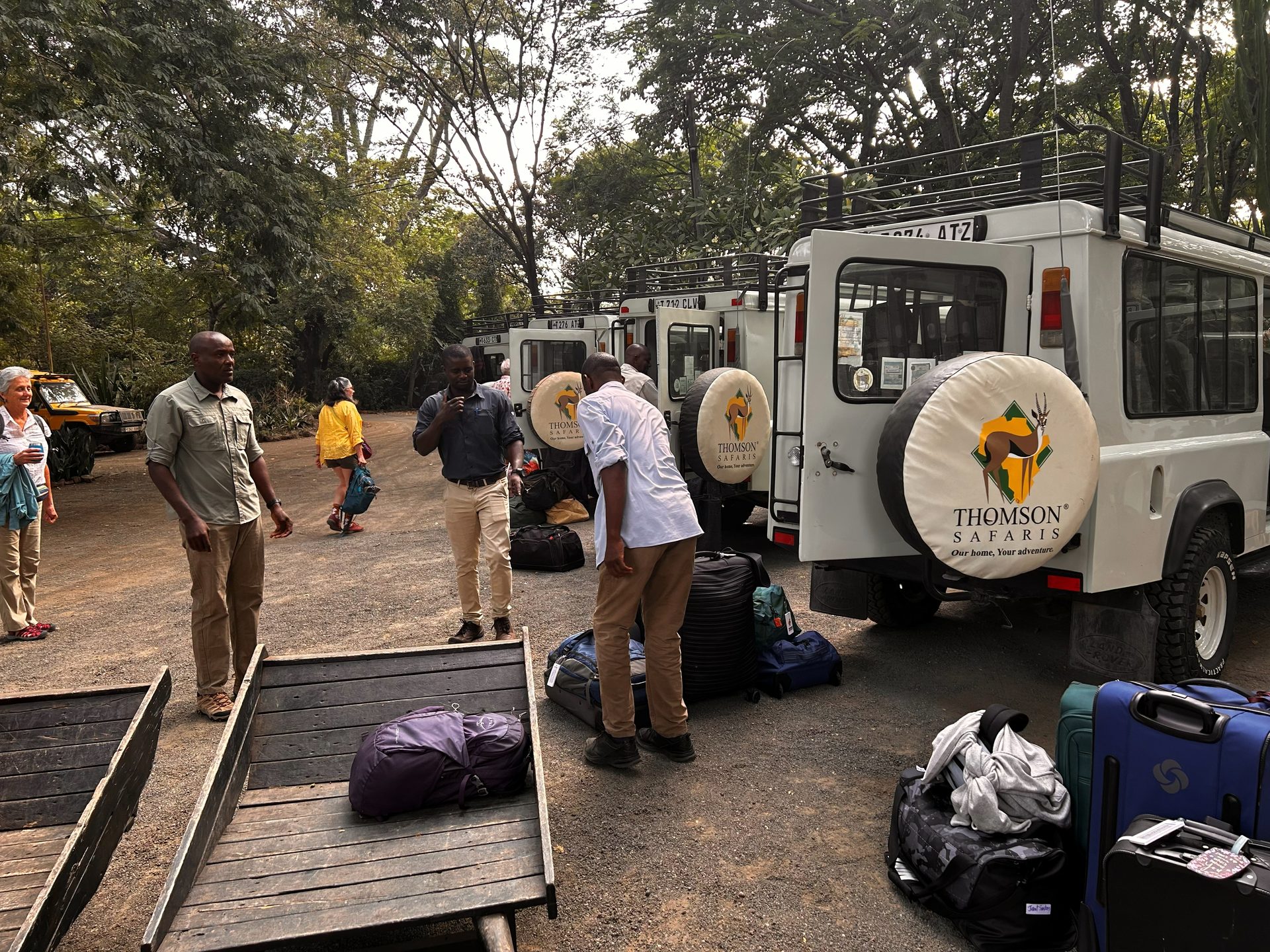
Packing up — bags loaded, guides ready, convoy pointed south toward Tarangire
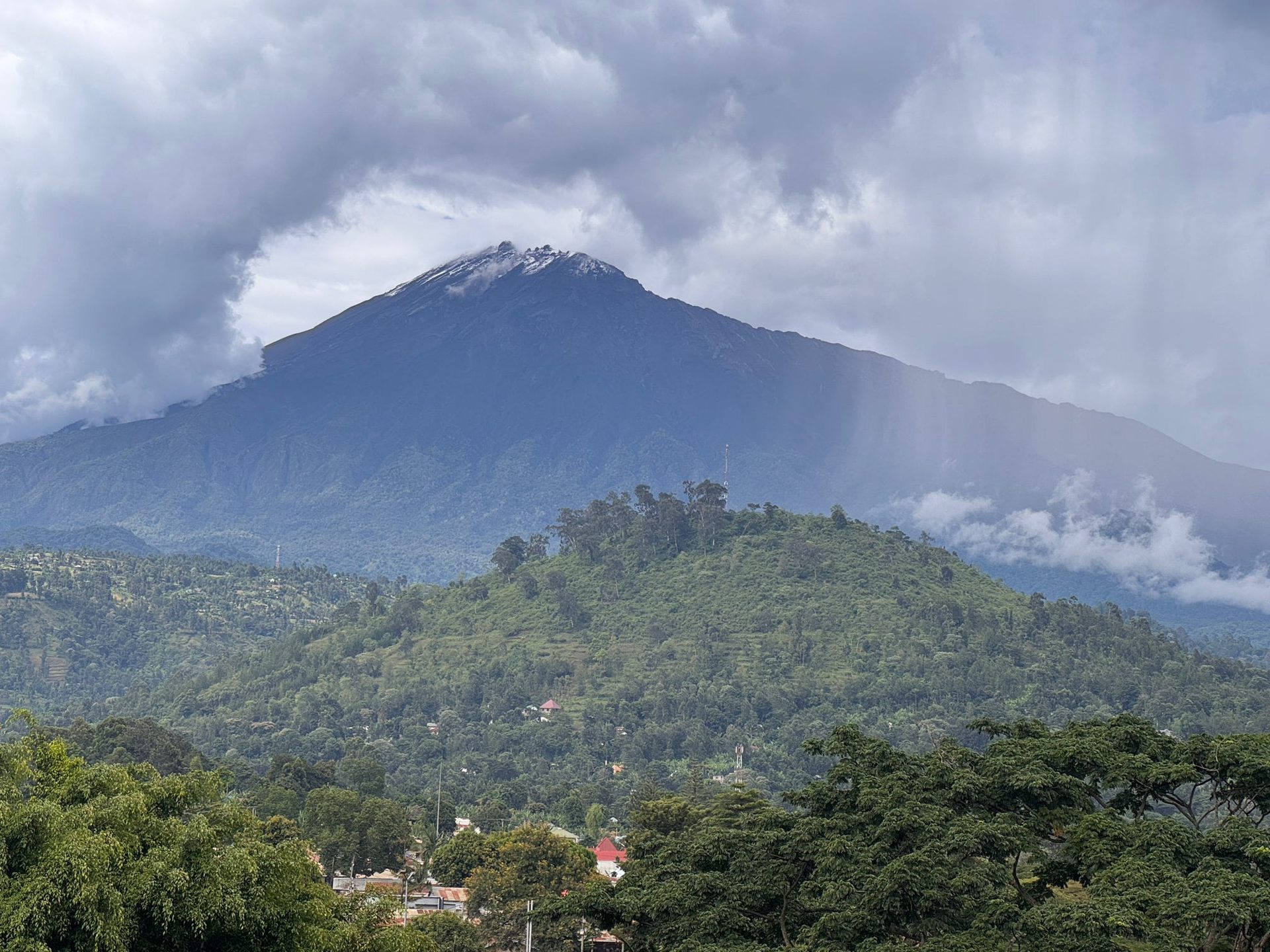
Mount Meru with a rare snowcap — the 4,566-metre volcano that watches over Arusha, seen from town on one of the few days a year when snow reaches the summit. We stopped and stared.
A giraffe encounter on the Arusha walking safari — close enough to hear it moving through the brush
Our armed park ranger leading the way — a quiet reminder this is wild Africa
The longest drive. The first gate. The beginning of everything.
The road to Tarangire is long. Half a day in a safari vehicle — bouncing, dusty, noisy, hot — cutting through the Tanzanian interior while the landscape slowly transforms around you. I was glad I'd packed noise-cancelling headphones. As I would come to learn over the days ahead, travelling in a safari truck over any significant distance is an exercise in endurance. Beautiful, worthwhile endurance — but endurance nonetheless.
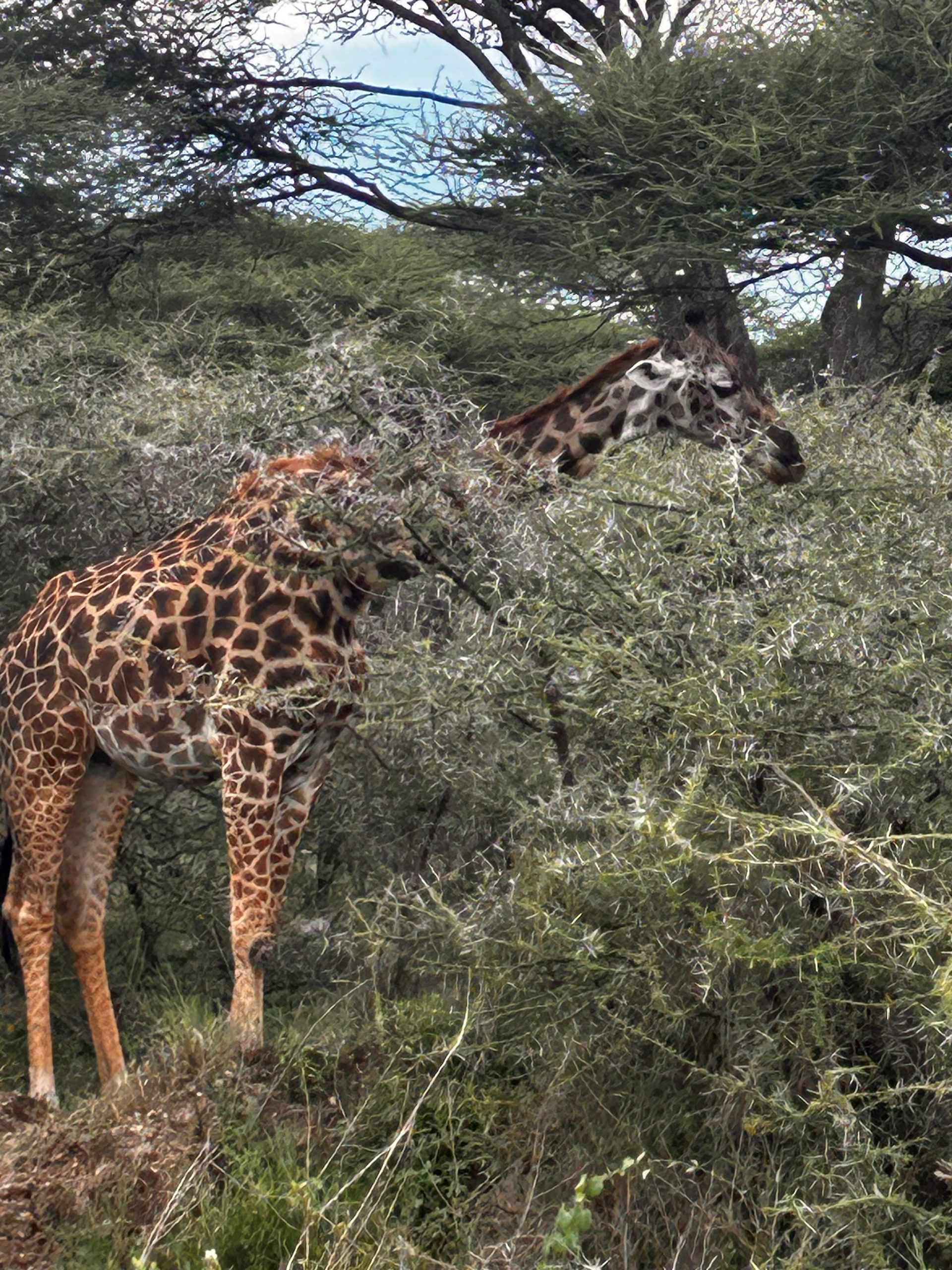
A Masai giraffe feeding close — its 18-inch tongue navigating the thorns of an acacia with casual precision
As the drive continued south, the landscape began to change. The towns thinned out. The road narrowed. Baobab trees appeared on the horizon — at first one or two, then more, enormous and ancient, their impossibly thick trunks rising from the red earth like something from a prehistoric world. Trees pushed over at the roots came into view along the roadside — not storm damage, our guides explained, but elephants. Feeding. We hadn't entered the park yet and already the wildlife was announcing itself.
Towering red termite mounds punctuated the savanna. The sky opened up. And then, through the windshield of our vehicle, we saw the Tarangire entrance gate — ENTRANCE / KUINGIA — in English and Swahili, and a queue of open-roof Land Cruisers waiting to pass through. We were here.
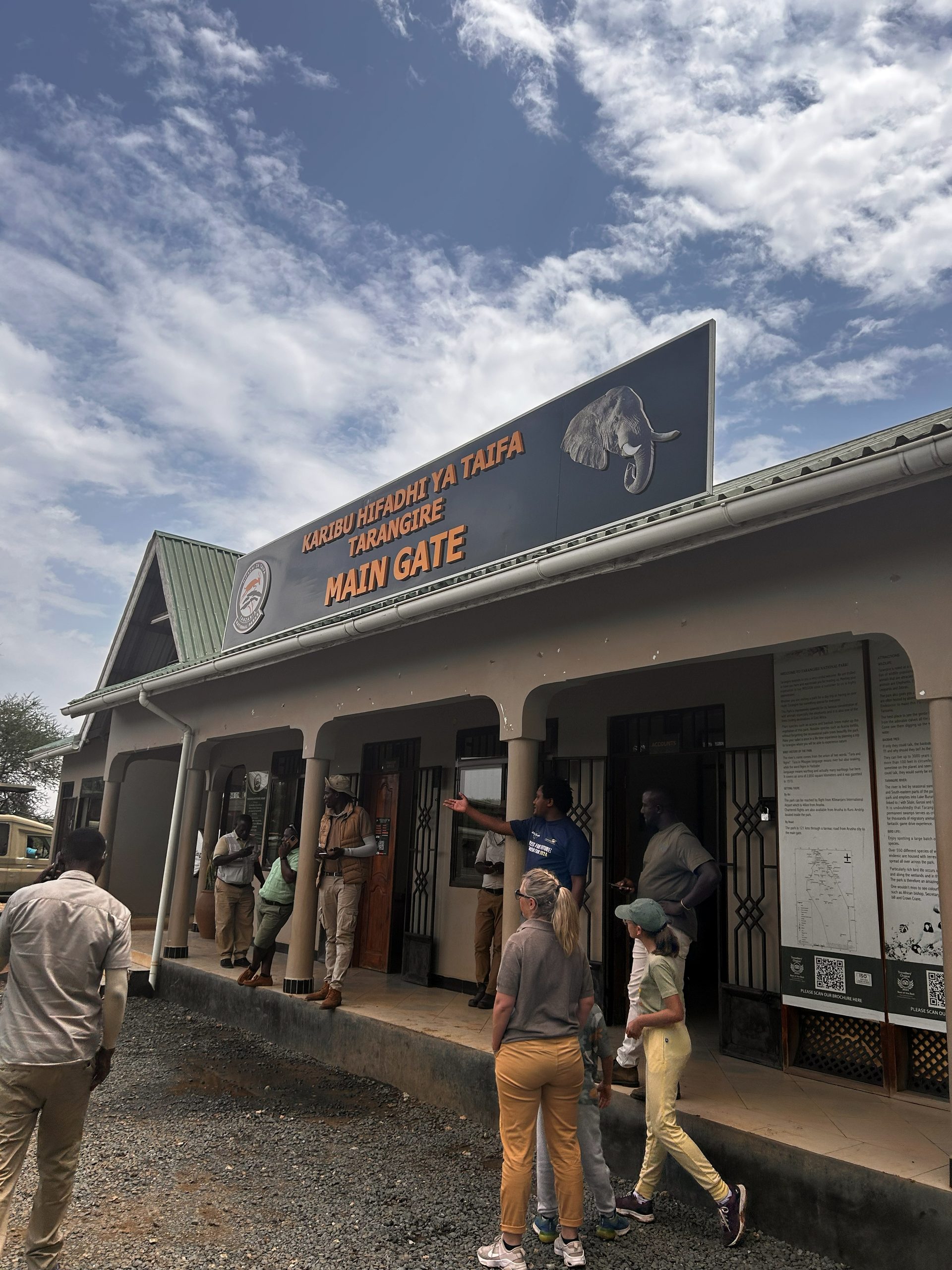
Karibu Hifadhi Ya Taifa Tarangire — Welcome to Tarangire National Park. The elephant head above the gate said everything.
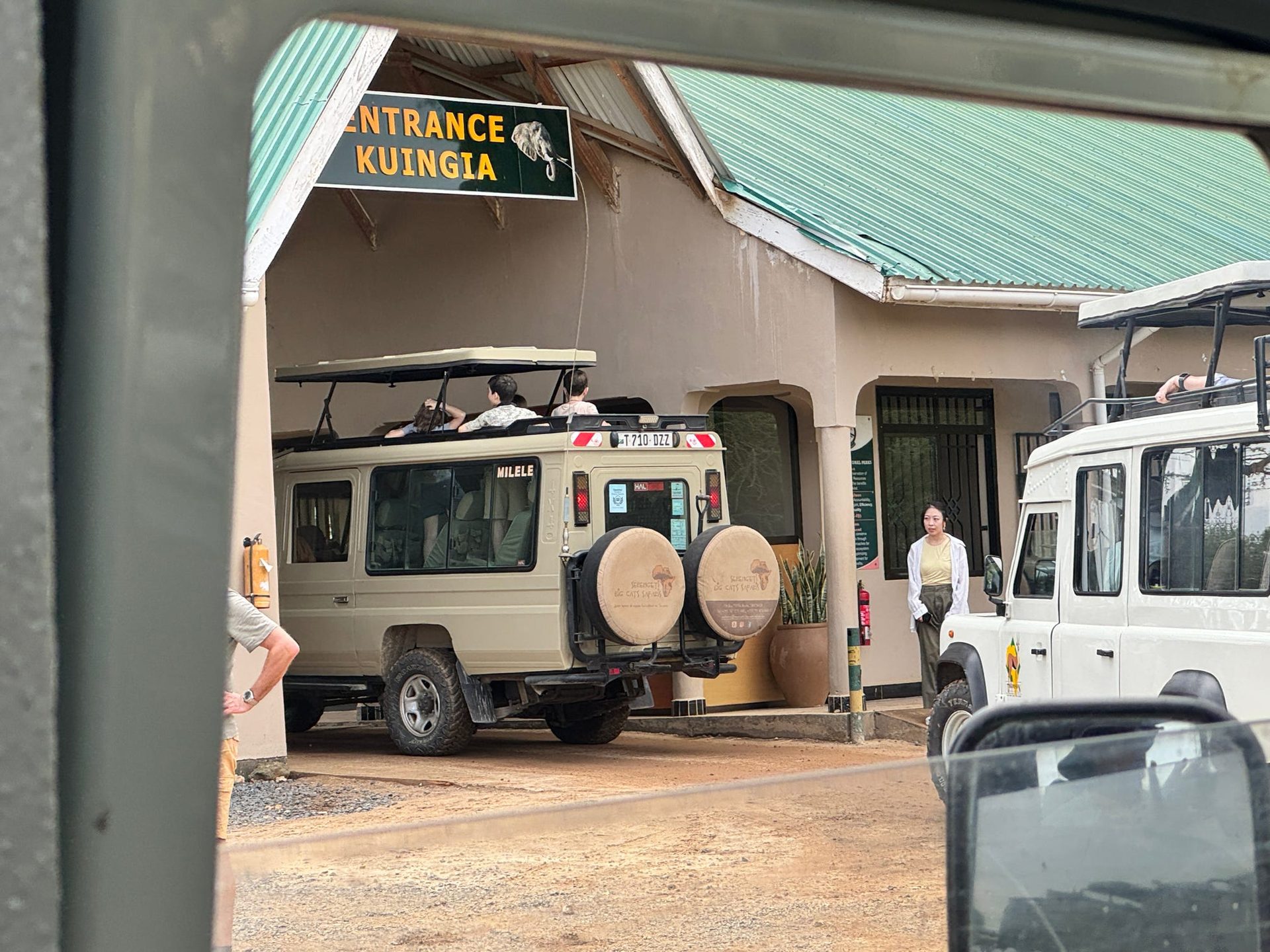
ENTRANCE / KUINGIA — the moment of crossing through, framed by the truck window. The park swallowed us whole.
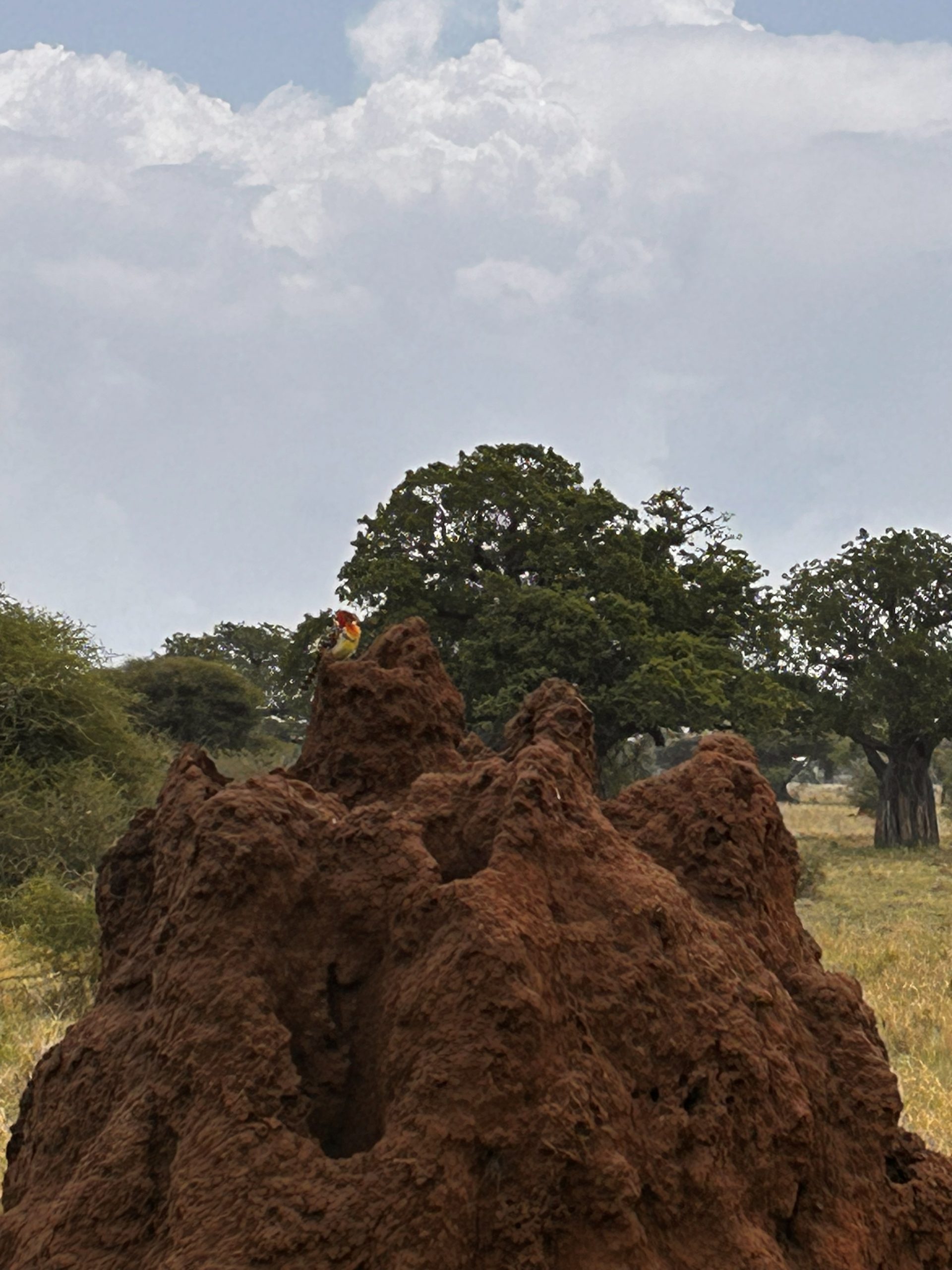
A termite mound cathedral — some stand taller than a person, built grain by grain over decades. A red-and-yellow barbet surveys his kingdom from the top.
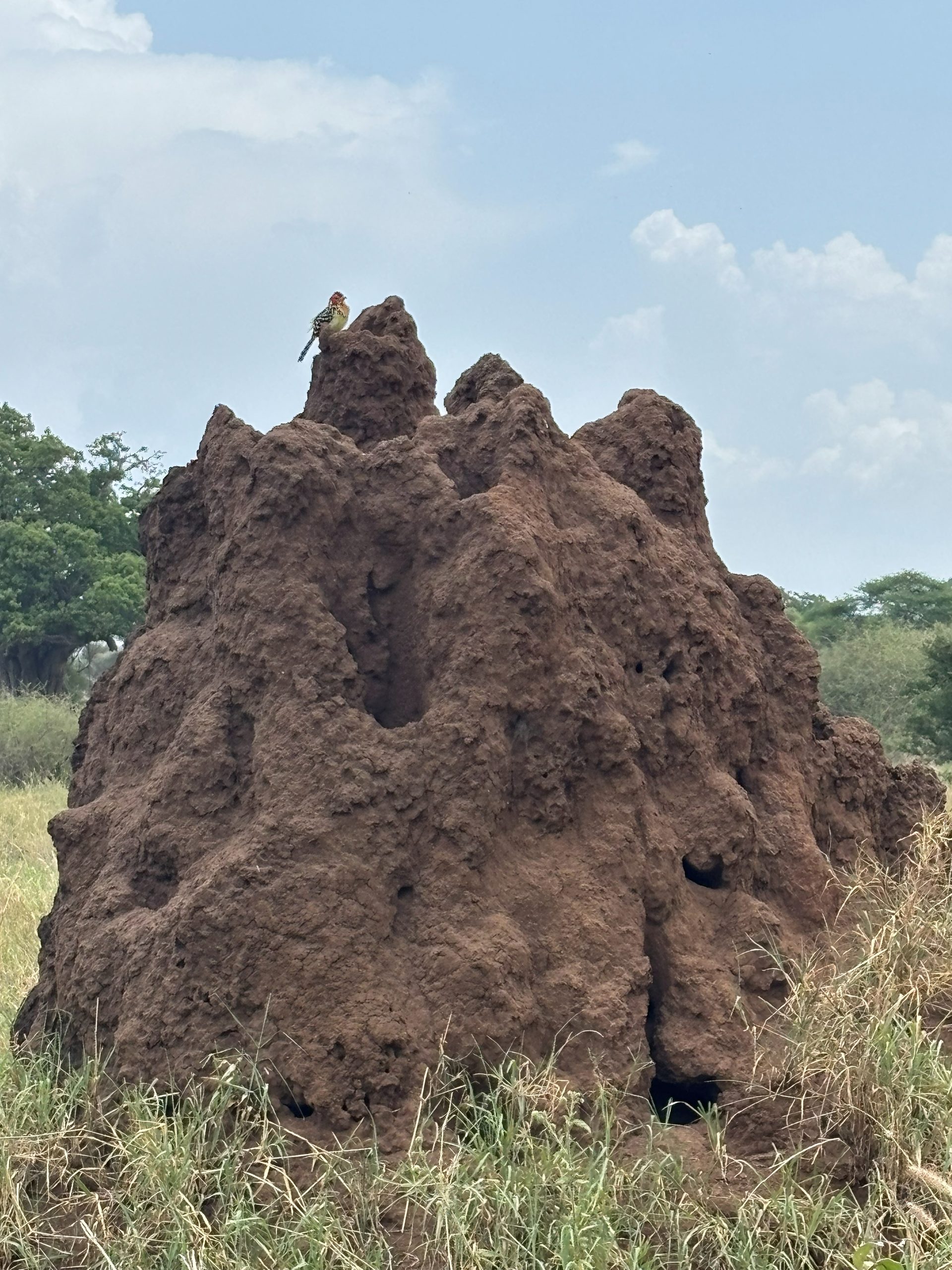
Every termite mound had a bird on it. Every single one. The guides knew every species by sight — we were still learning the big ones.
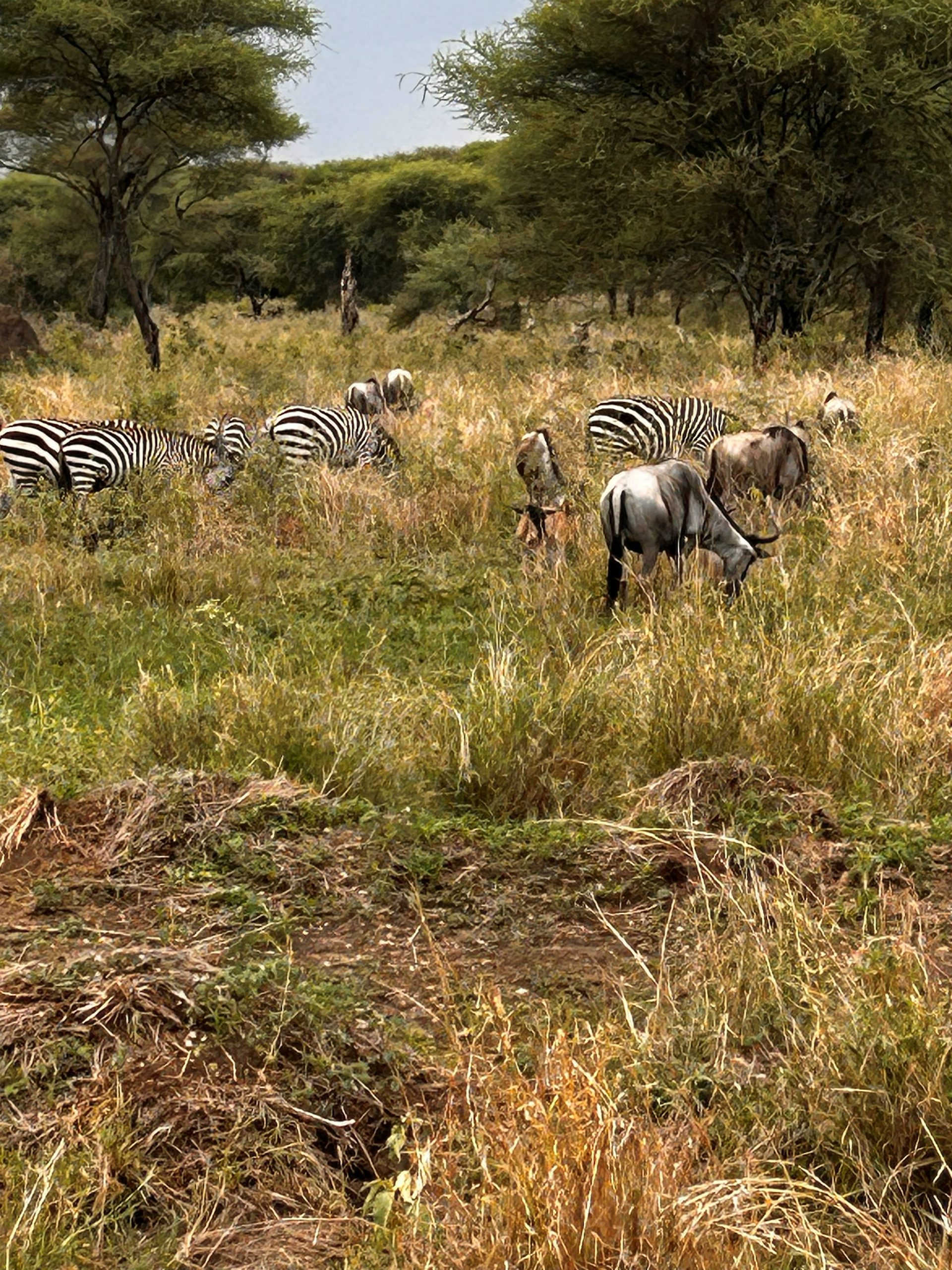
Wildebeest and zebra sharing the grassland — one of Africa's great partnerships, the zebra's sharp eyes and the wildebeest's keen nose working together
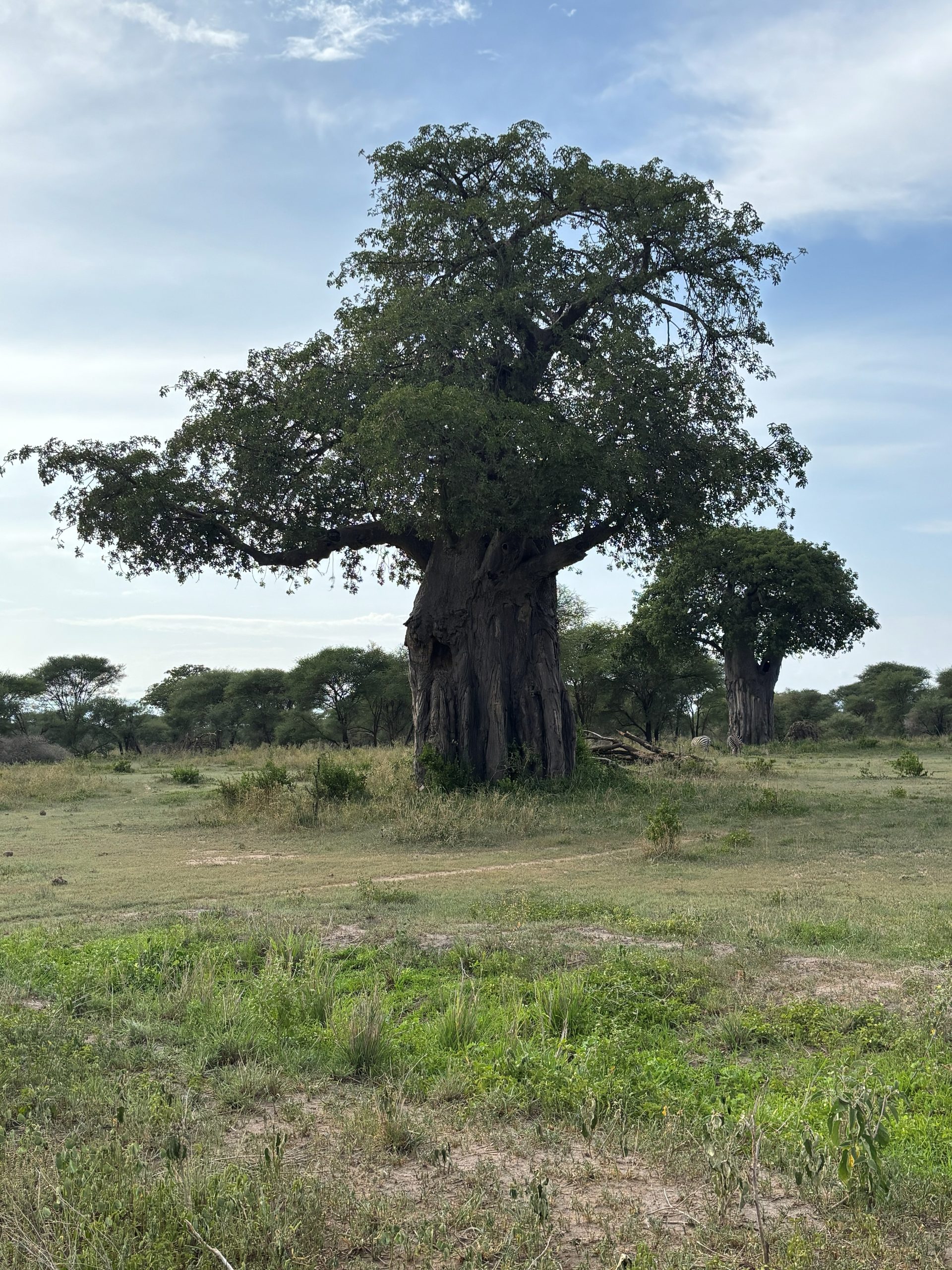
An ancient baobab standing alone in the Tarangire plains — these trees can live for thousands of years, storing tens of thousands of liters of water in their trunks
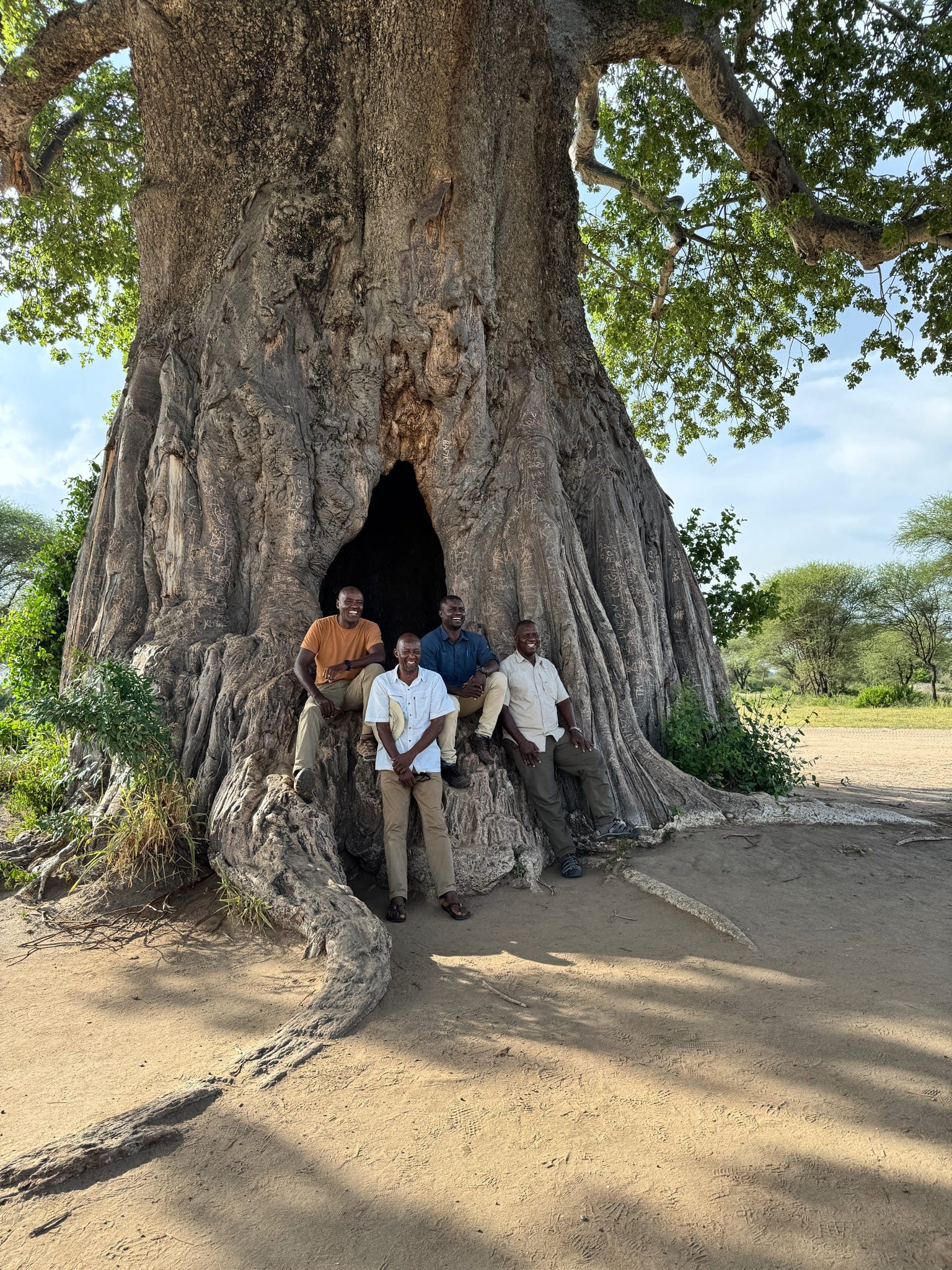
Our four Tanzanian game driver-guides inside the hollow of the giant baobab — four grown men fitting comfortably gives you a sense of the scale
Nothing prepares you for the first game drive. Not documentaries, not photographs, not anything. What nobody tells you is that at first, you can't see anything at all.
The guides were extraordinary from the very beginning — pointing out animals that to our untrained eyes were simply part of the landscape. A shape in the grass. A shadow between trees. A flicker of movement a hundred meters away. It took days of practice before our brains learned how to read the bush. The guides had spent their lives doing it. We were beginners, and we knew it, and we were grateful.
The first animals that stopped the vehicle were zebras. There is something about seeing a zebra in the wild for the first time — not behind glass, not in an enclosure, just standing there in the open grass doing exactly what it has always done — that makes something click. This is real. This is actually happening.
Then the elephants came.
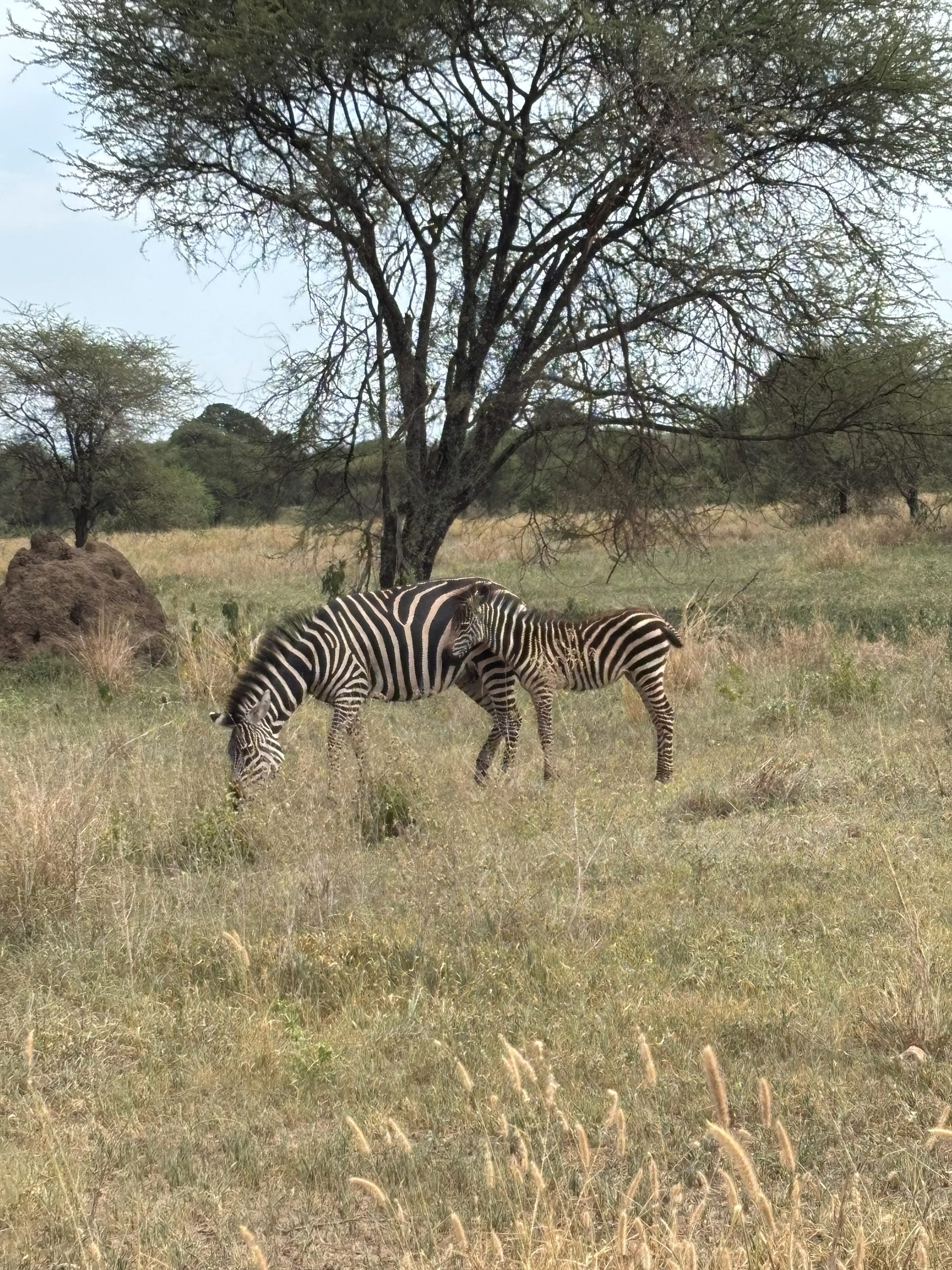
A zebra and her foal — the foal's stripes still soft brown rather than black, close enough to its mother that you could barely separate one from the other
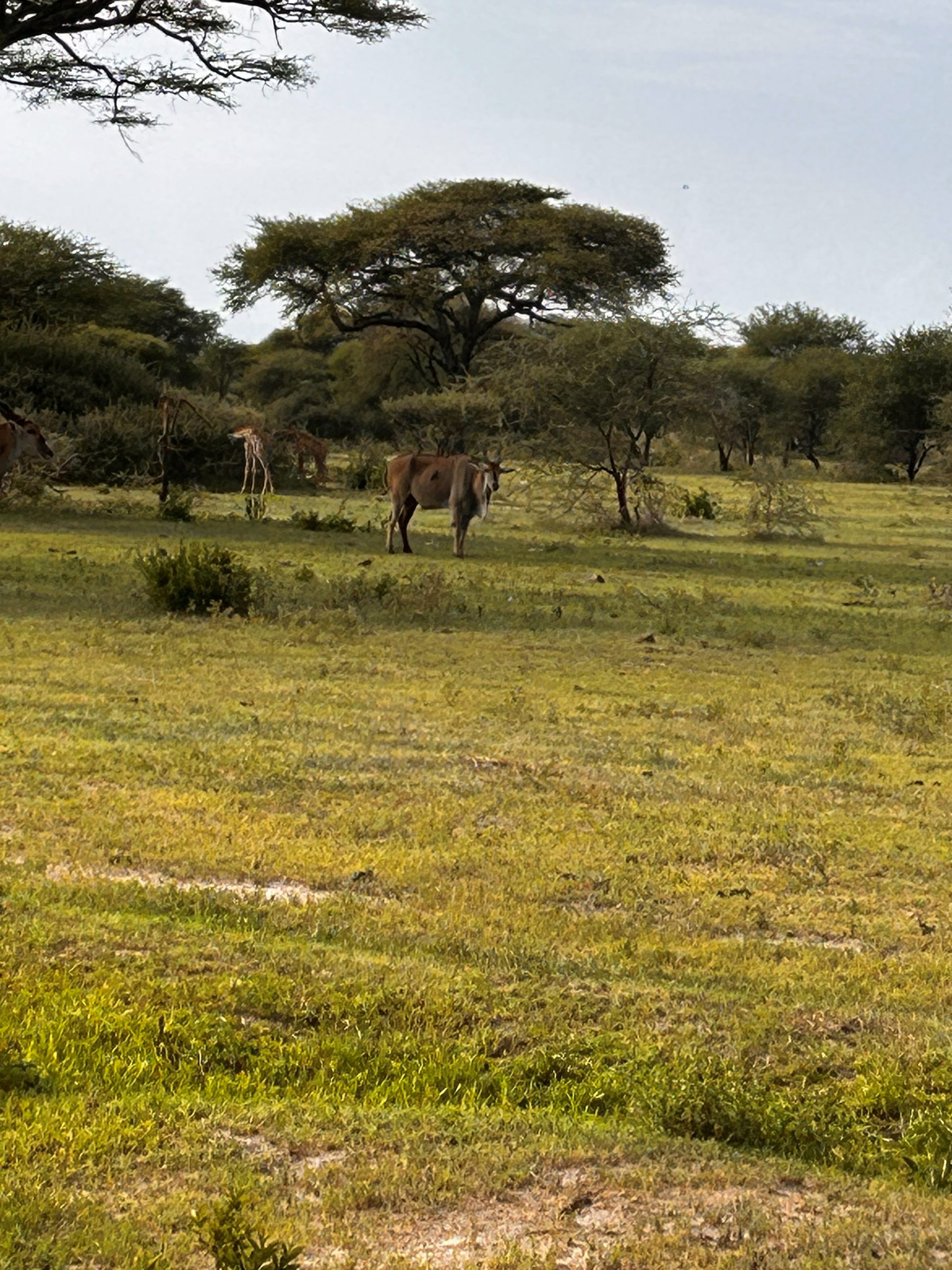
An eland — Africa's largest antelope — with a giraffe browsing in the distance beyond. The plains just kept producing.
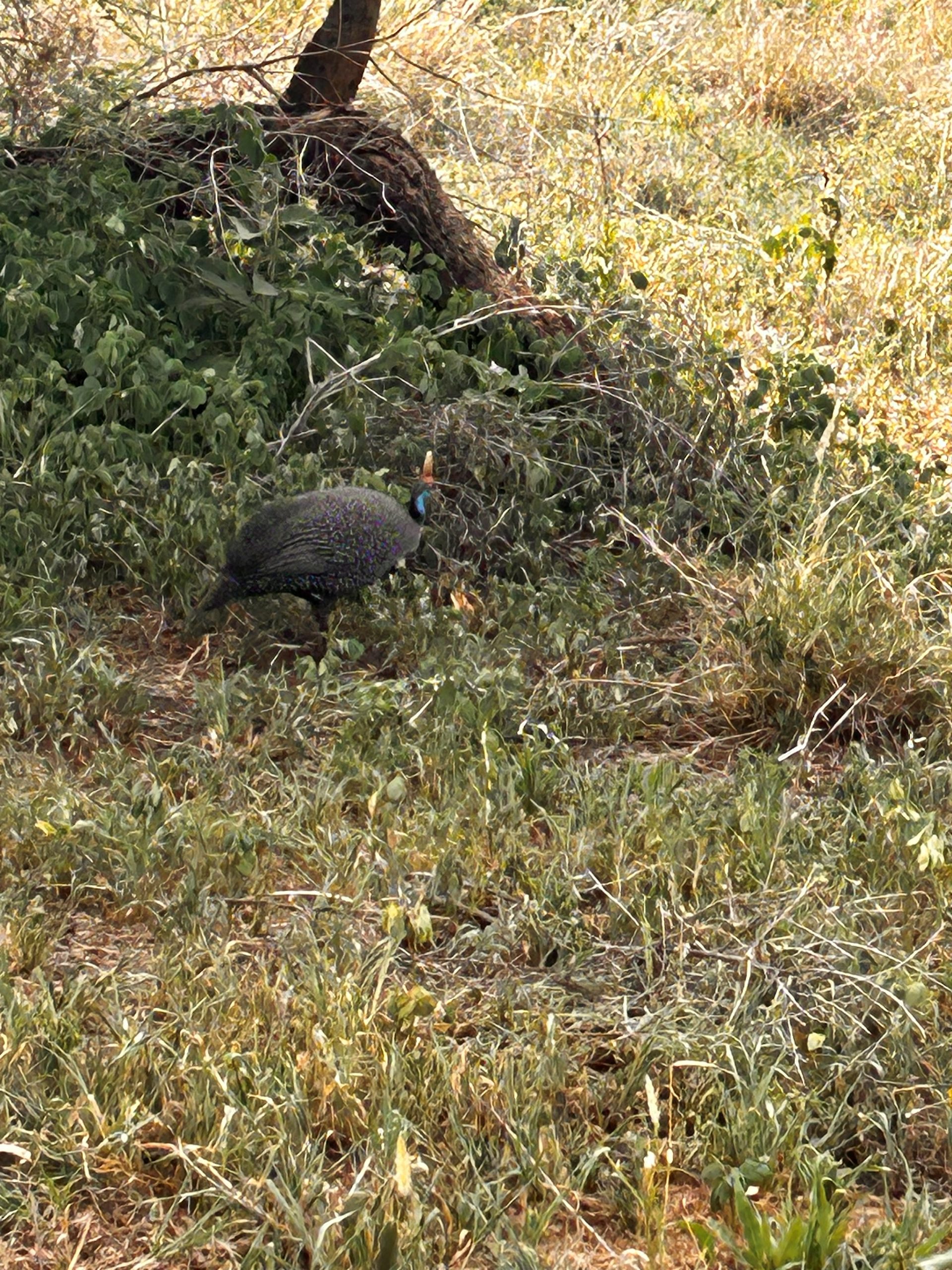
A helmeted guinea fowl — speckled, blue-faced, and magnificently unbothered by our presence
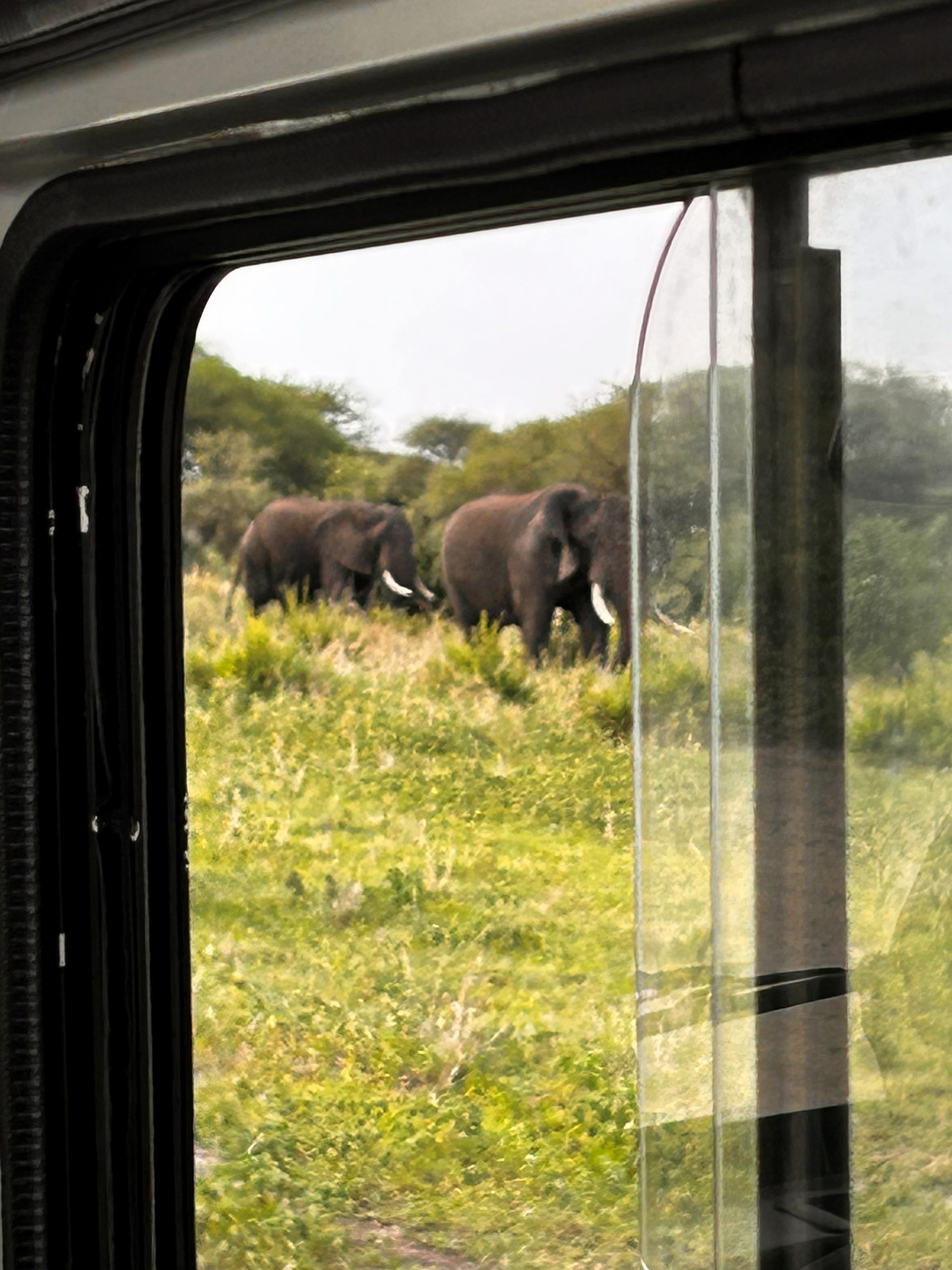
Two bulls framed through the truck window — the view that made everyone reach for their camera at once
Passing through the Tarangire gate — the moment the park swallows you whole
Tarangire is elephant country. They were everywhere — moving through the bush in small family groups, standing in the road, materializing from between trees as if conjured from the landscape itself. Our guides navigated around them with calm familiarity while we watched in near silence from the open roof of the vehicle. The mood in the truck was hushed — quiet murmurs, pointing fingers, cameras raised and lowered. Nobody wanted to break the spell.
One bull elephant walked directly toward us. Ears spread wide, ivory tusks catching the light, enormous and utterly unhurried. He stopped perhaps twenty meters from the vehicle, regarded us for a moment with ancient, unreadable eyes, and then continued on his way. The guides were unconcerned. The elephants were gentle — accustomed to vehicles, uninterested in confrontation. We believed them. But the heart still moved a little faster.
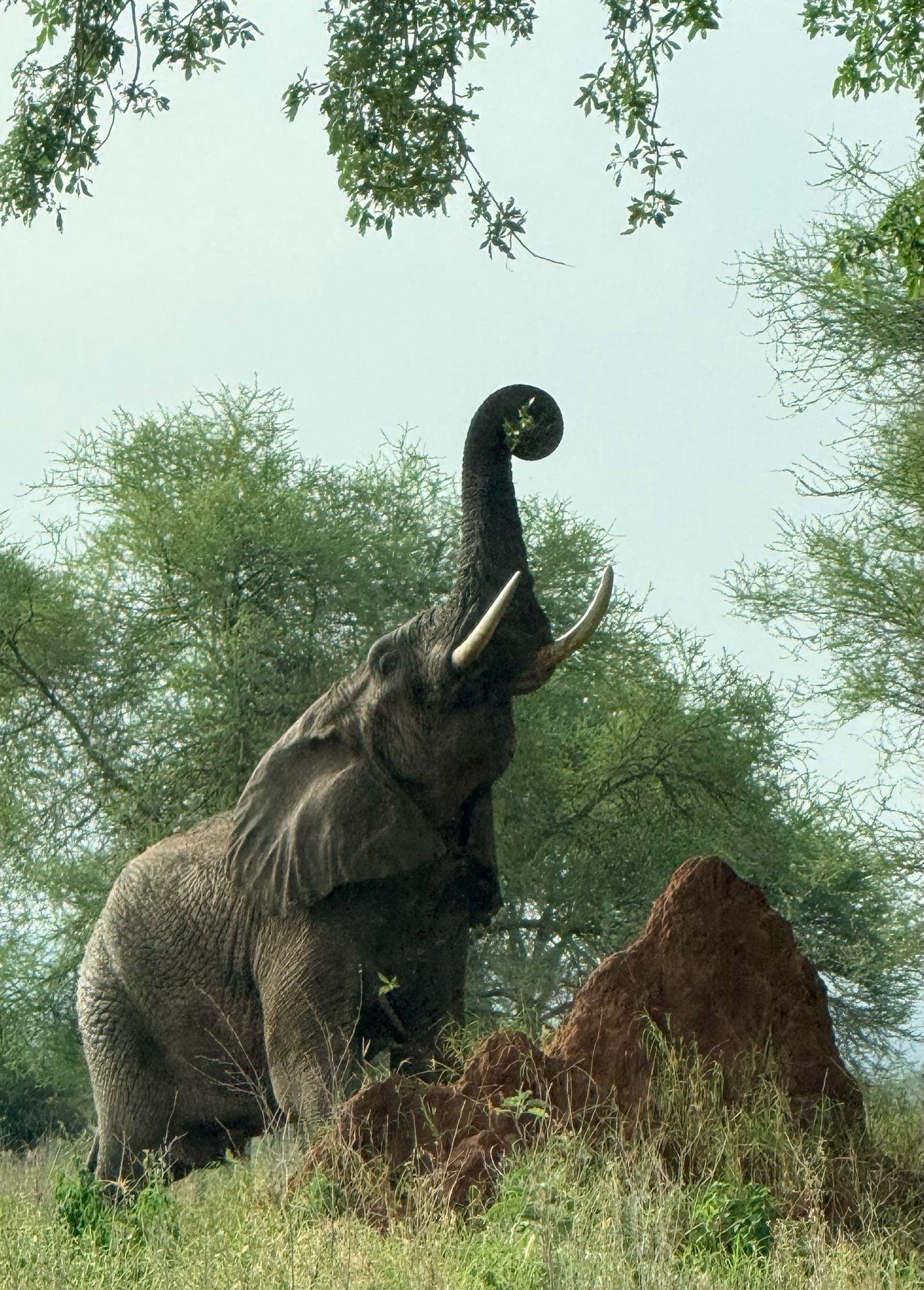
A bull reaching for the high branches — trunk fully extended, tusks gleaming, a termite mound at his feet. This is Tarangire.
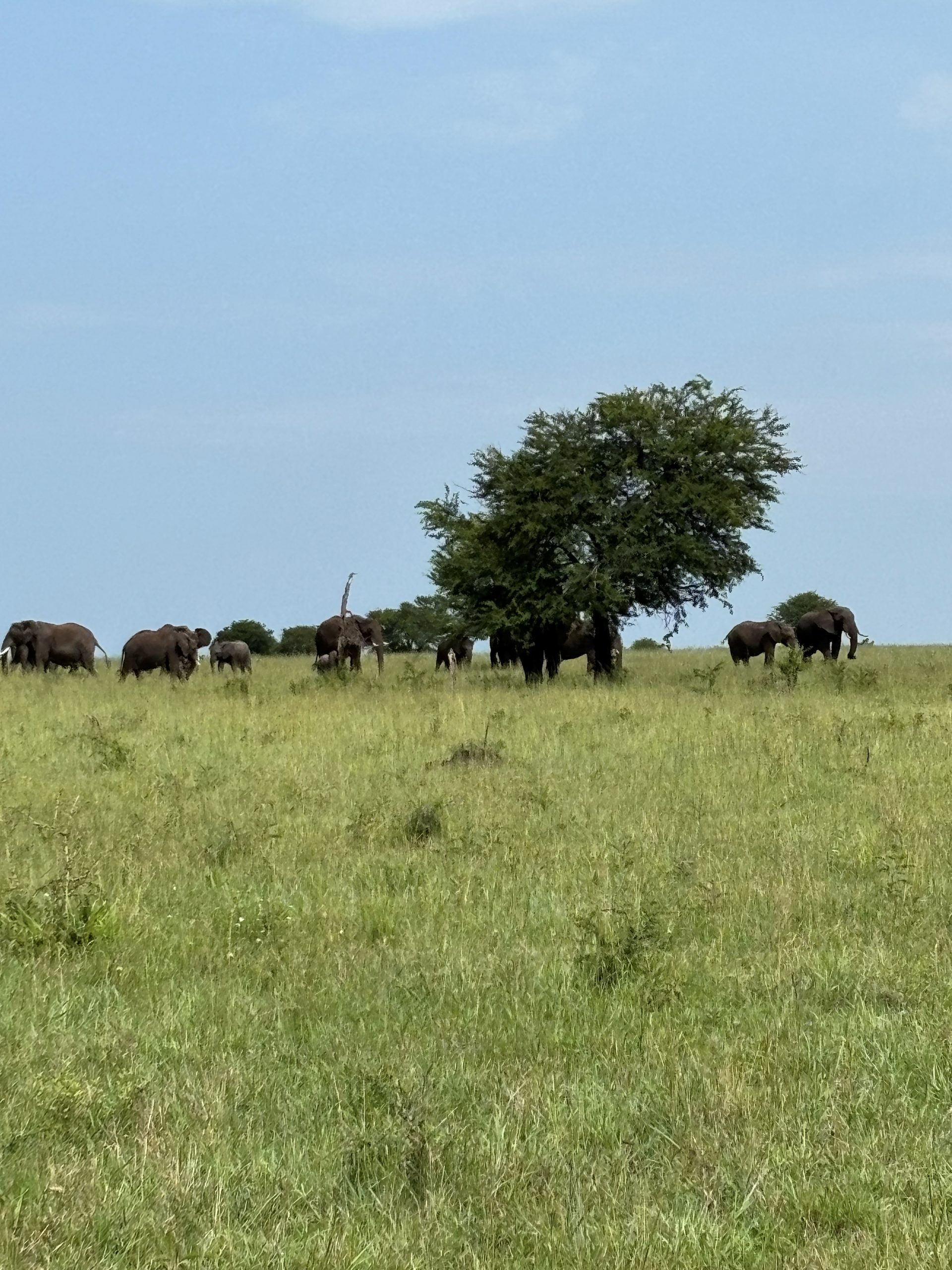
A family herd on the move — adults flanking the calves, tusks catching the light, the plain stretching flat in every direction around them
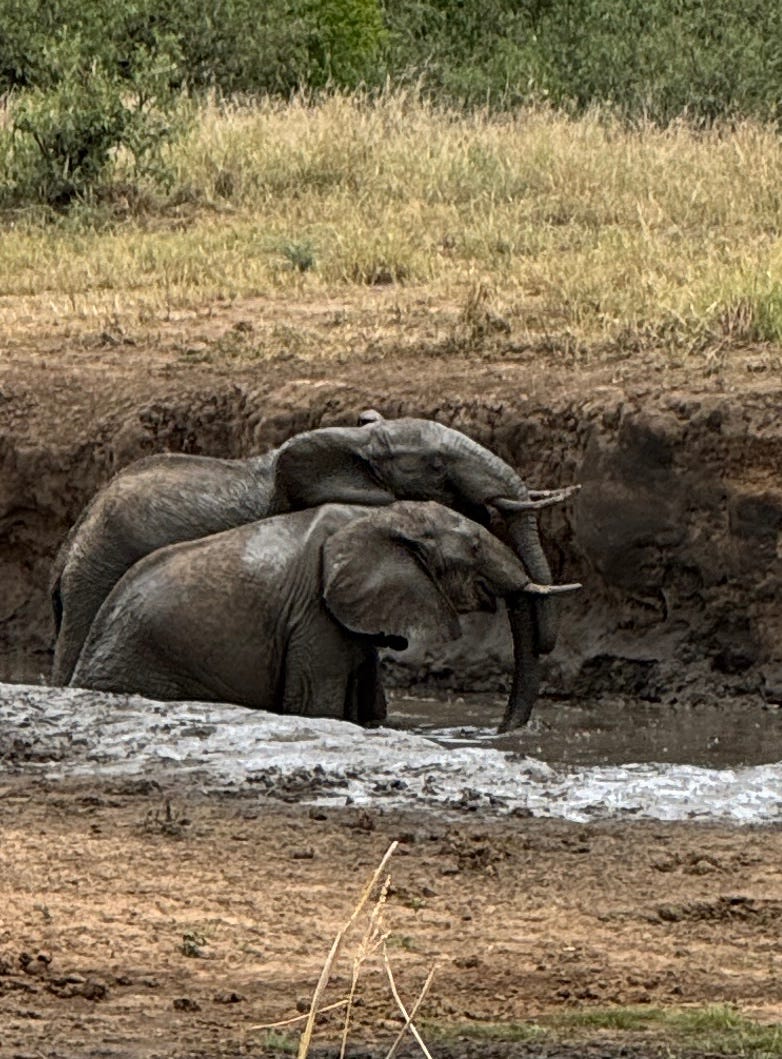
Bath time — two young bulls at the waterhole, trunks entwined, mud flying. The Tarangire River in the dry season becomes the centre of everything.
One of the trip favorites — elephants at the Tarangire waterhole, splashing and playing in the red mud
An elephant feeding — stripping branches with effortless strength in the Tarangire bush
Not every remarkable thing in Tarangire was large. A dik-dik picked its way delicately through the undergrowth close enough to observe in detail. A dwarf mongoose darted across the track. Warthogs trotted past with their tails raised like little flags. Impala, waterbuck, wildebeest and eland grazed at various distances across the plain.
And then, on the red dirt road ahead of the vehicle, something small and extraordinary appeared. The driver stopped. A chameleon — bright yellow against the rust-colored earth — was making its way across the track. We watched it for five full minutes, this small prehistoric creature going about its business while a truckload of humans stared in amazement. And then, without drama, slowly changing to a greenish color, it simply vanished. One moment it was there. The next it had dissolved into the dry grass at the roadside as completely as if it had never existed.
The road offered other small wonders too. A dung beetle — one of nature's most industrious engineers — rolled a perfect sphere across the track with single-minded determination, navigating every obstacle in its path without deviation or doubt. The guides told us dung beetles navigate by the Milky Way. Standing in the Tanzanian heat watching one cross a dirt road, that felt entirely plausible.
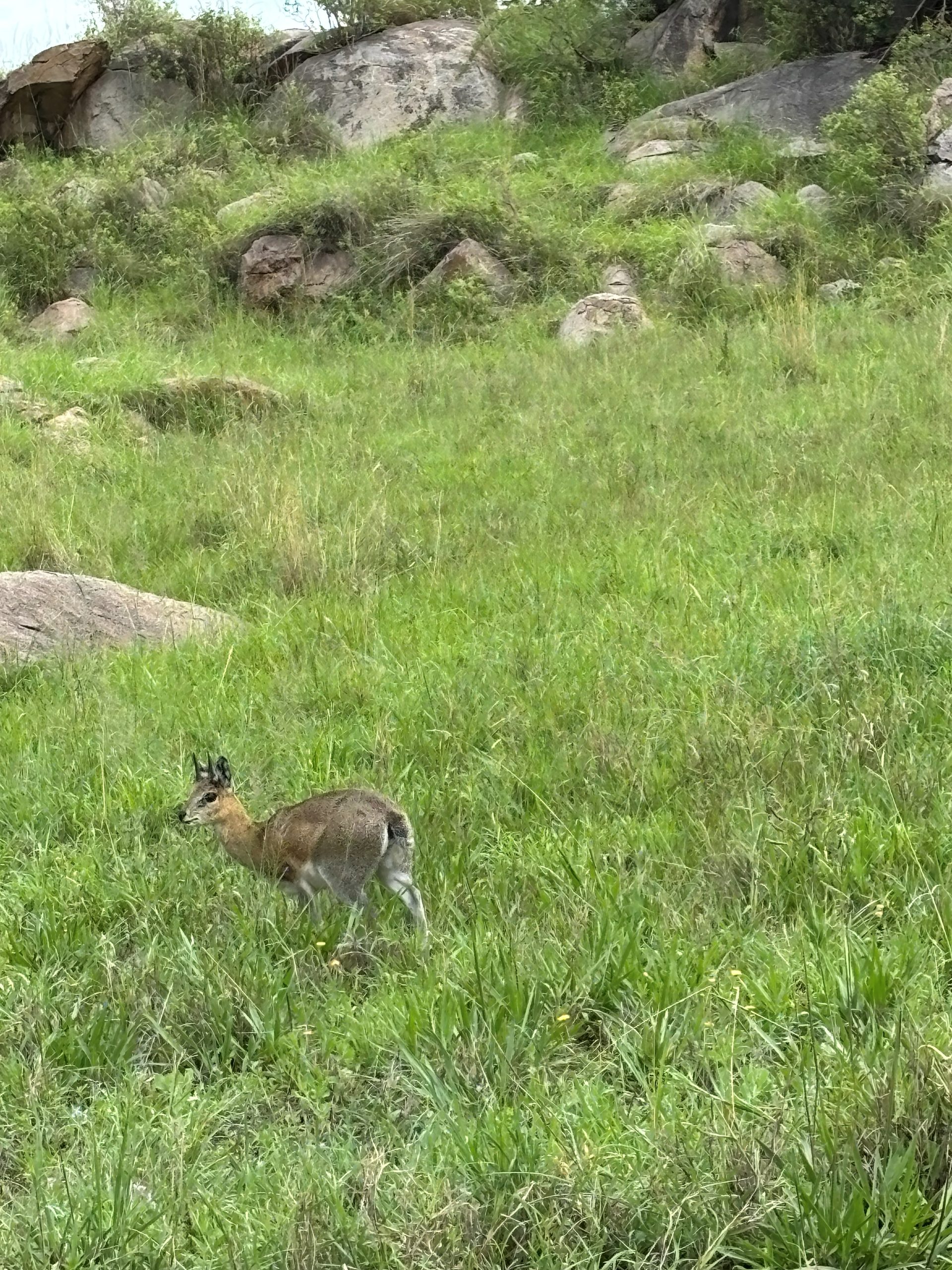
A dik-dik at the kopje base — Africa's smallest antelope, barely knee-height, with eyes entirely out of proportion to the rest of it. It regarded us and then moved on with great dignity.
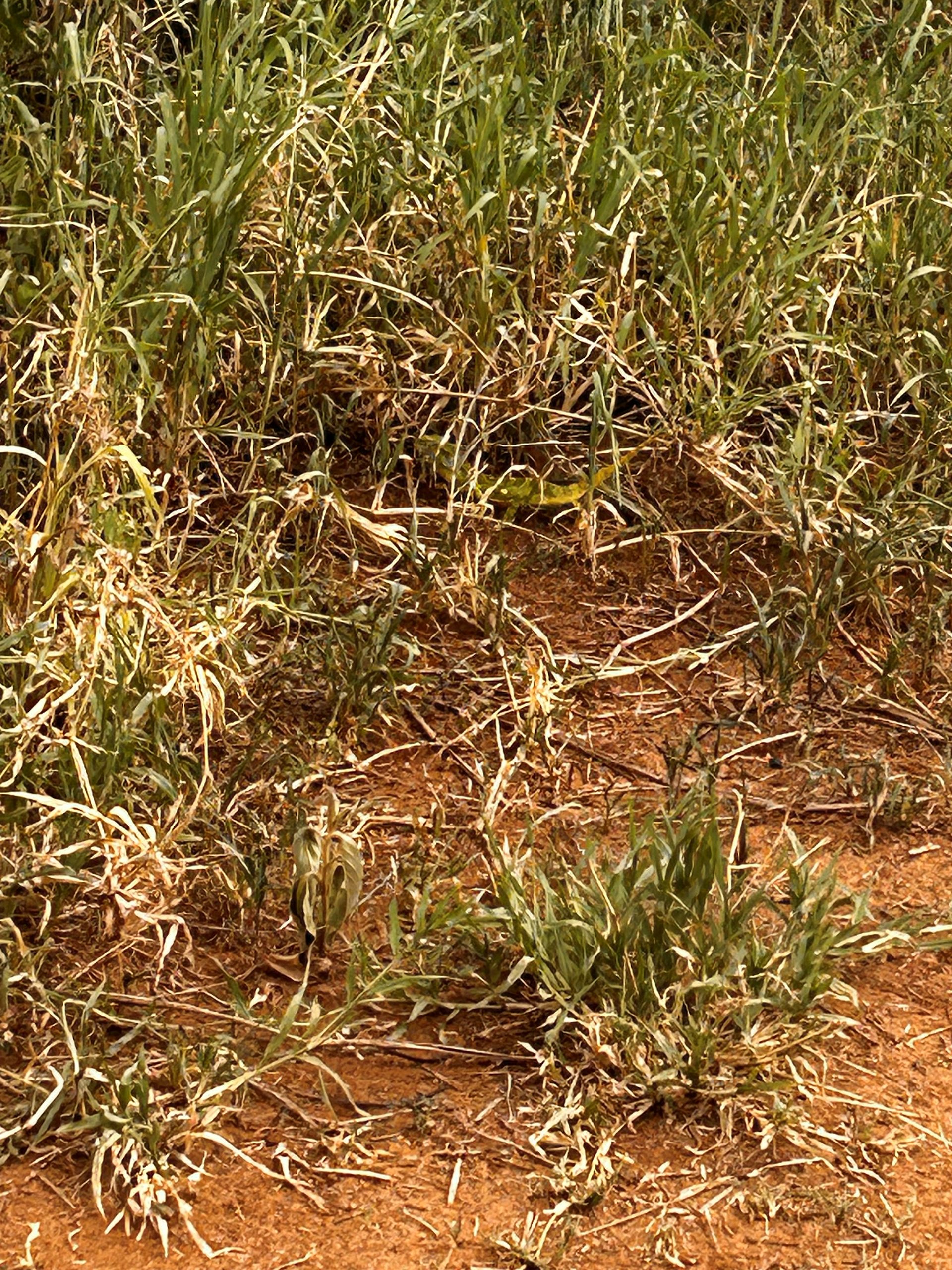
Can you spot it? The chameleon, moments before it vanished completely into the grass
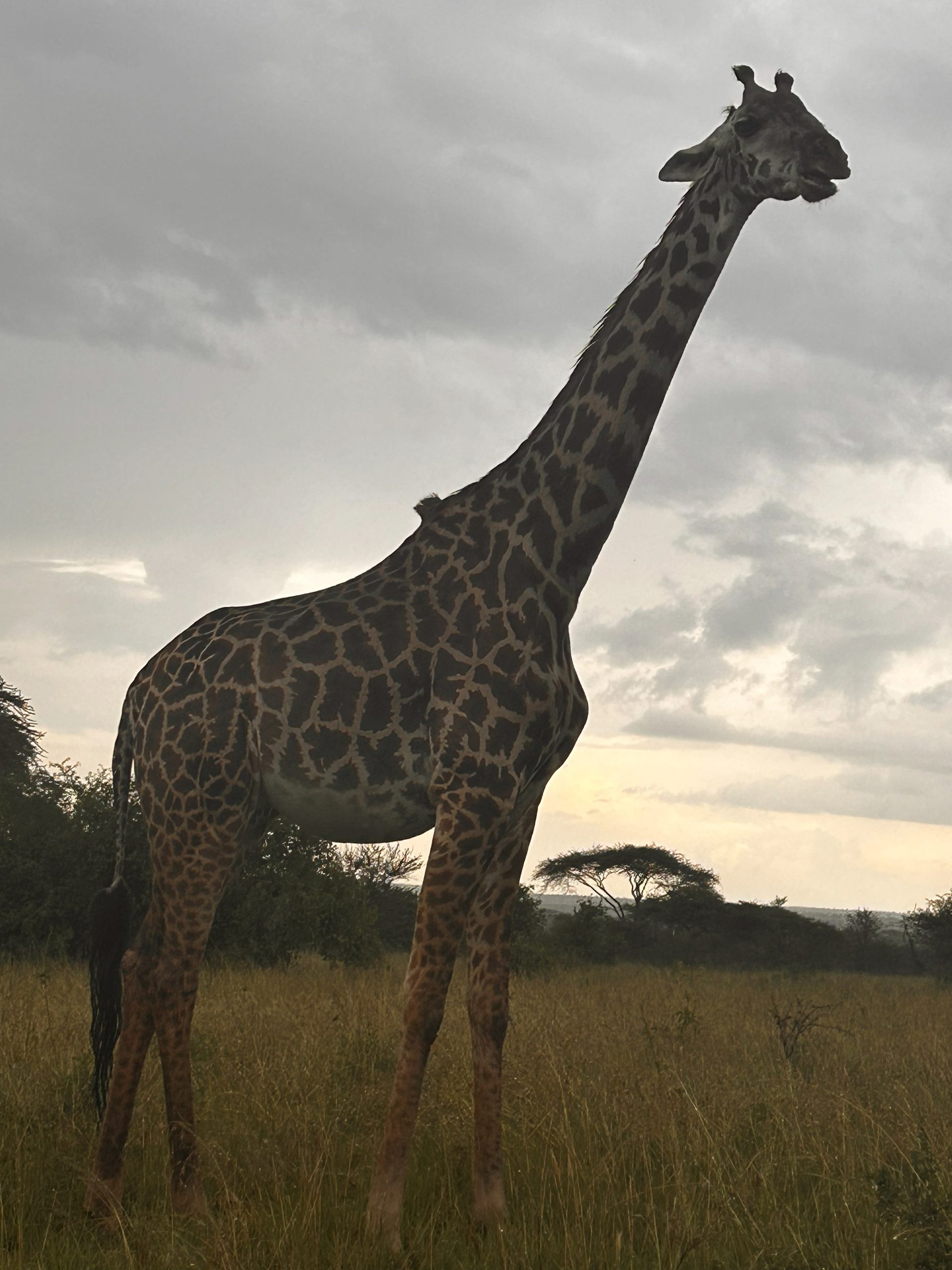
A Masai giraffe against the dramatic Tarangire sky
A juvenile elephant makes its feelings about our presence absolutely clear — the family watches on
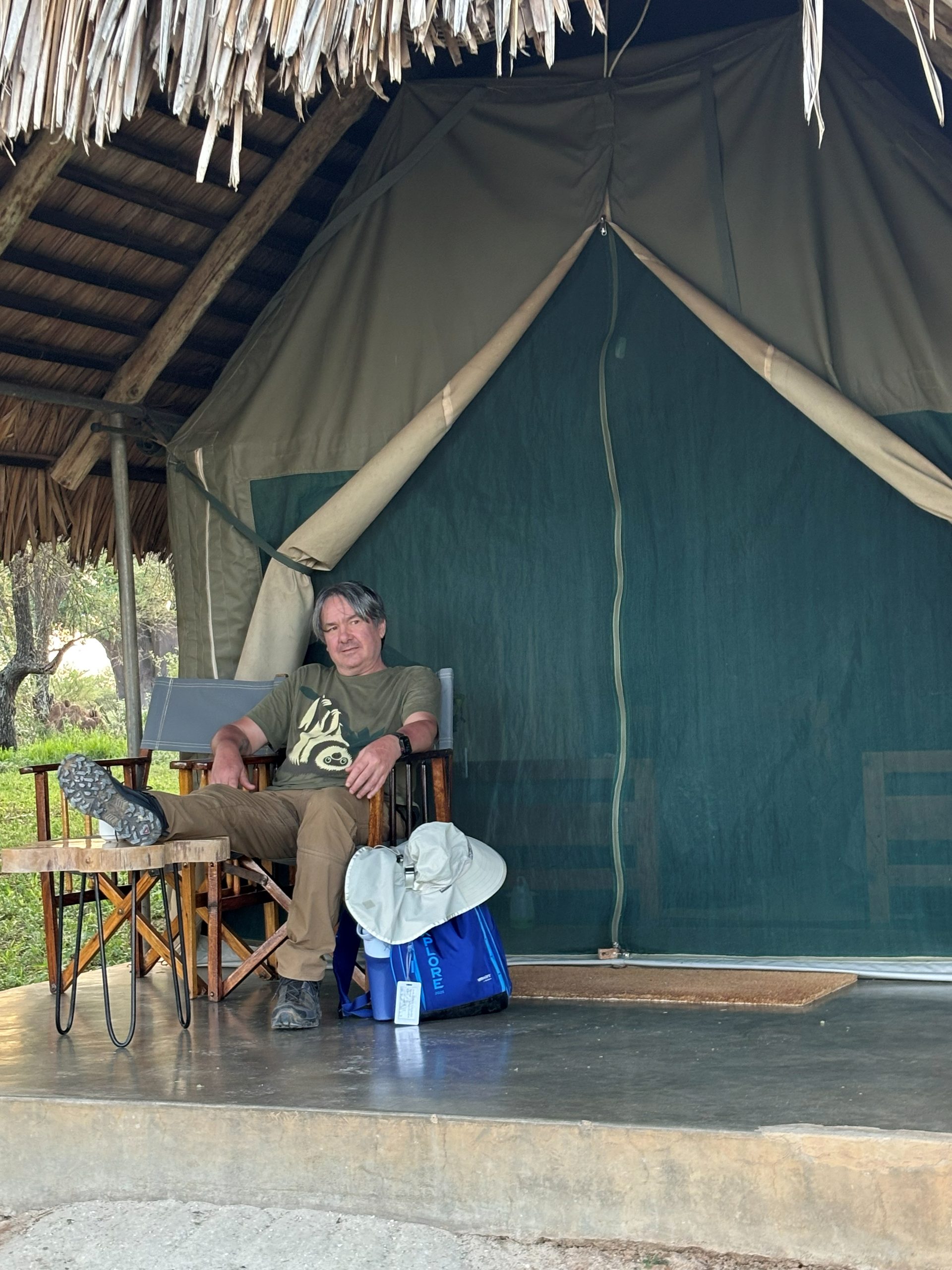
The tent porch at Tarangire Safari Lodge — director's chair, thatched overhang, hat on the bag, and nowhere else on earth to be
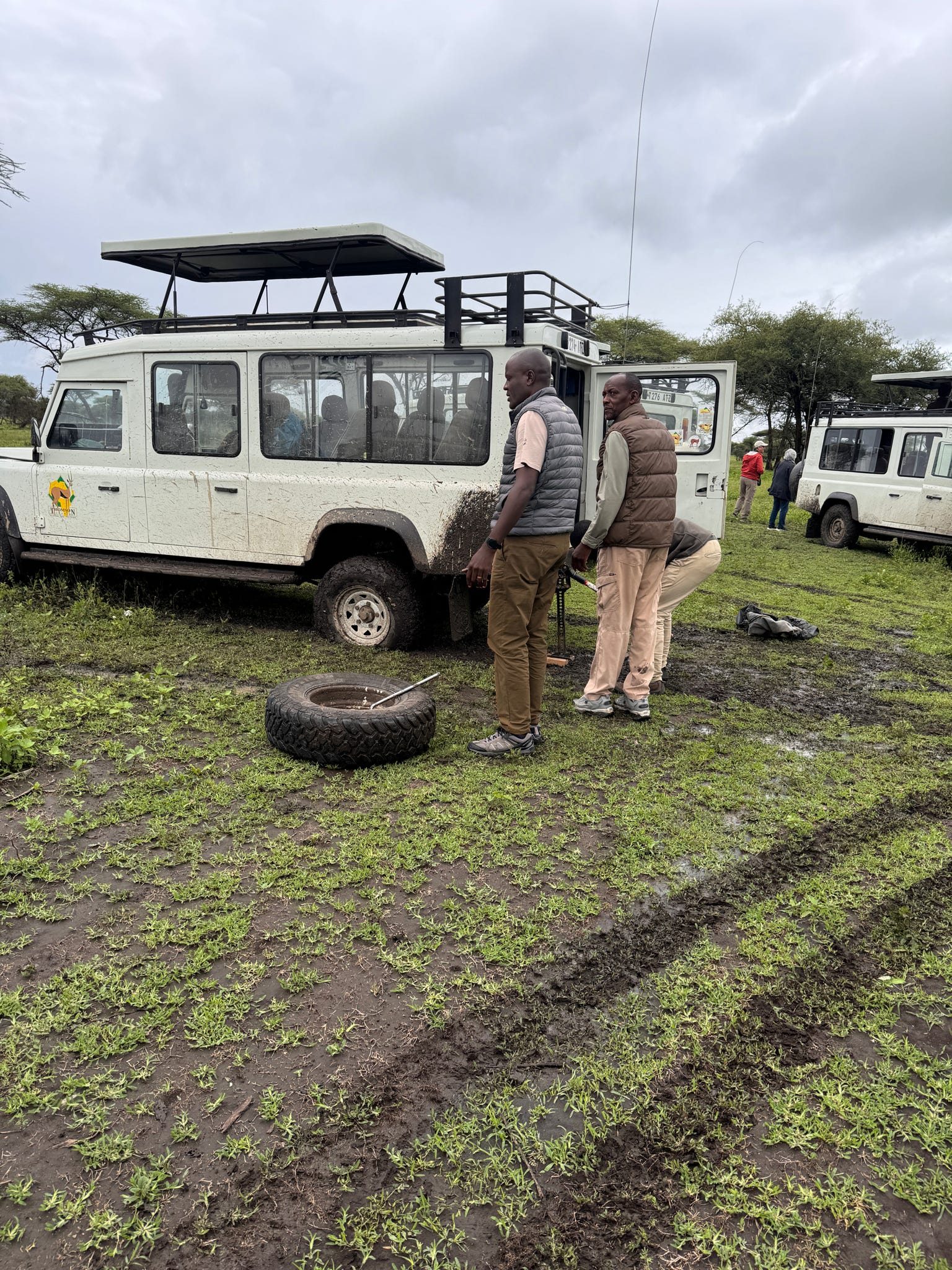
The flat tire — somewhere in the Tarangire mud after a downpour. The guides had it changed in under twenty minutes. We sat in the truck and stayed out of the way.
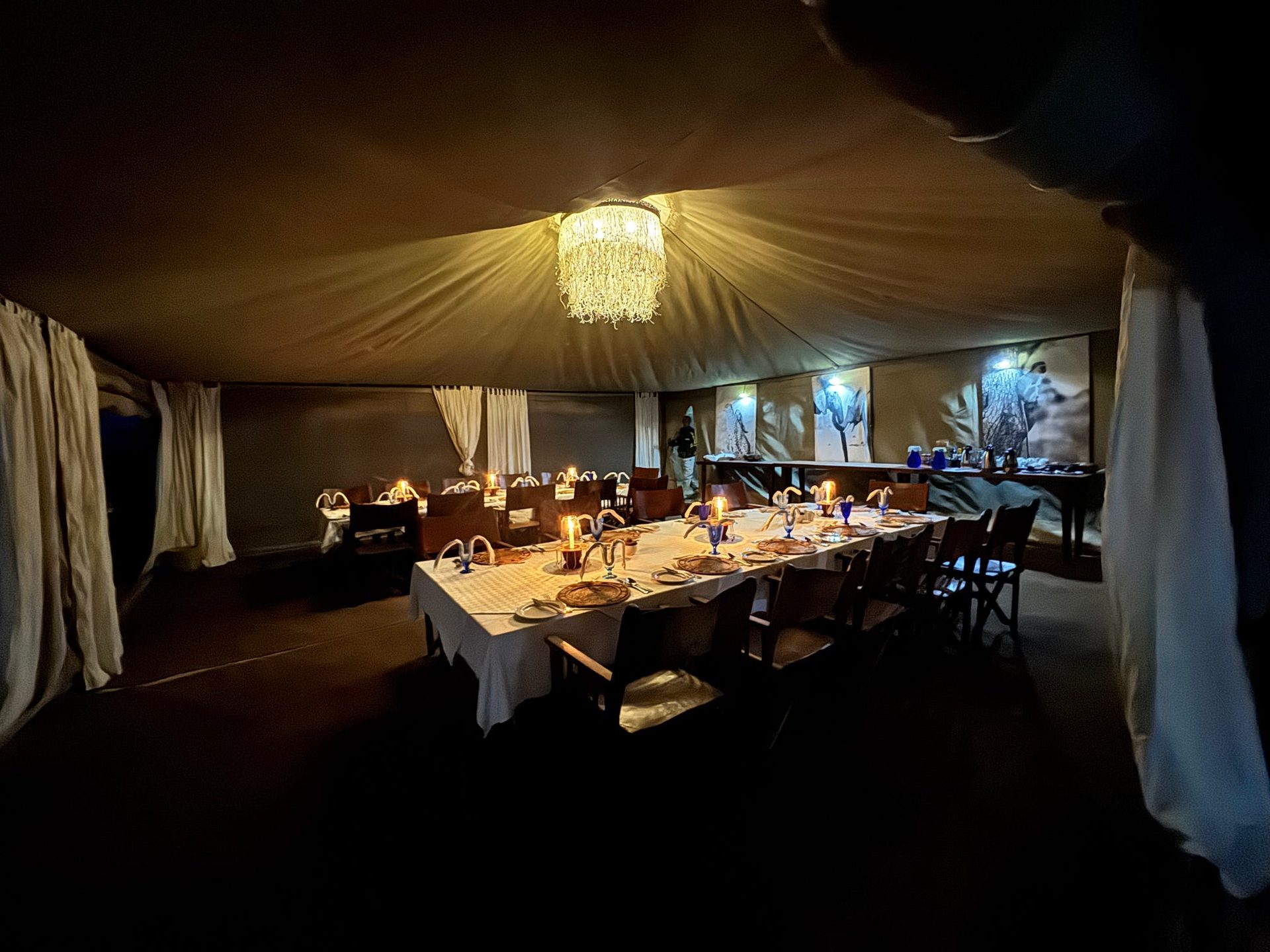
Dinner at the Tarangire Safari Lodge — white linen, cobalt glassware, a beaded chandelier overhead, and wildlife art on the canvas walls. The bush outside, the civilized world somehow in here.
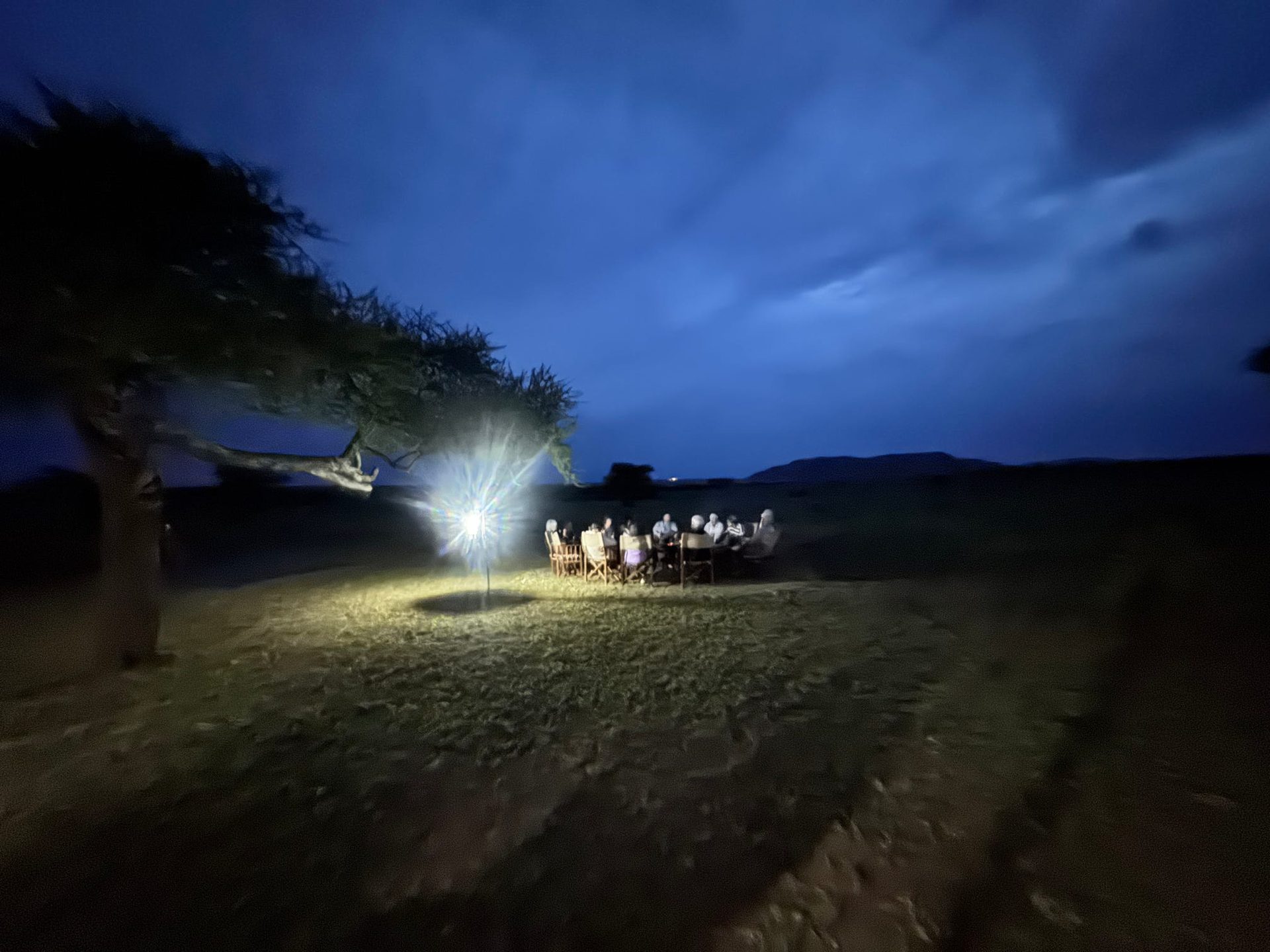
One night, dinner moved outside — a single lantern under the acacia, the group gathered in the dark, the Tanzanian plains stretching away in every direction beyond the light
The heart of the safari. The place that changes you.
The drive from Tarangire to the Serengeti was the longest of the entire trip — a full day across the crater highlands, bouncing through dust and heat, watching the landscape shift and open as we climbed higher and then descended toward the plains. My noise-cancelling headphones earned their place in the luggage that day.
Along the way we stopped at the entrance sign to Olduvai Gorge — our dust-covered Land Cruiser parked beneath the "Welcome to Olduvai Gorge" board under a sky building with dramatic clouds. This was one stop that nobody had anticipated quite so philosophically.
Here, the group climbed out of the vehicles and ate packed lunches at the base of a remarkable monument — two enormous terracotta-colored skulls representing early human ancestors, commemorating sixty years of paleontological discoveries by Mary Leakey. We sat on the steps of that monument, eating sandwiches in the warm breeze, looking up at the faces of our oldest relatives. It was impossible not to feel the weight of time in that moment. We were sitting at the edge of where humanity began. Tanzanian plains stretching out ahead of us, ancient and indifferent to the passage of time. A fitting portal between one world and the next.
And then — the Serengeti.
No photograph or film prepares you for the scale of it. The plains simply go. They go in every direction, grass and acacia and sky, as far as the eye can resolve. The horizon is not a suggestion here — it is a presence. You understand immediately why this place has captured the human imagination for as long as humans have been here to imagine.
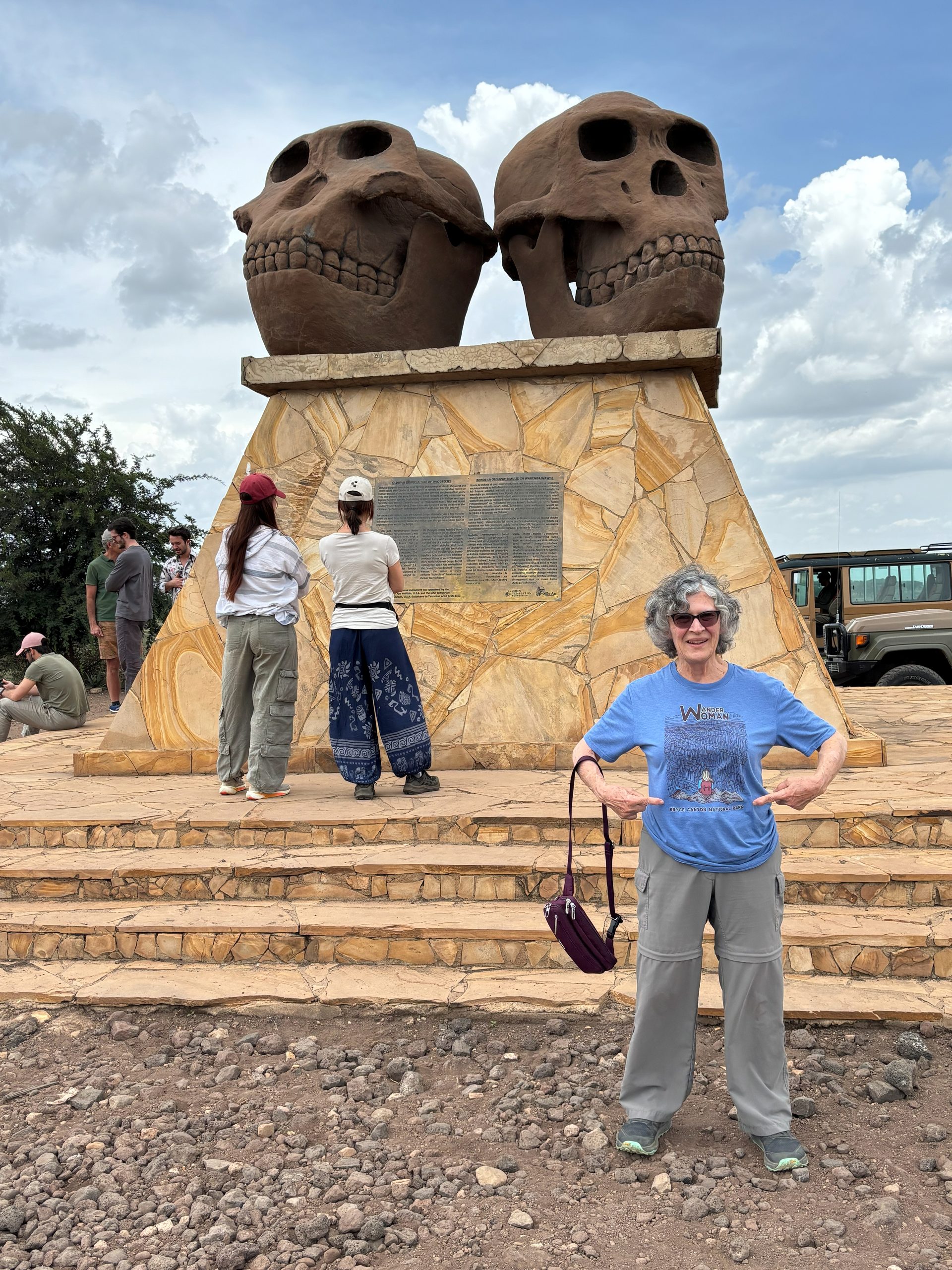
At the Olduvai Gorge monument — two skulls of our earliest ancestors looking down, two friends smiling back up
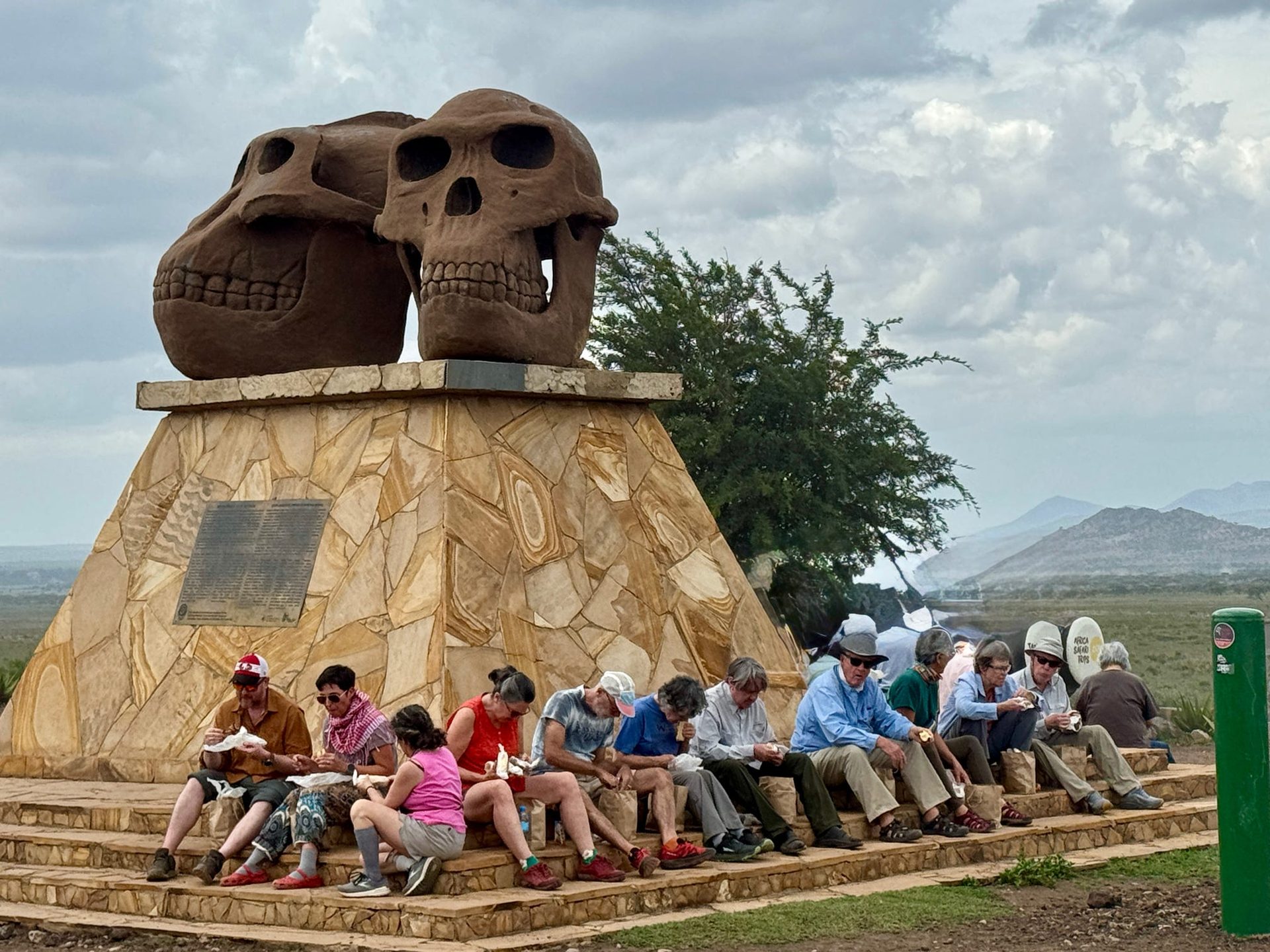
Lunch at Olduvai Gorge — the whole group seated on the monument steps, sandwiches in hand, the ancient plains of the Rift Valley stretching away behind us. A slightly surreal picnic at the edge of human history.
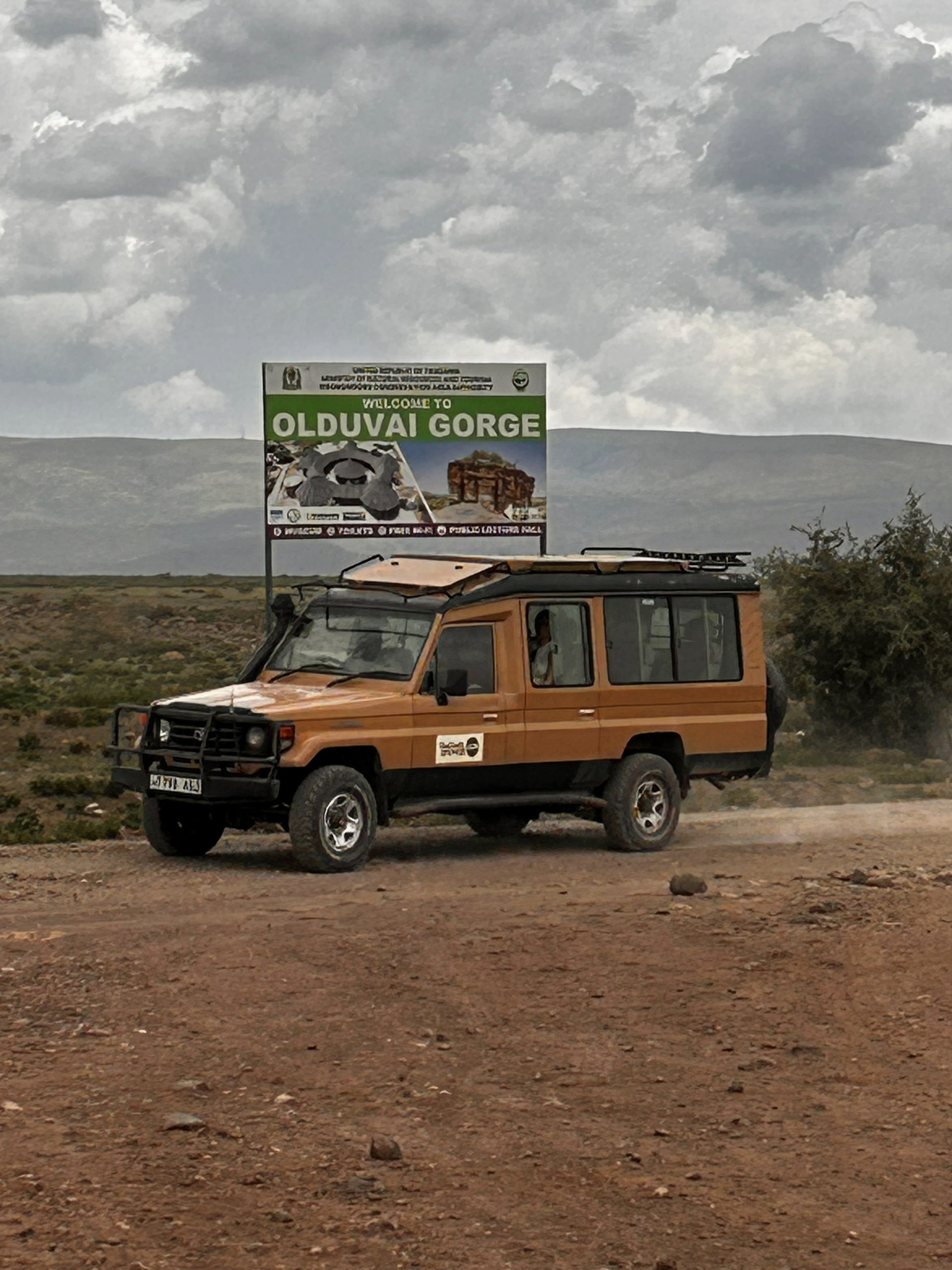
Our Thomson Land Cruiser at the Olduvai Gorge entrance — the crater highlands rising behind, the Serengeti ahead
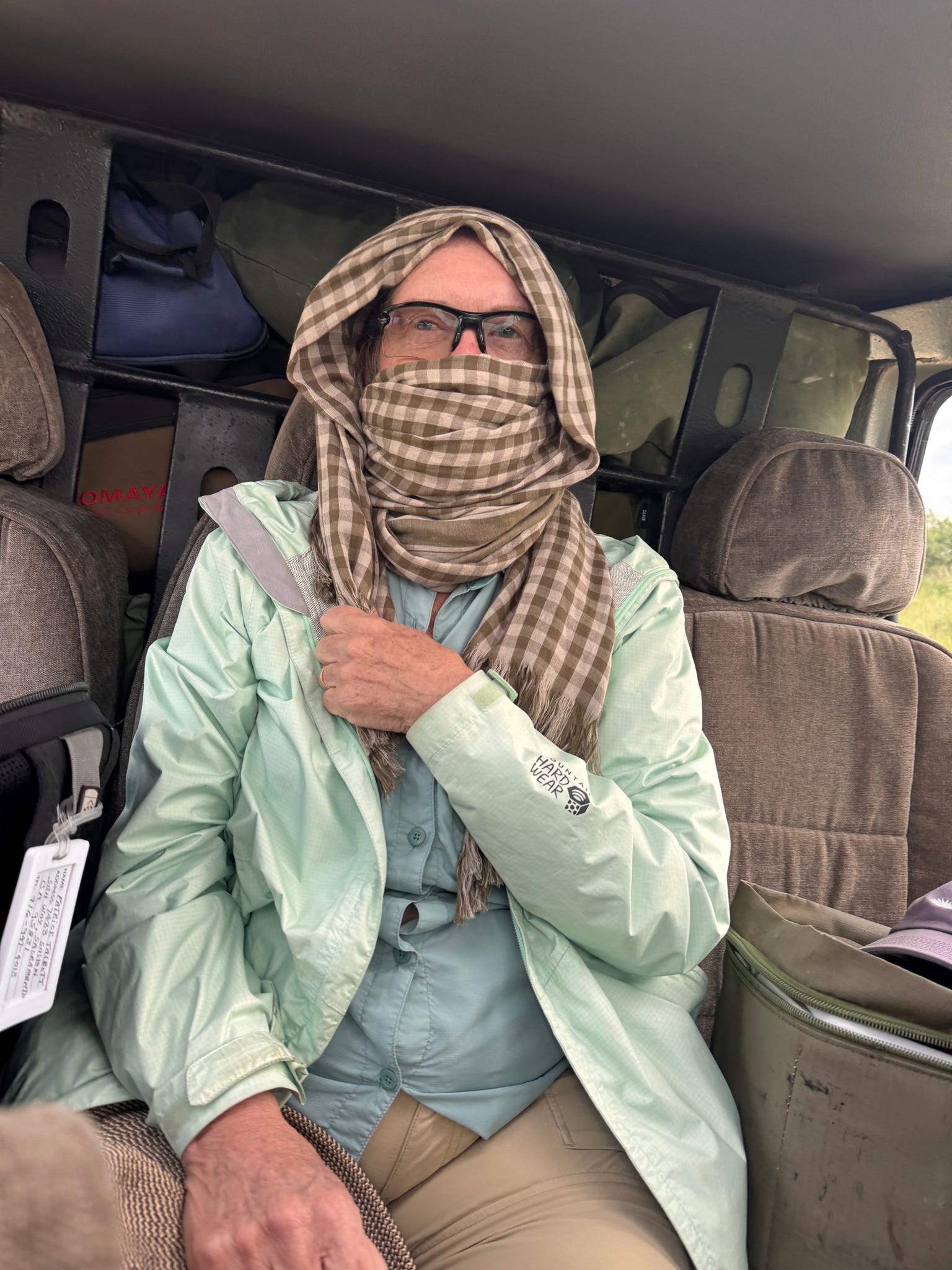
The dust solution — somewhere in the Olduvai corridor, a scarf becomes a full face wrap. This is the correct approach. No further questions.
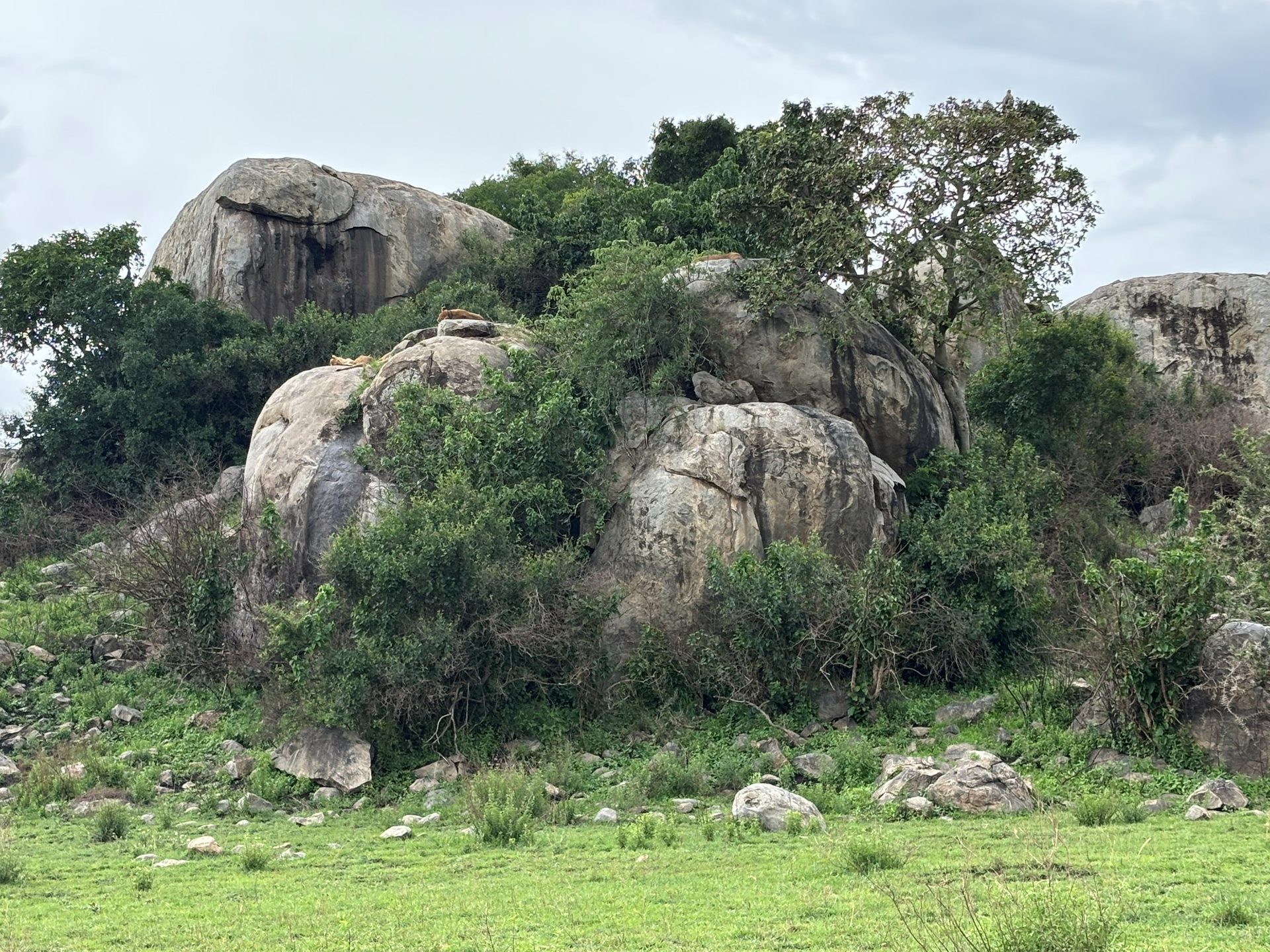
Lion cubs draped across a kopje — the Serengeti's granite outcrops are prime cub territory, warm in the sun and high enough to survey the plain
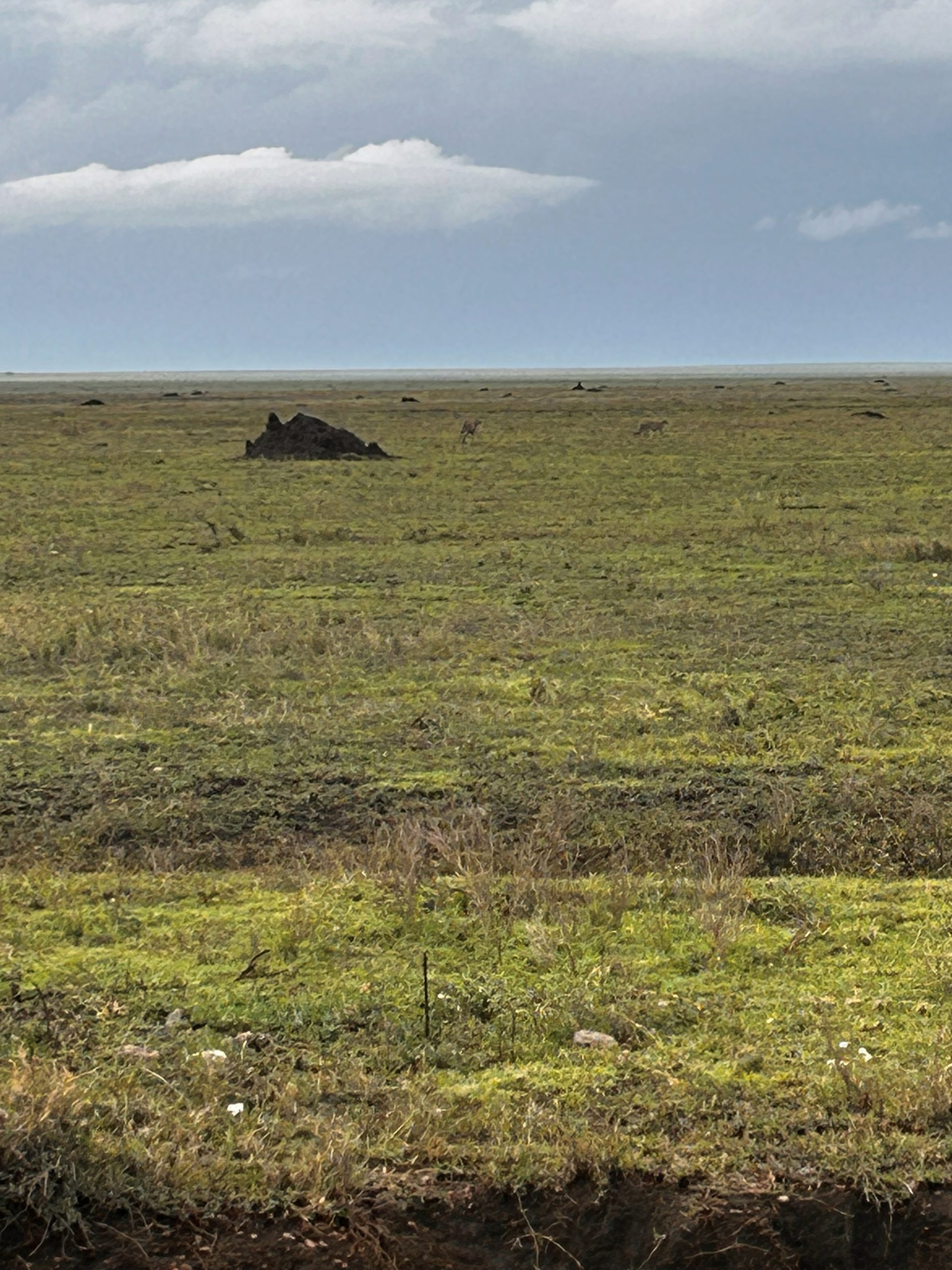
Two cheetah cubs on the open plain — the Serengeti's scale is hard to convey until you see animals this size reduced to specks against it
Arriving at the Serengeti Nyumba camp — the tents materializing from the plain like a mirage
A Serengeti rainstorm rolling in over the camp — the canvas holding, the plain turning silver
The Serengeti Nyumba camp was the most primitive accommodation of the trip — and in many ways the most memorable. Thomson Safaris sets up these mobile camps in the heart of the parks, as close to the wildlife as it is legally and safely possible to be. There are no permanent structures. The tents go up, the camp comes alive, and when the group moves on, the land returns to what it was.
The tents themselves were simple and comfortable — a proper bed with white linens, canvas walls printed with African geometric patterns, a wooden clothes rack, and a lantern for the night. The wash station used terracotta bowls and glass pitchers rather than running water — rustic, elegant, and entirely appropriate for where we were.
What surprised everyone was the bar. Inside the social tent, a beautifully carved wooden dresser served as the camp bar, stocked with a remarkable selection of bottles — whiskies, gins, wines — presided over by a cheerful camp manager standing in front of a dramatic black-and-white photograph of a wildebeest. After a long game drive, nothing quite compares to a sundowner on the Serengeti plain.
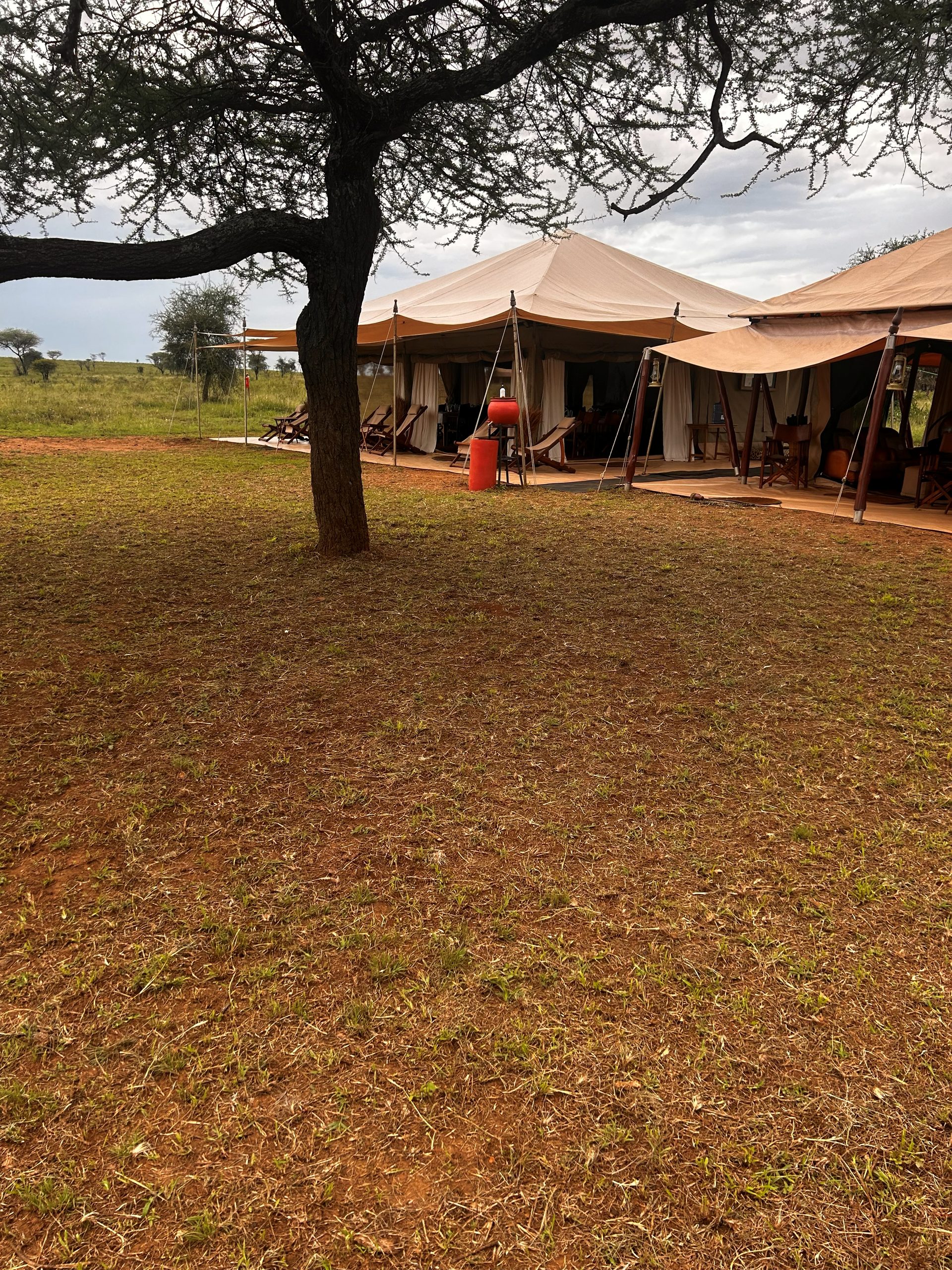
The Nyumba dining tent — open to the plain on all sides, deck chairs lined up, the Serengeti right there beyond the canvas edge
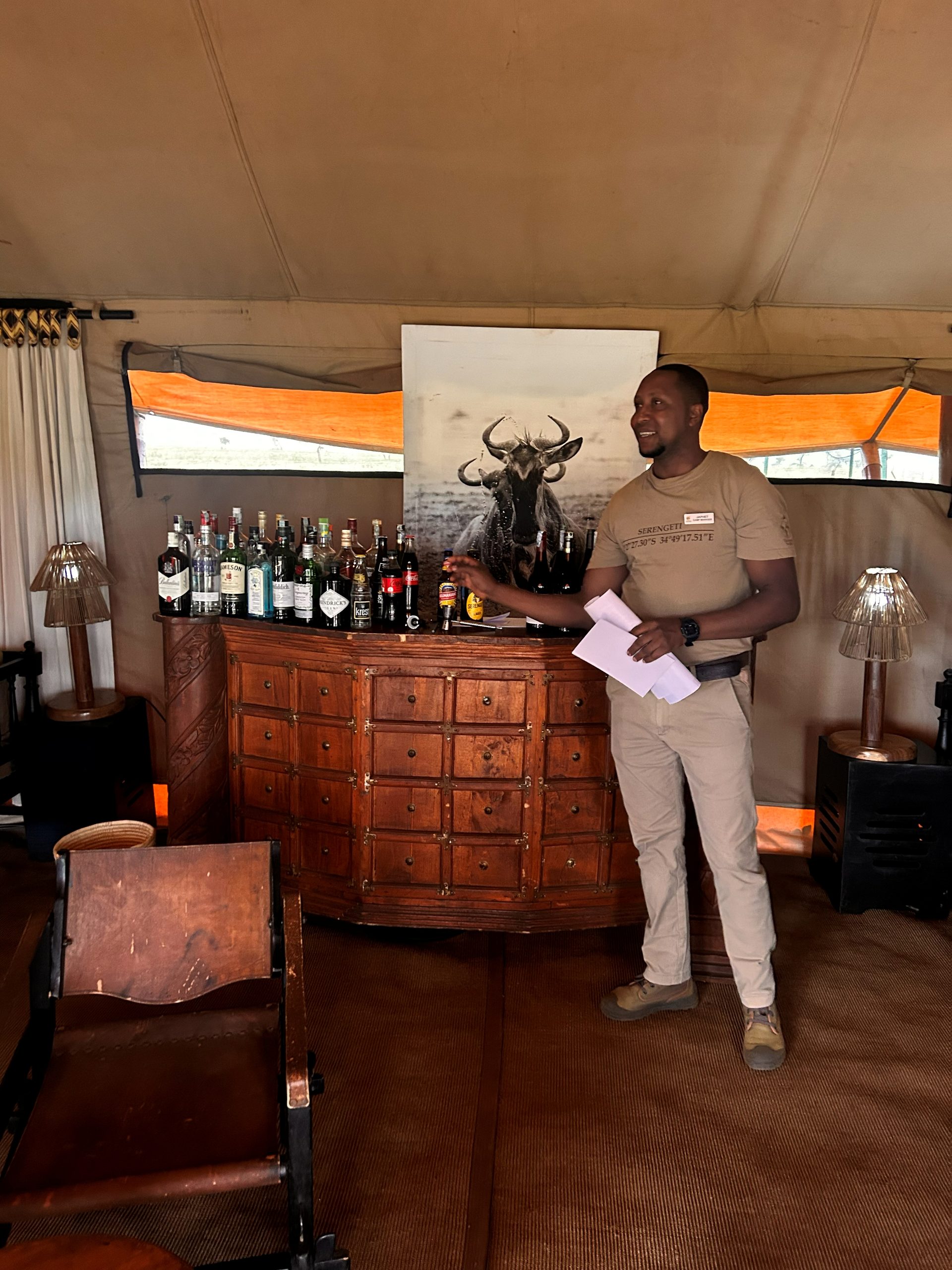
The Nyumba camp bar — unexpectedly well-stocked, and very welcome after a day in the field
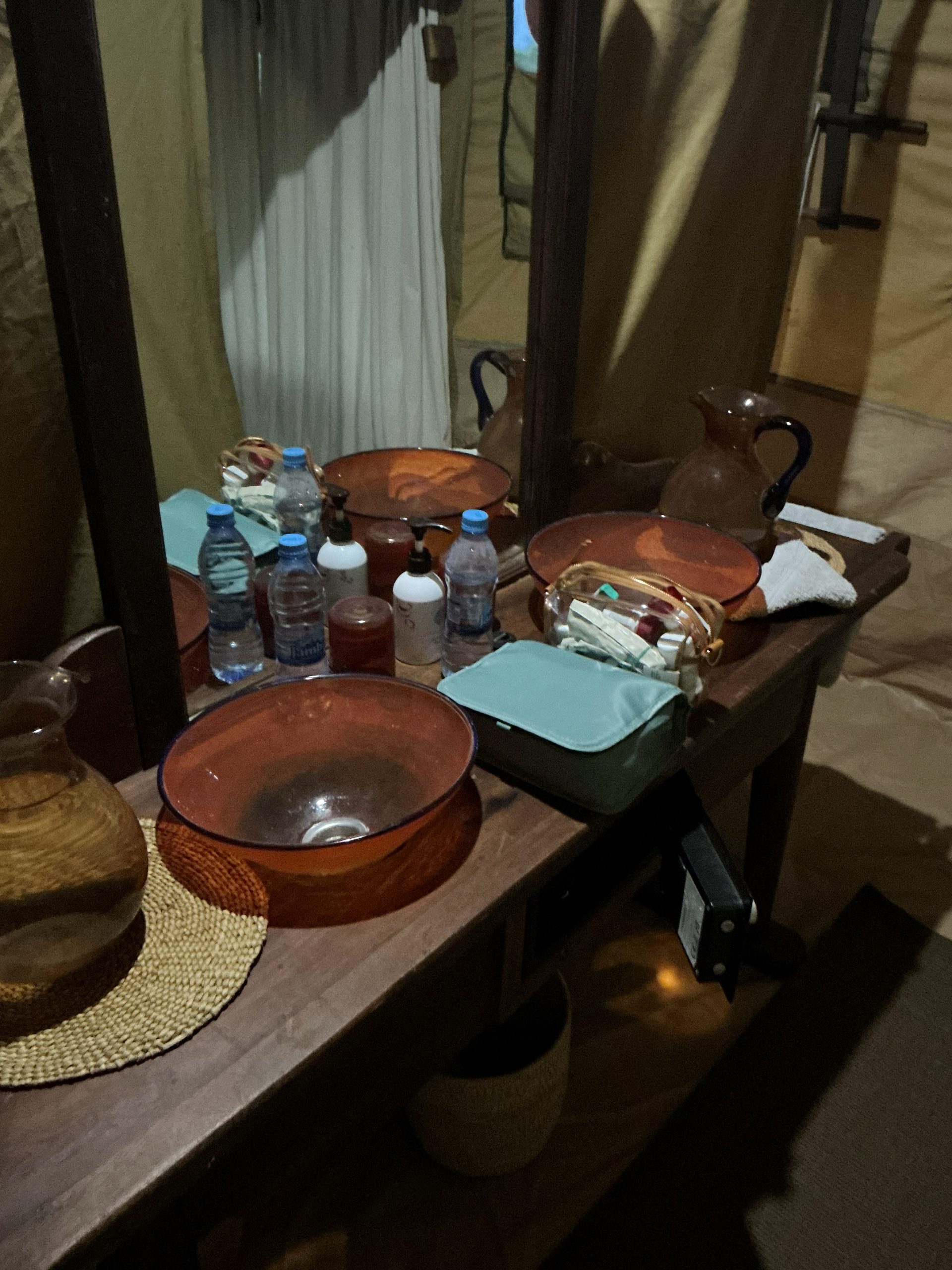
The washbasin — terracotta bowls and a glass pitcher. Rustic perfection.
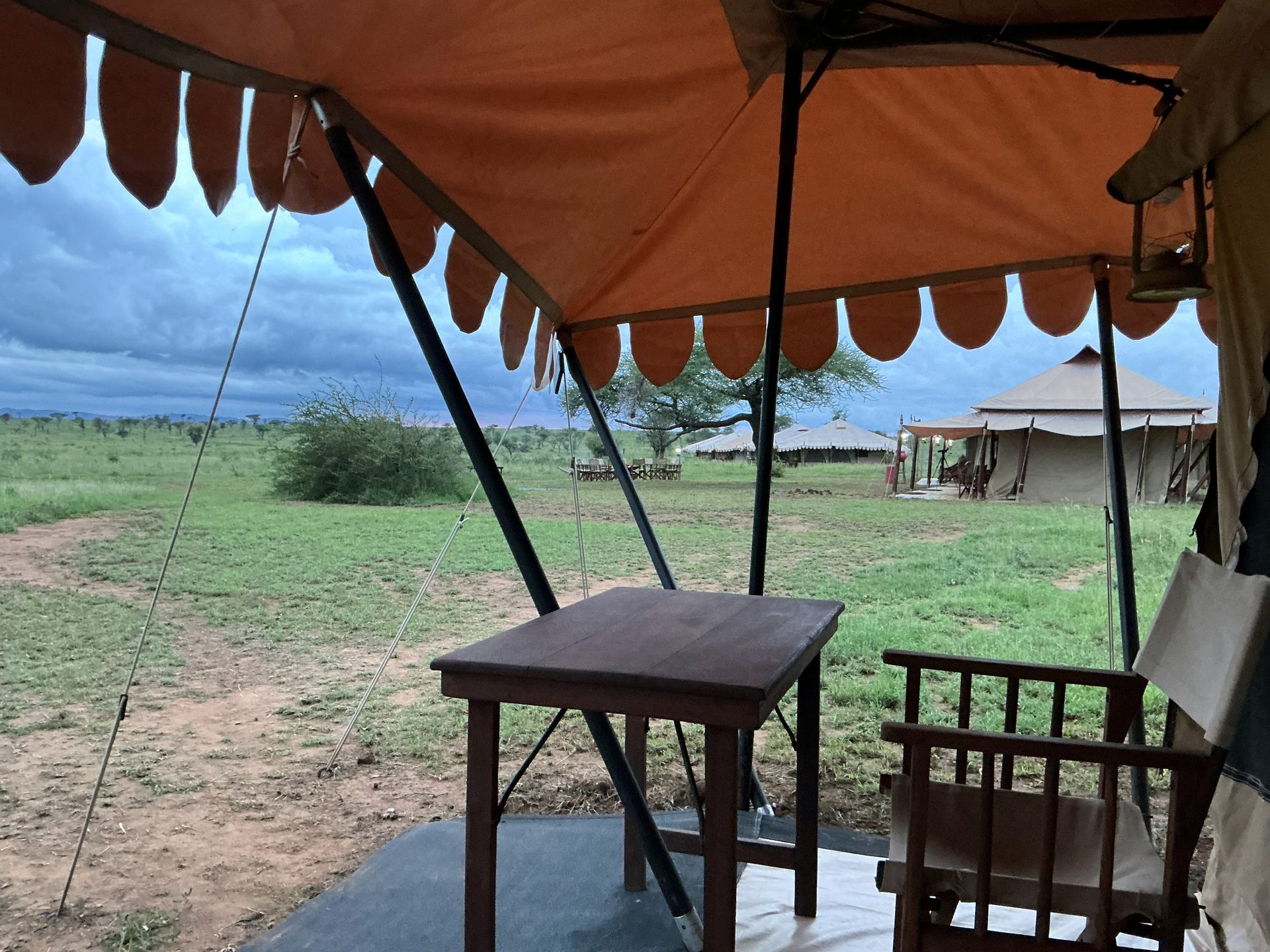
The view from the tent porch — the Serengeti stretching to the horizon under building storm clouds
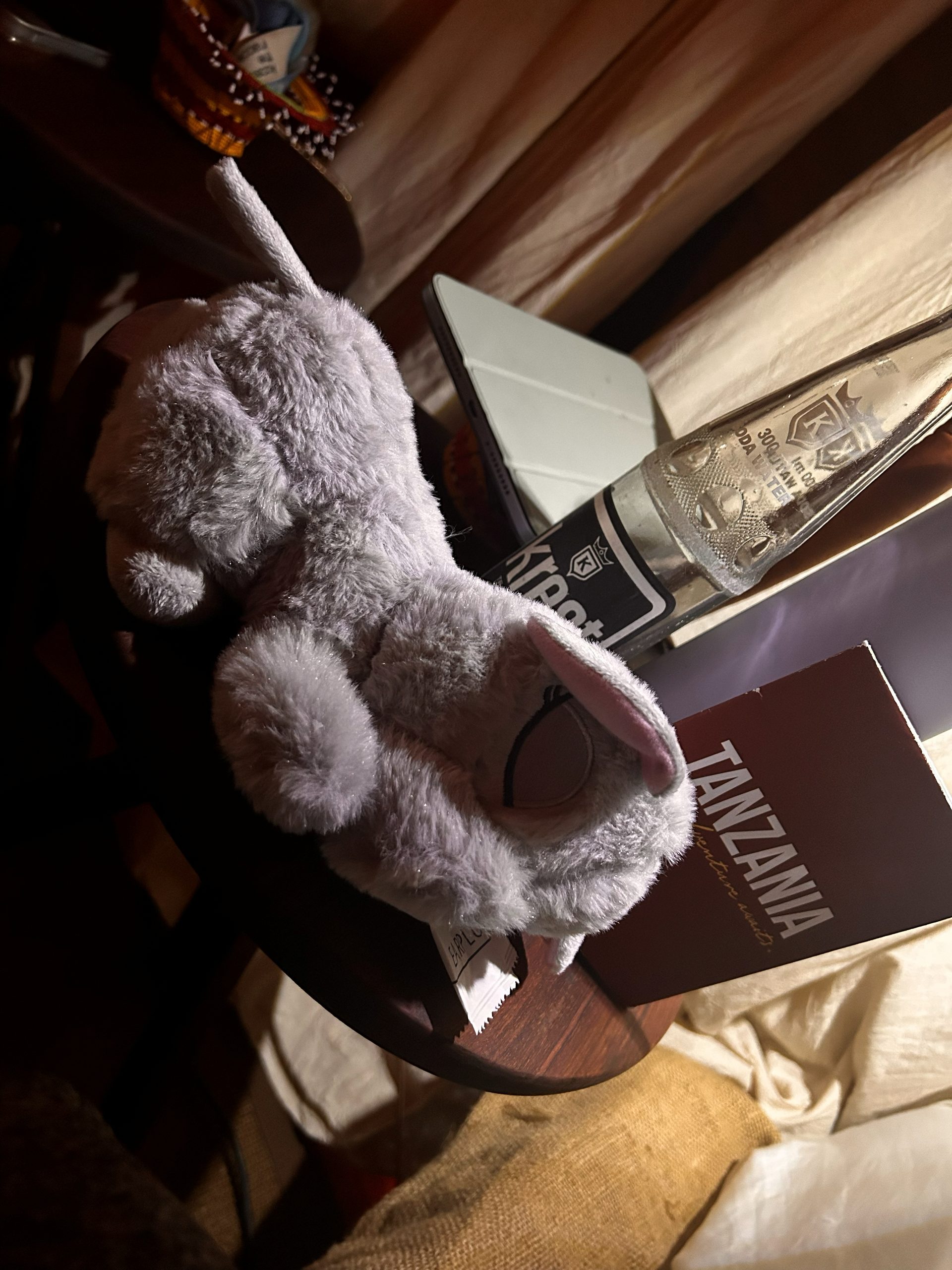
Tent mascot — a small stuffed elephant on the bedside table, the Tanzania guidebook beside it, the Krest soda water emptied. Every tent had its own small world inside.
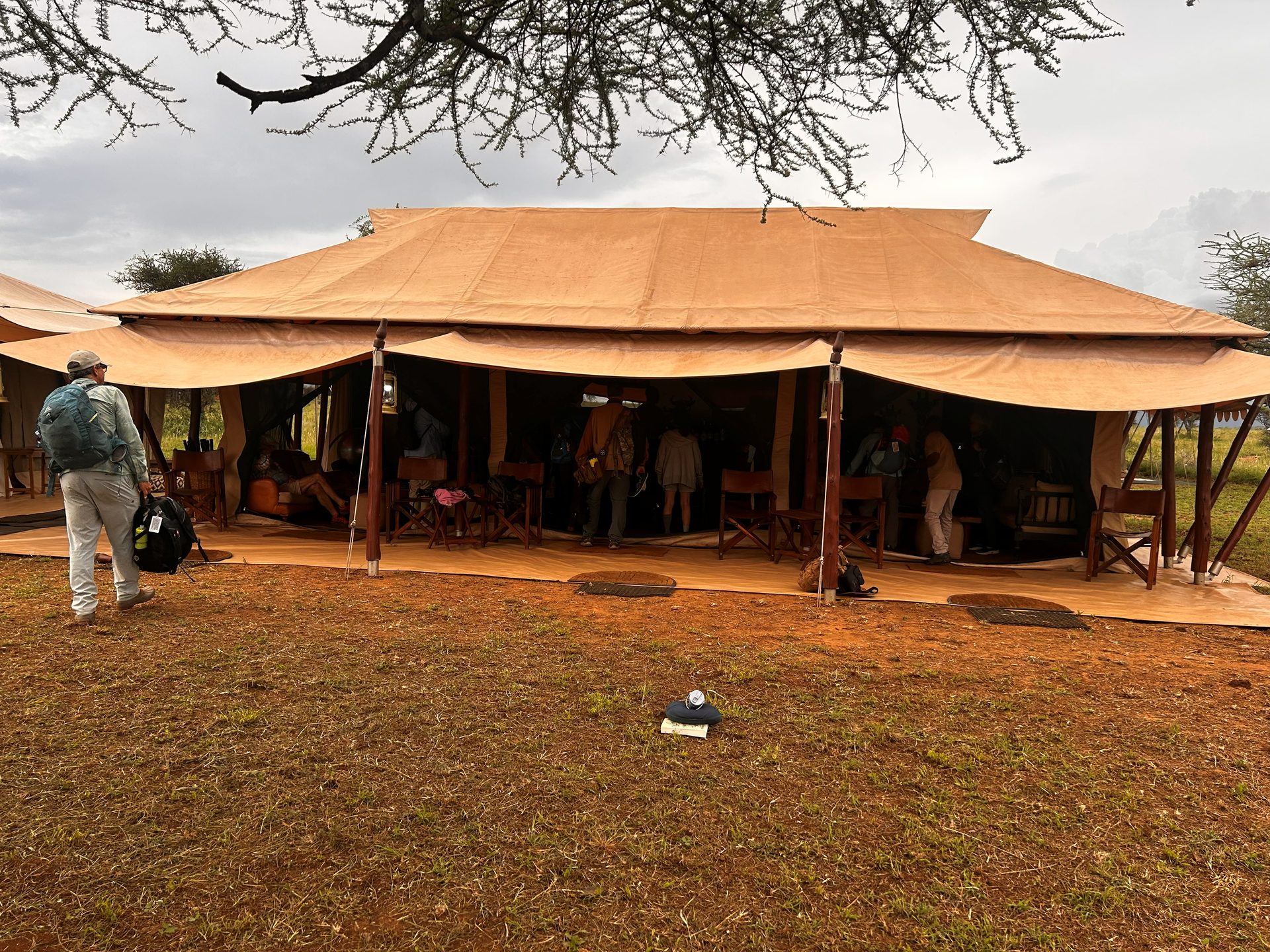
The social tent — where stories were swapped and everyone fell asleep before 9pm
The social tent — where stories were swapped and everyone fell asleep before 9pm
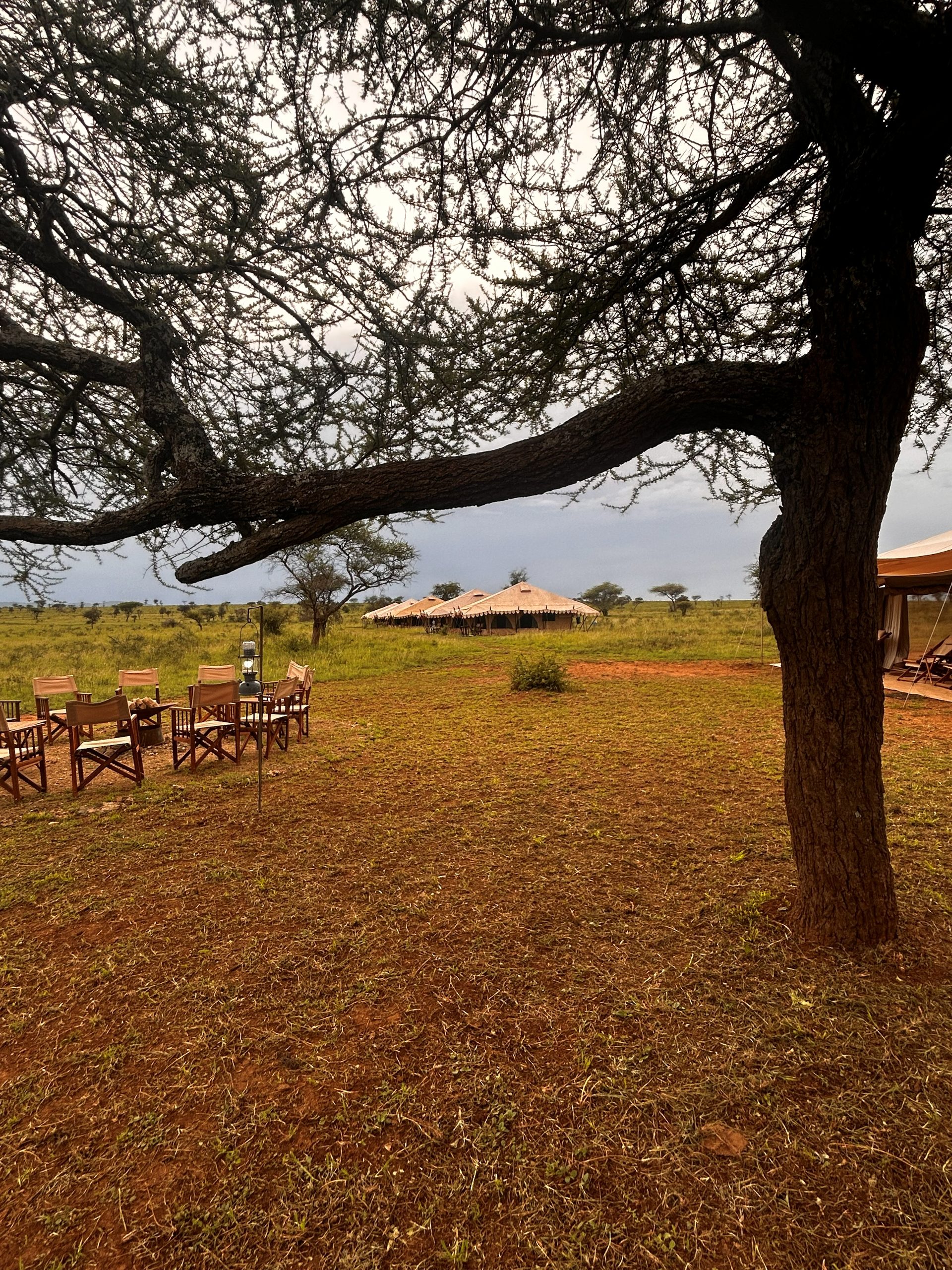
The Nyumba camp circle — director's chairs around a lantern, the thatched dining tent beyond, and the Serengeti in every direction
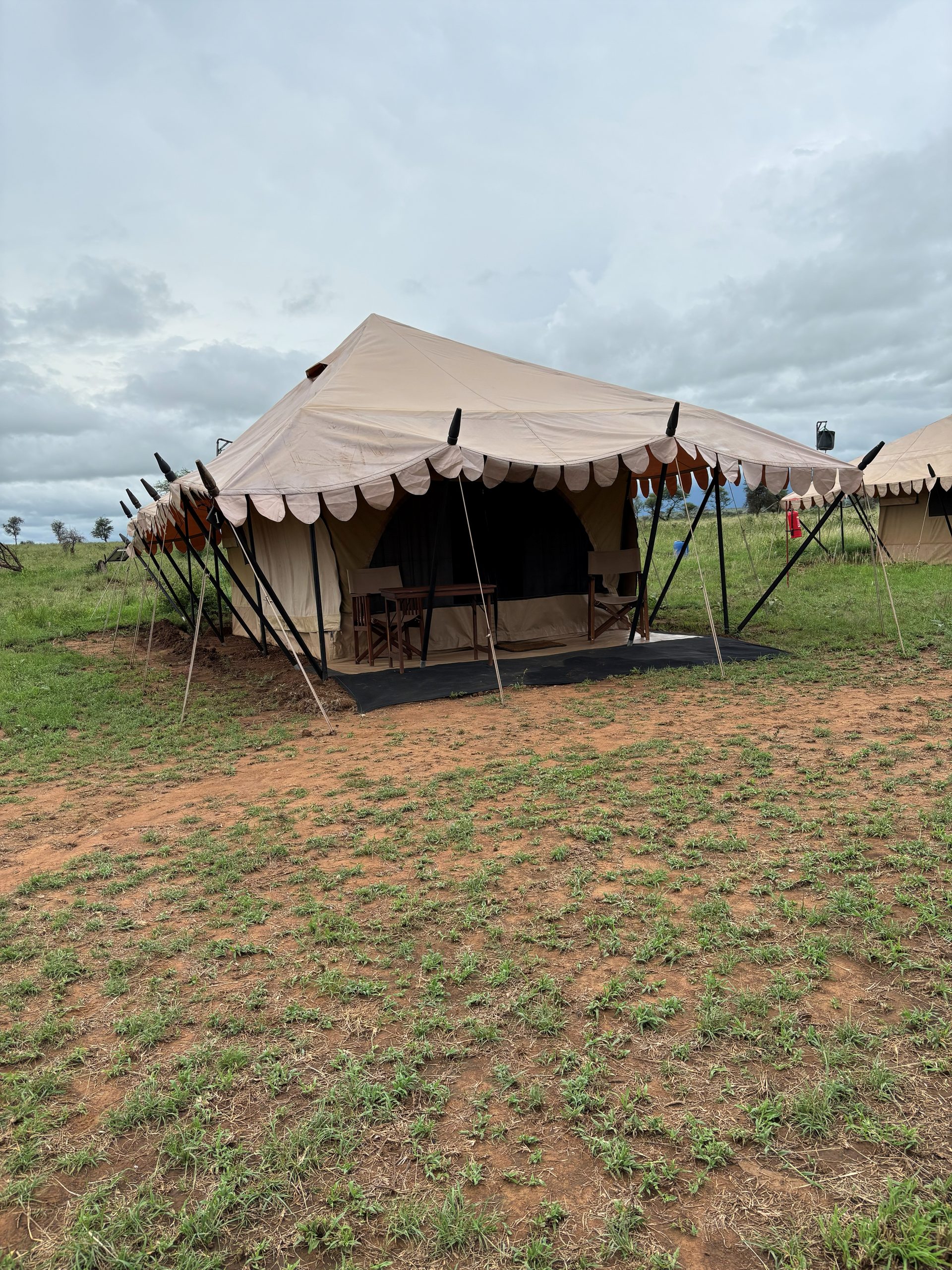
Home for four nights — the Nyumba tent standing alone on the plain, director's chairs on the porch, nothing between you and the Serengeti
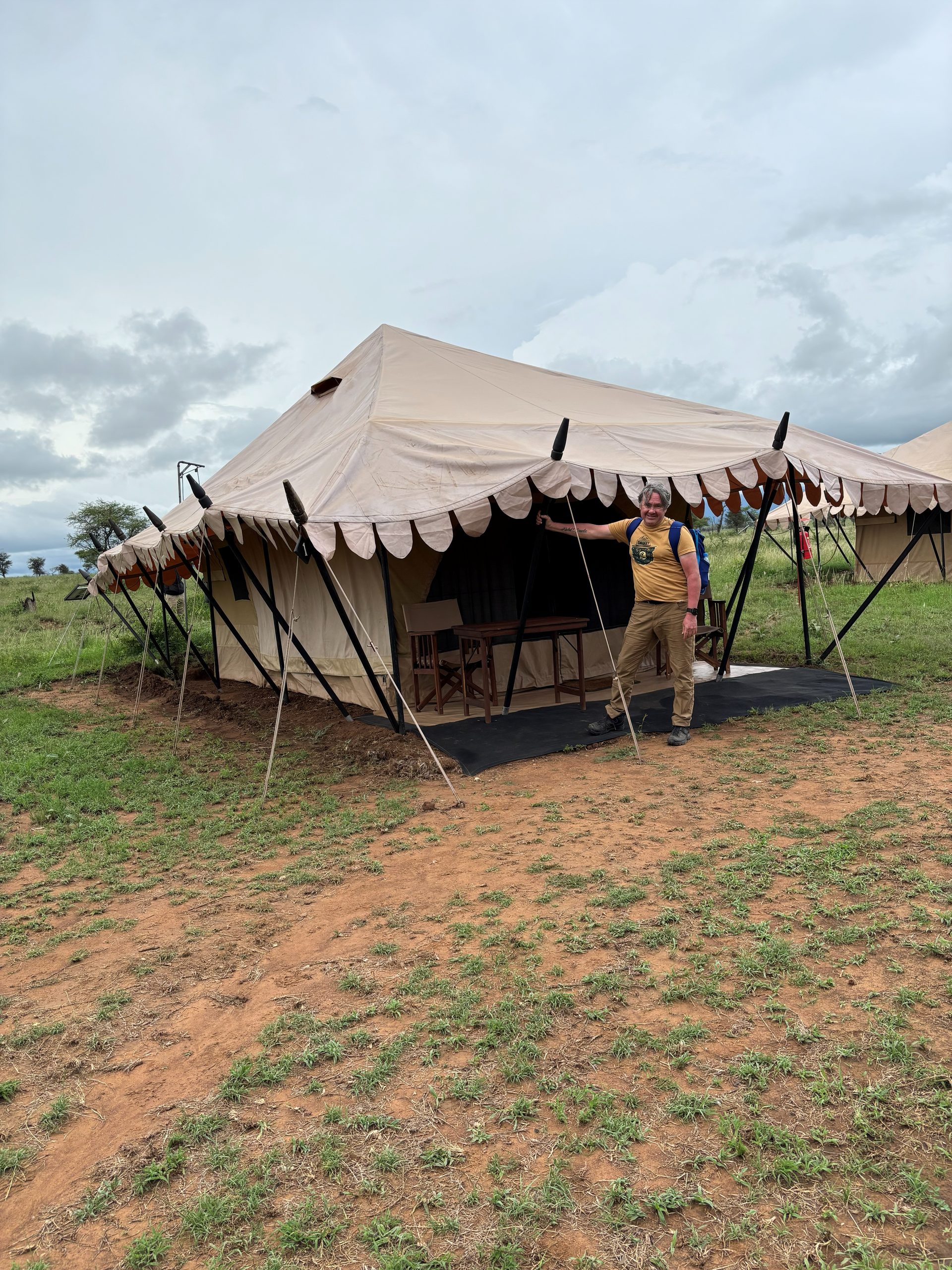
This one's mine — the porch, the plain, the clouds rolling in. A very good place to sleep.
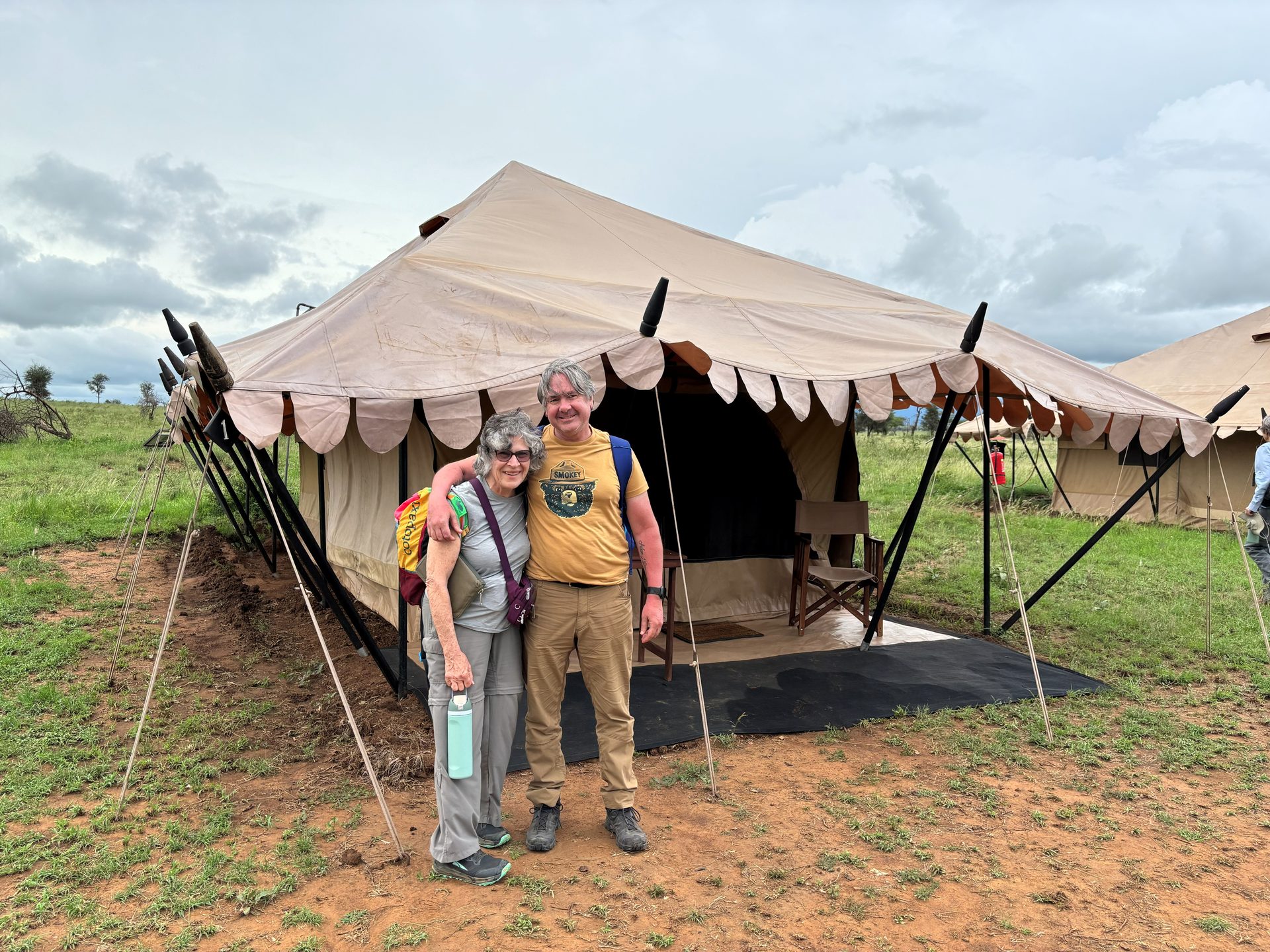
Happy campers — the scalloped canvas, the Serengeti sky, and two people who have just realized this kind of travel suits them very well
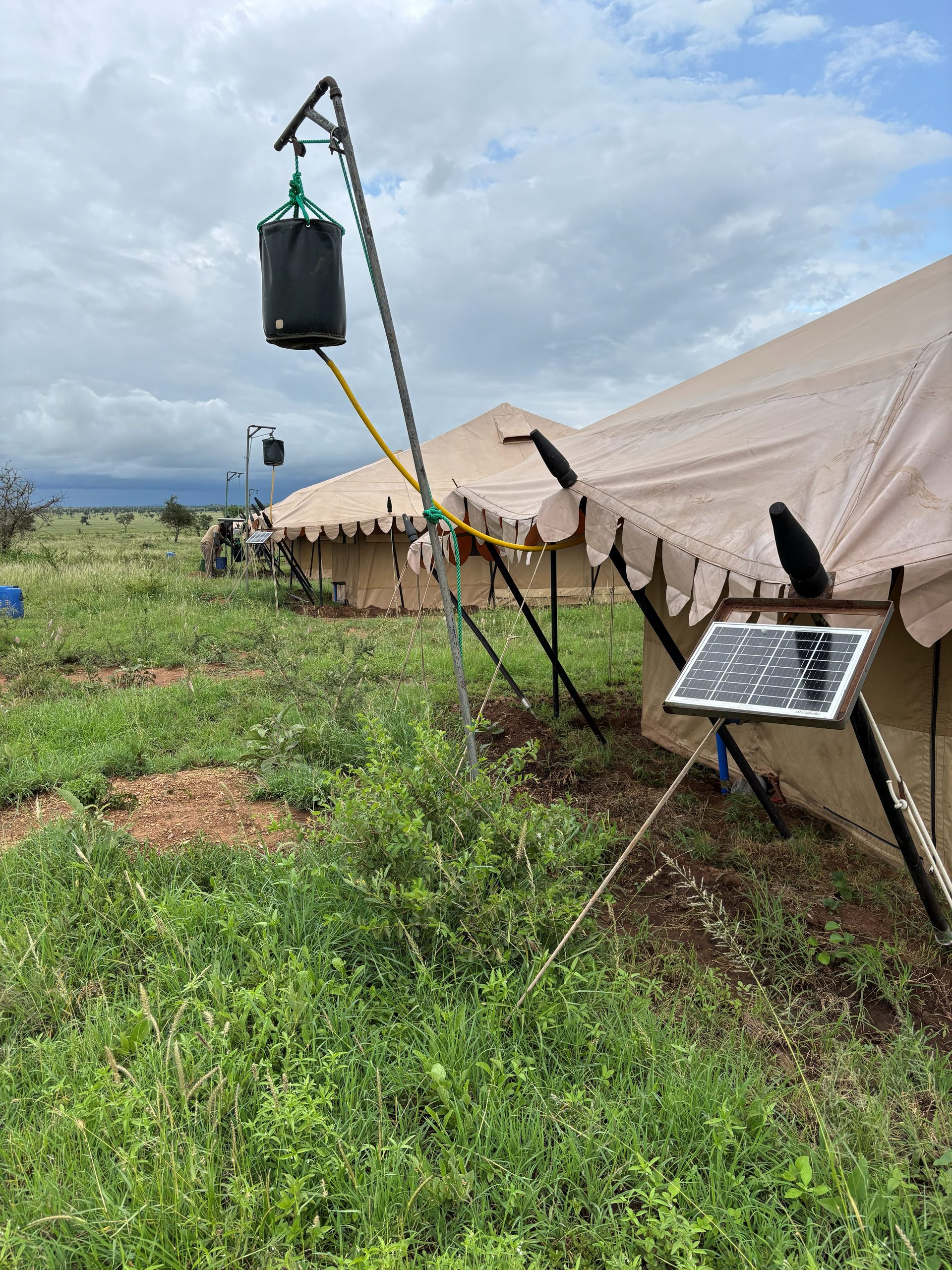
The bucket shower and solar panel — low-impact, elegantly practical, and genuinely satisfying. A hot rinse under a canvas bucket on the Serengeti plain after a long game drive is something to remember.
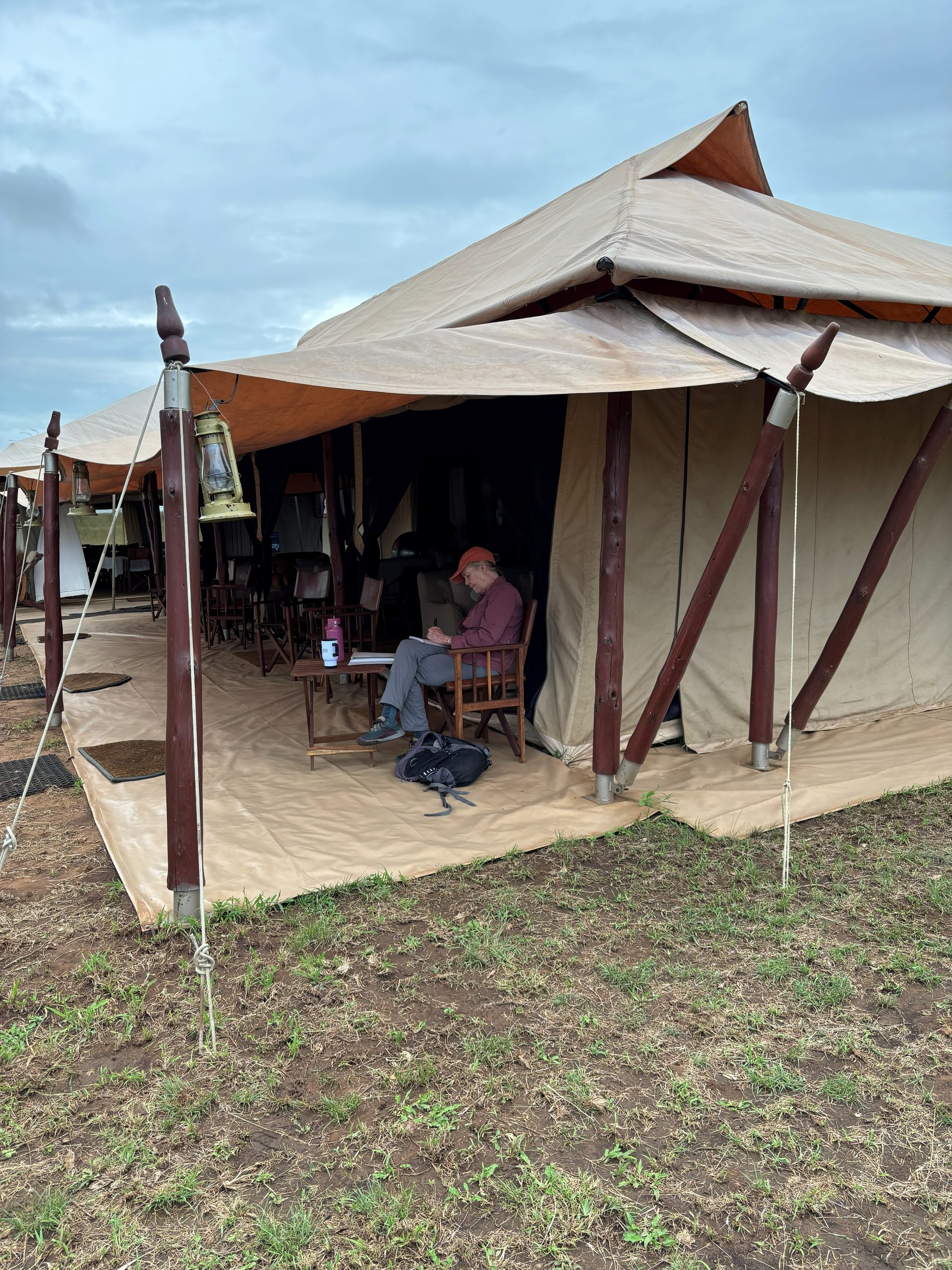
Writing it down — someone doing the right thing and getting it onto paper before the details blur. The dining tent, an old lantern, and the Serengeti just outside.
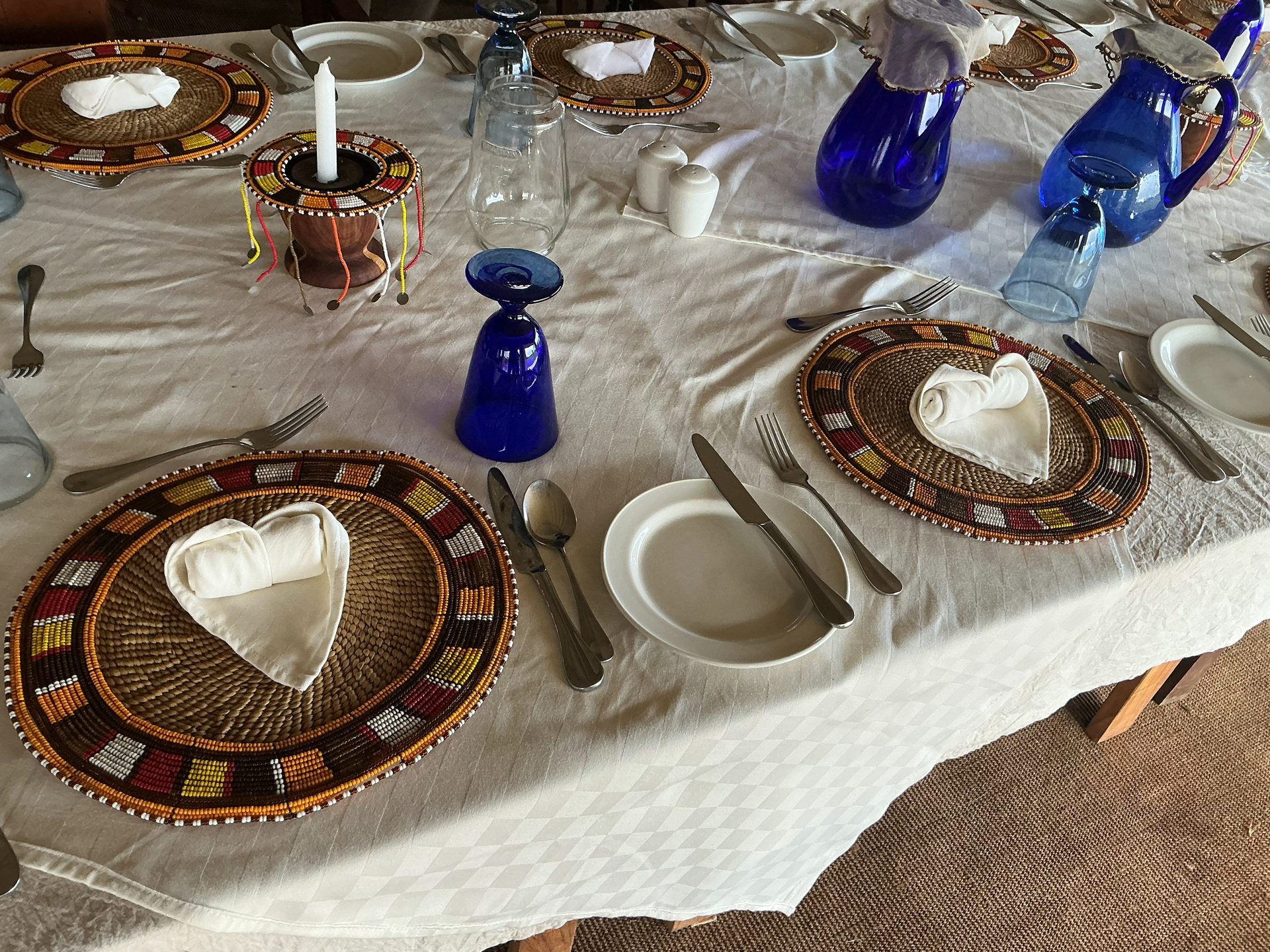
Dinner set — Maasai-beaded placemats, cobalt pitchers, napkins folded into hearts. Every night the camp team made the table beautiful, in the middle of the Serengeti, for sixteen people who had just spent the day watching lions.
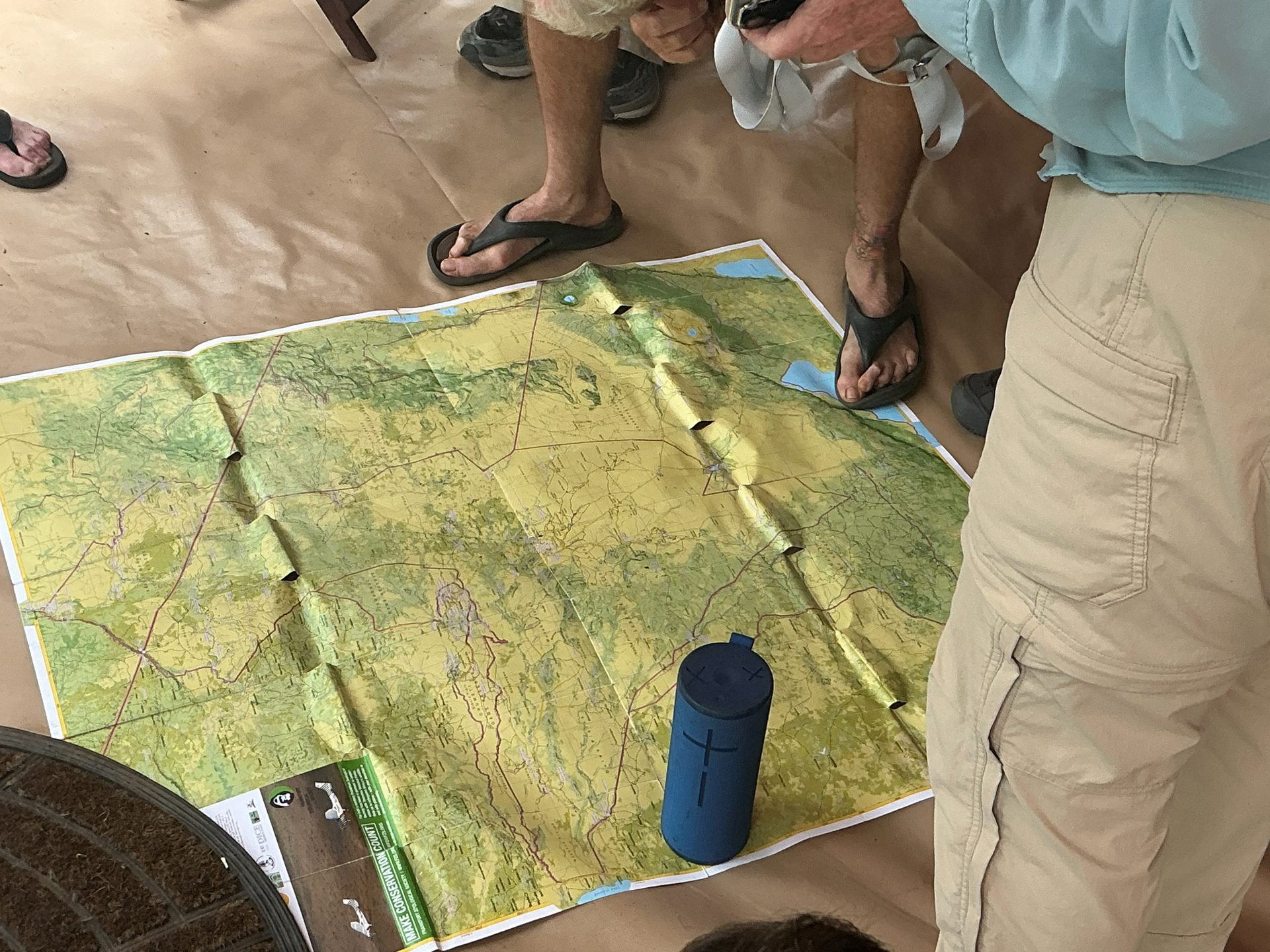
The evening briefing — the guide's topographic map spread across the dining tent floor, the whole group gathered around it, tomorrow's route being traced with a weathered finger
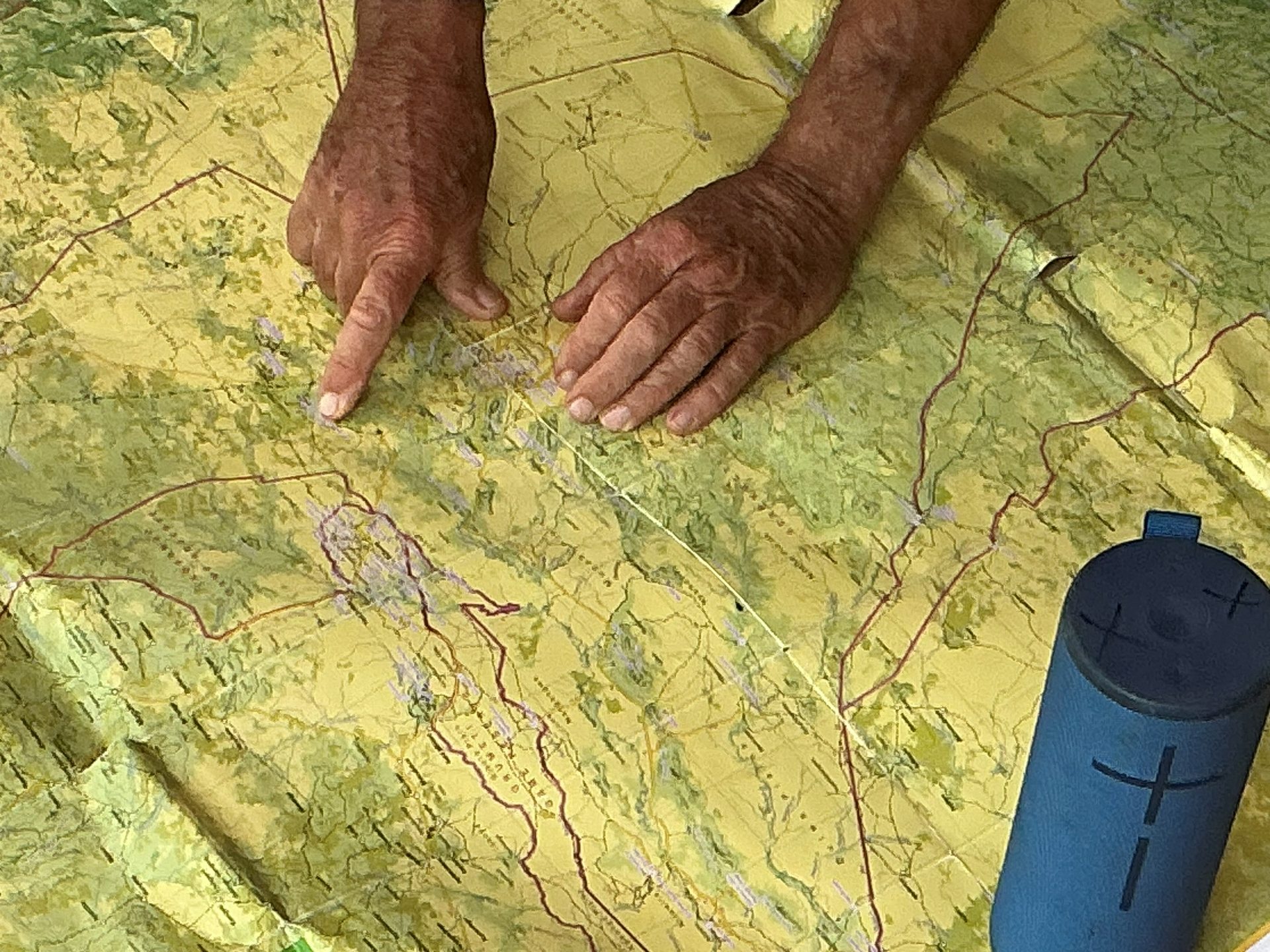
Here — the finger lands on a point on the map, and a name is given to the place you drove through today, the place you'll drive to tomorrow. The Serengeti stops being abstract.
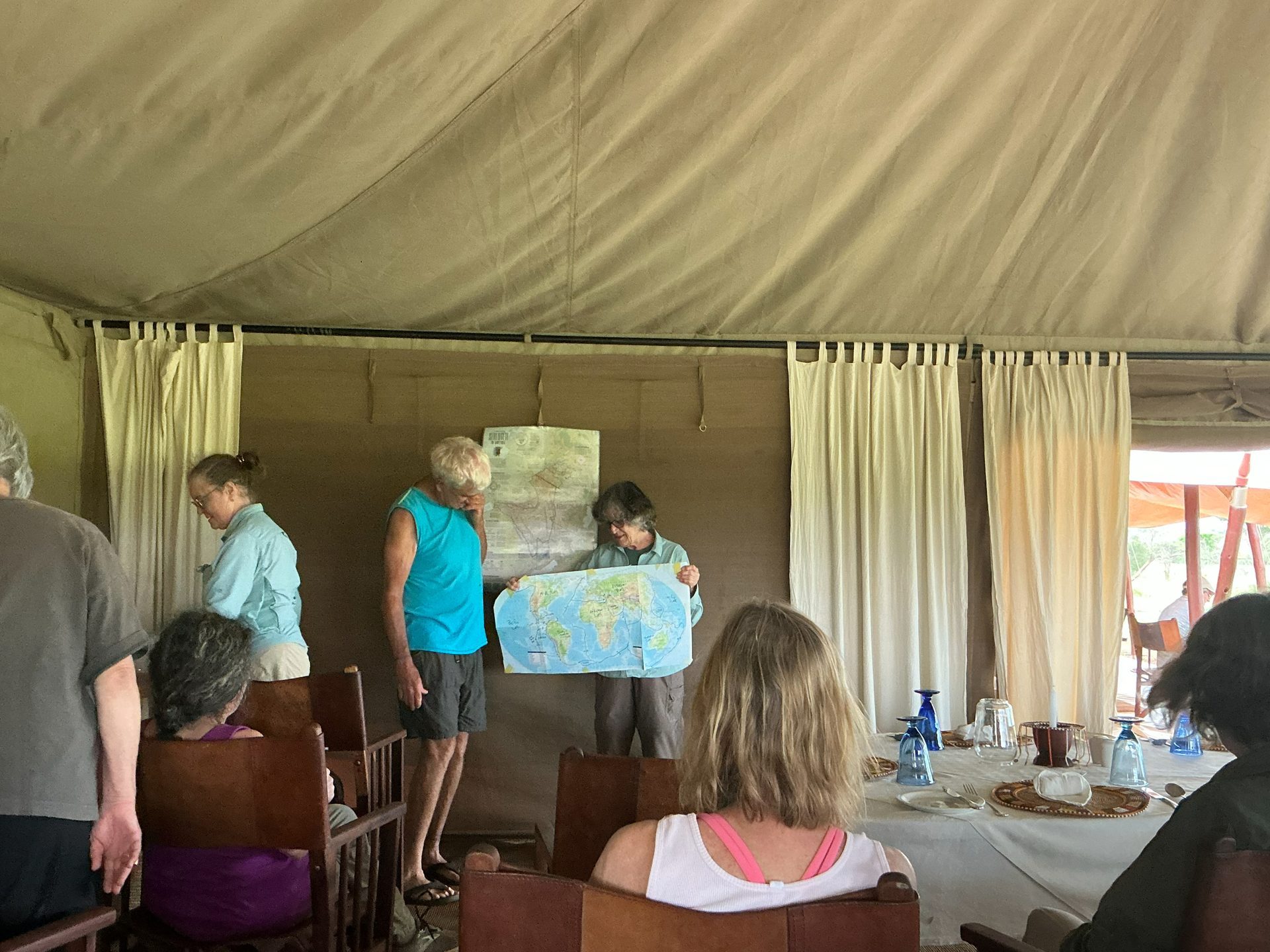
An evening presentation in the dining tent — someone has produced a world map to put Tanzania in context. The table is set, the blue glassware is ready, and nobody wants the evening to end.
The Nyumba camp runs on logistics that are invisible until you look for them. The delivery truck — a heavy-duty canvas-topped lorry — arrives ahead of the group at each new site, carrying the tents, the cooking equipment, the water, and everything required to build a functioning bush camp in a matter of hours. Two black polytanks on a steel scaffold provide pressurized water. The kitchen operates on a wood-fired iron oven and a charcoal brazier that produces three meals a day for many travellers and staff (17 travellers, 4 guides and numerous camp staff), in the open, with no main power. Dishes are washed in three tubs of water — wash, rinse, rinse again — all of it sourced and managed on a rolling basis. It is an extraordinary operation, and it runs with quiet efficiency every single day.
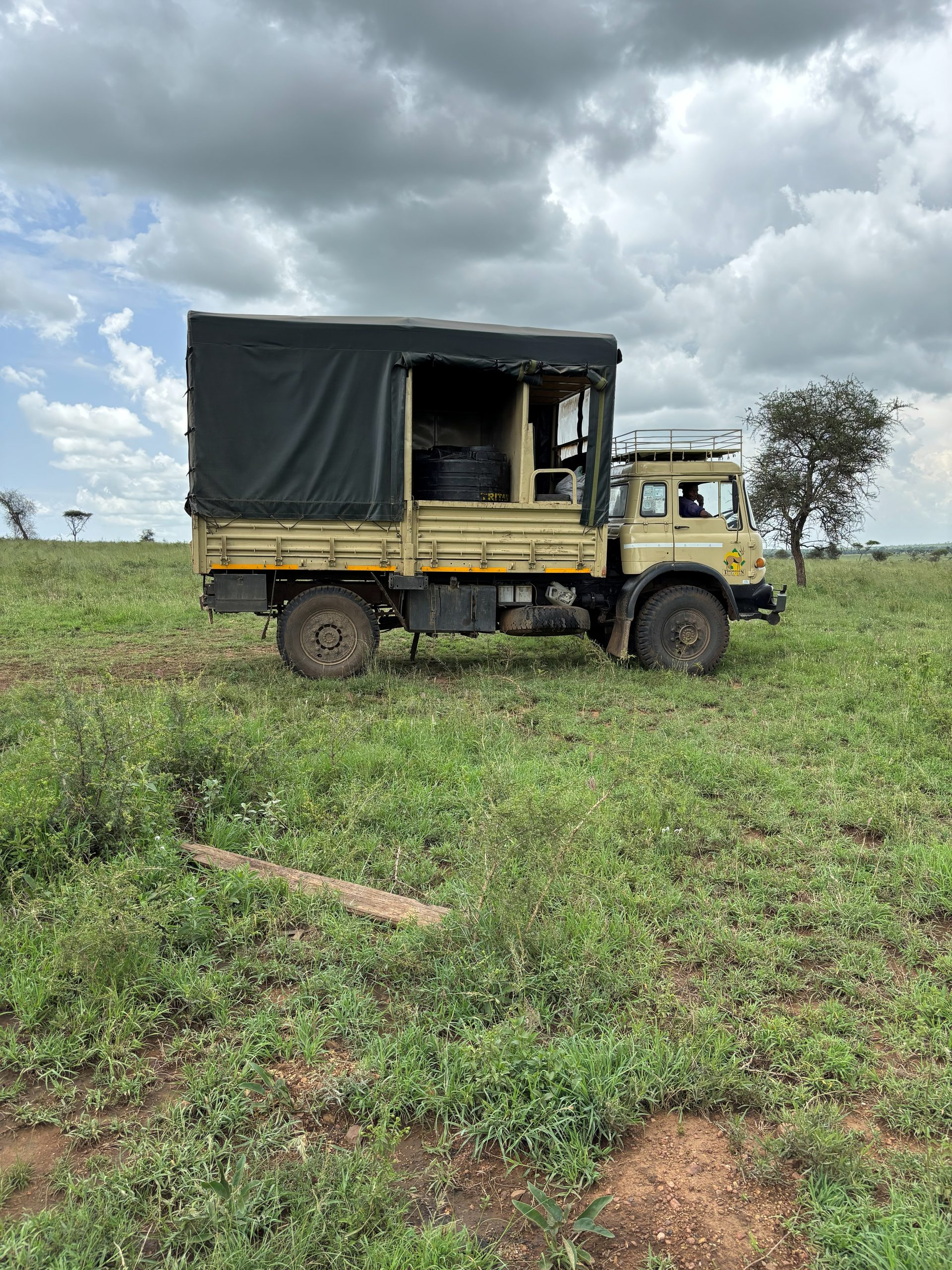
The supply truck — this lorry arrives first at every new camp site, carrying tents, kitchen equipment, water tanks, and everything else needed to build a bush camp from nothing
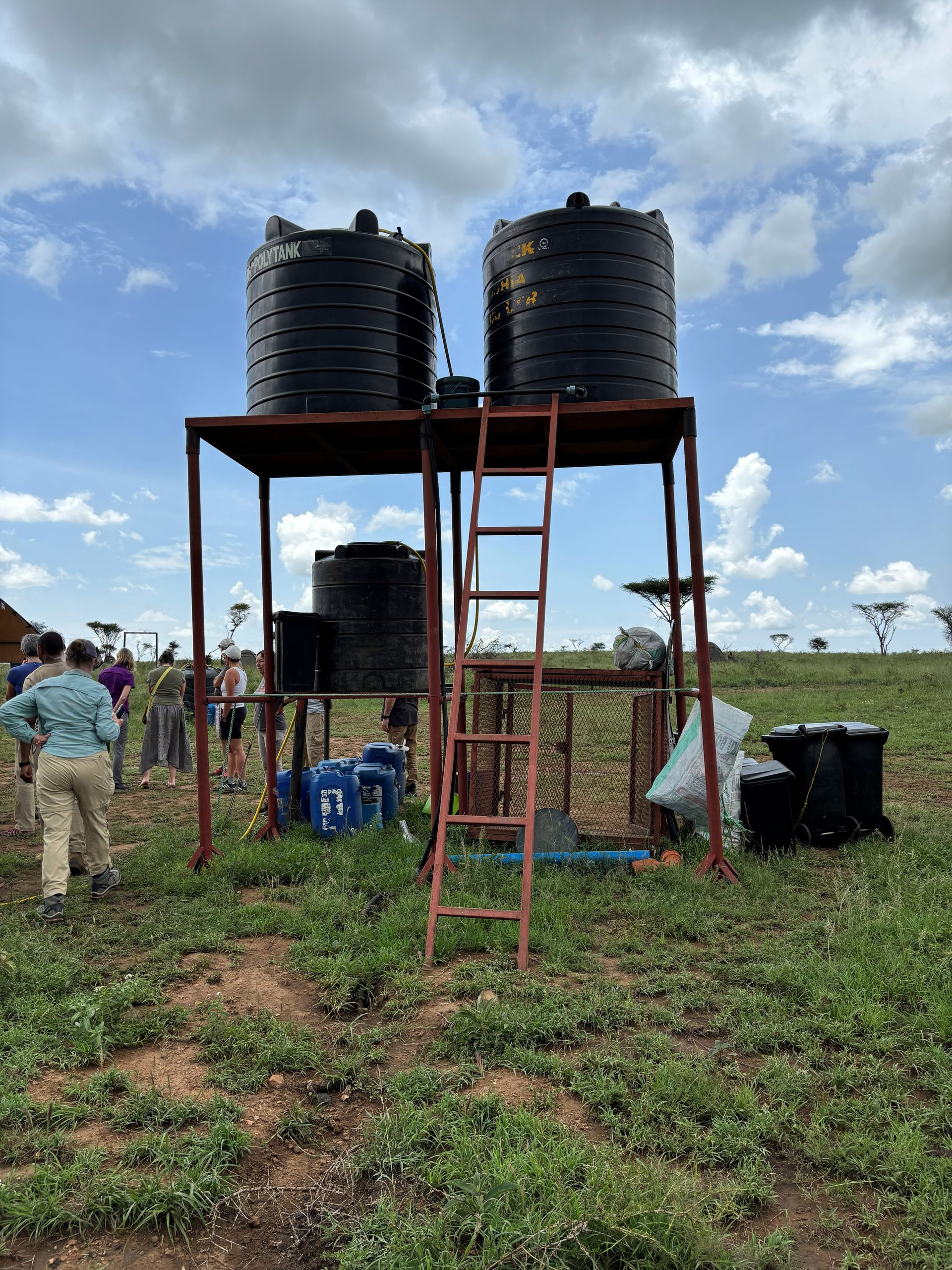
The water towers — two polytanks on a scaffold, gravity-fed to the bucket showers and washing stations. The group gets a tour on arrival. This is how water works in the Serengeti.
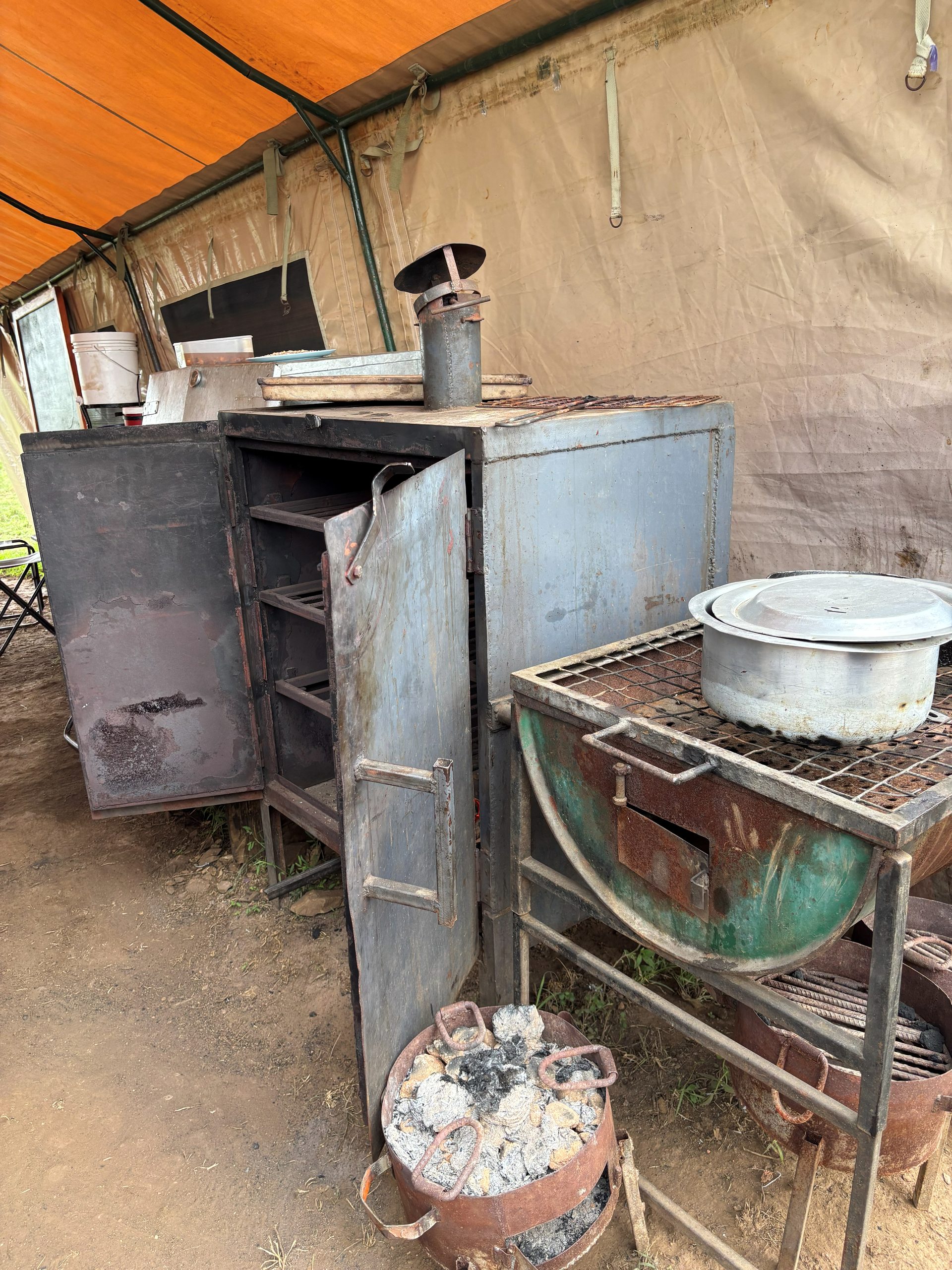
The camp kitchen — a wood-fired iron oven and charcoal brazier. Three meals a day for 16 travelers, 5 guides and camp staff, cooked here, in a tent, on the Serengeti. The food was genuinely excellent.
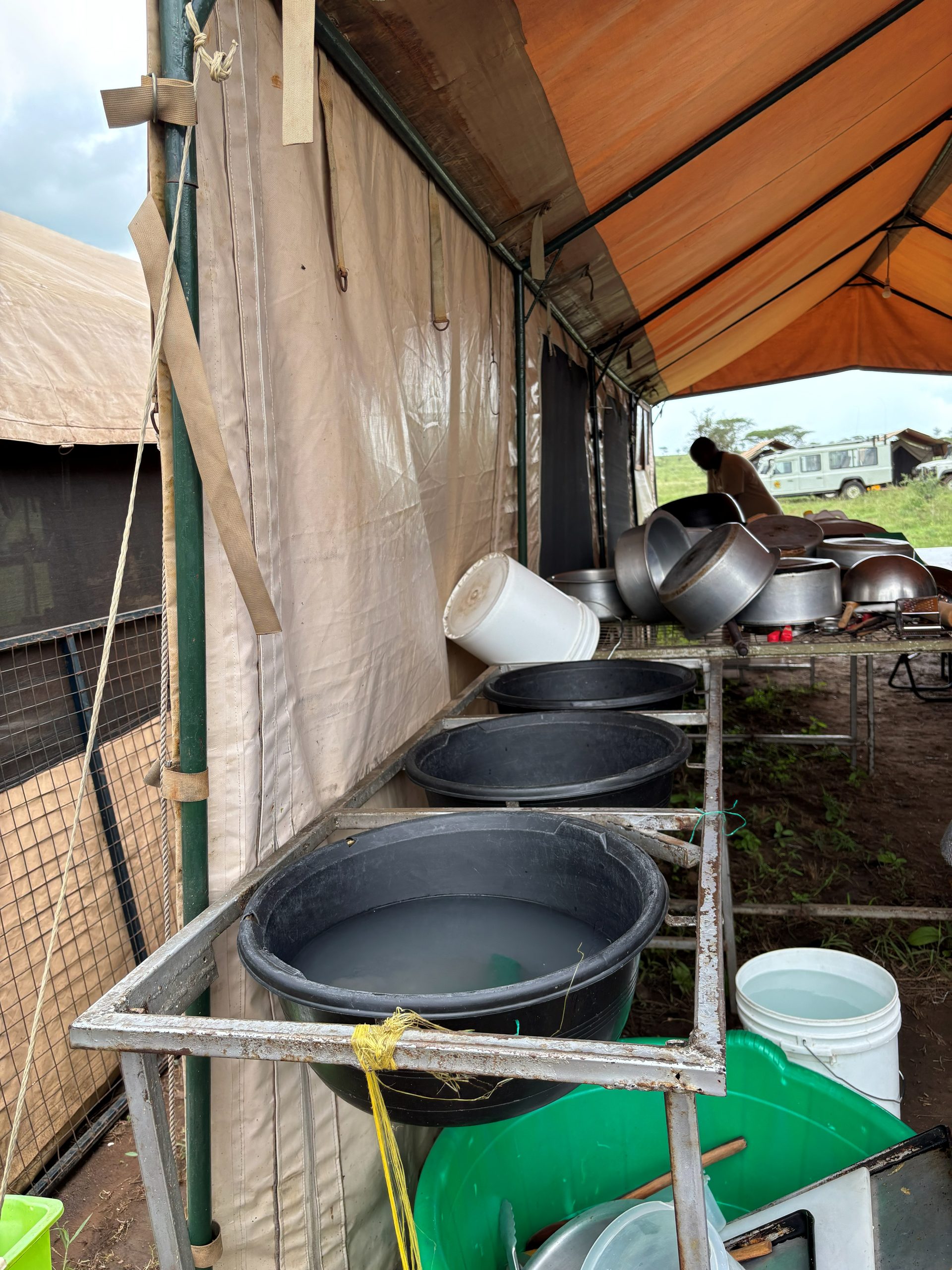
The dishwashing station — three tubs, three stages, zero electricity. The camp staff had every pot and plate clean and put away before you finished your coffee.
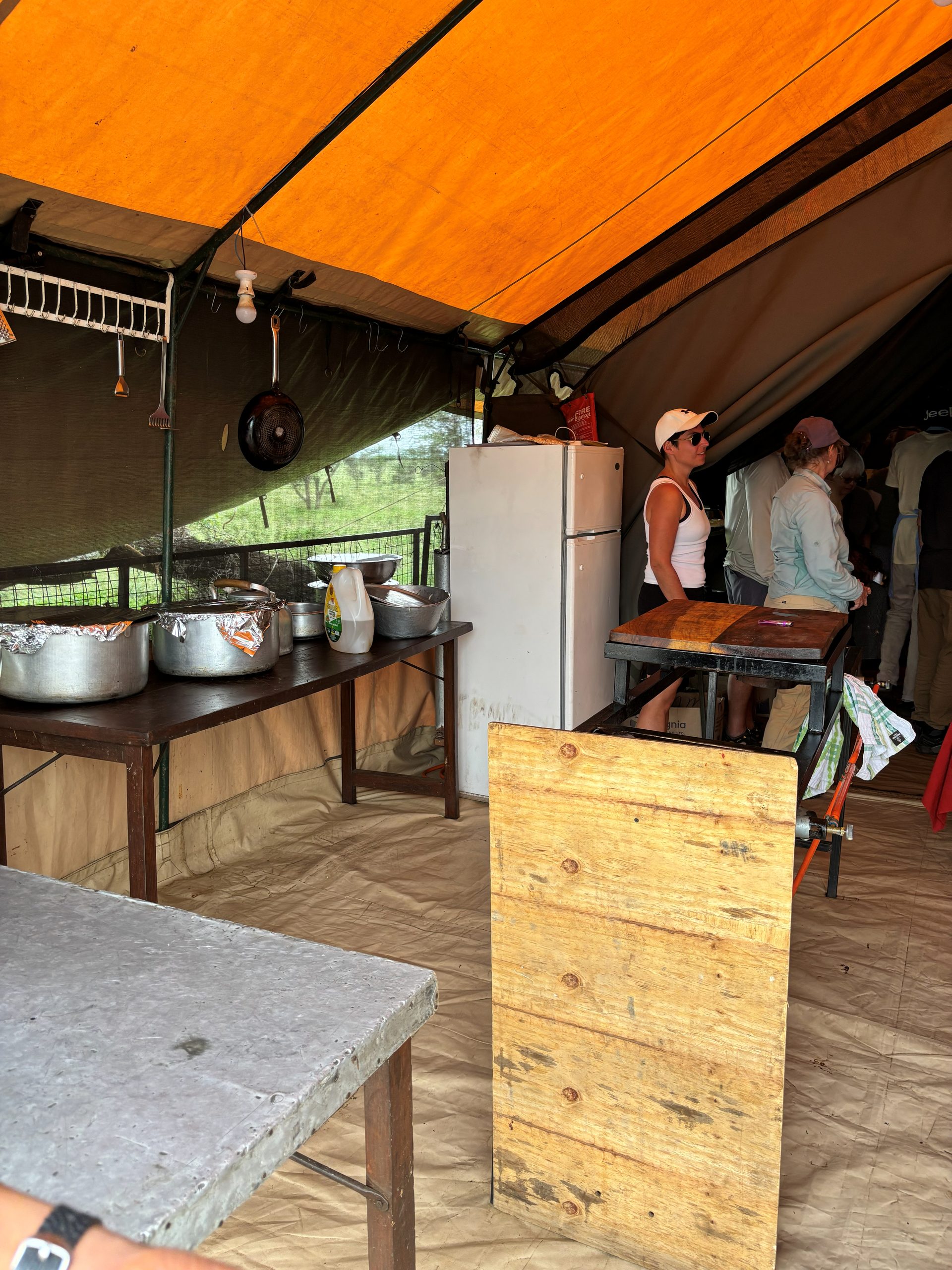
Inside the kitchen tent — a portable fridge, hanging utensils, and a cook who turned out three full meals a day without complaint or fanfare
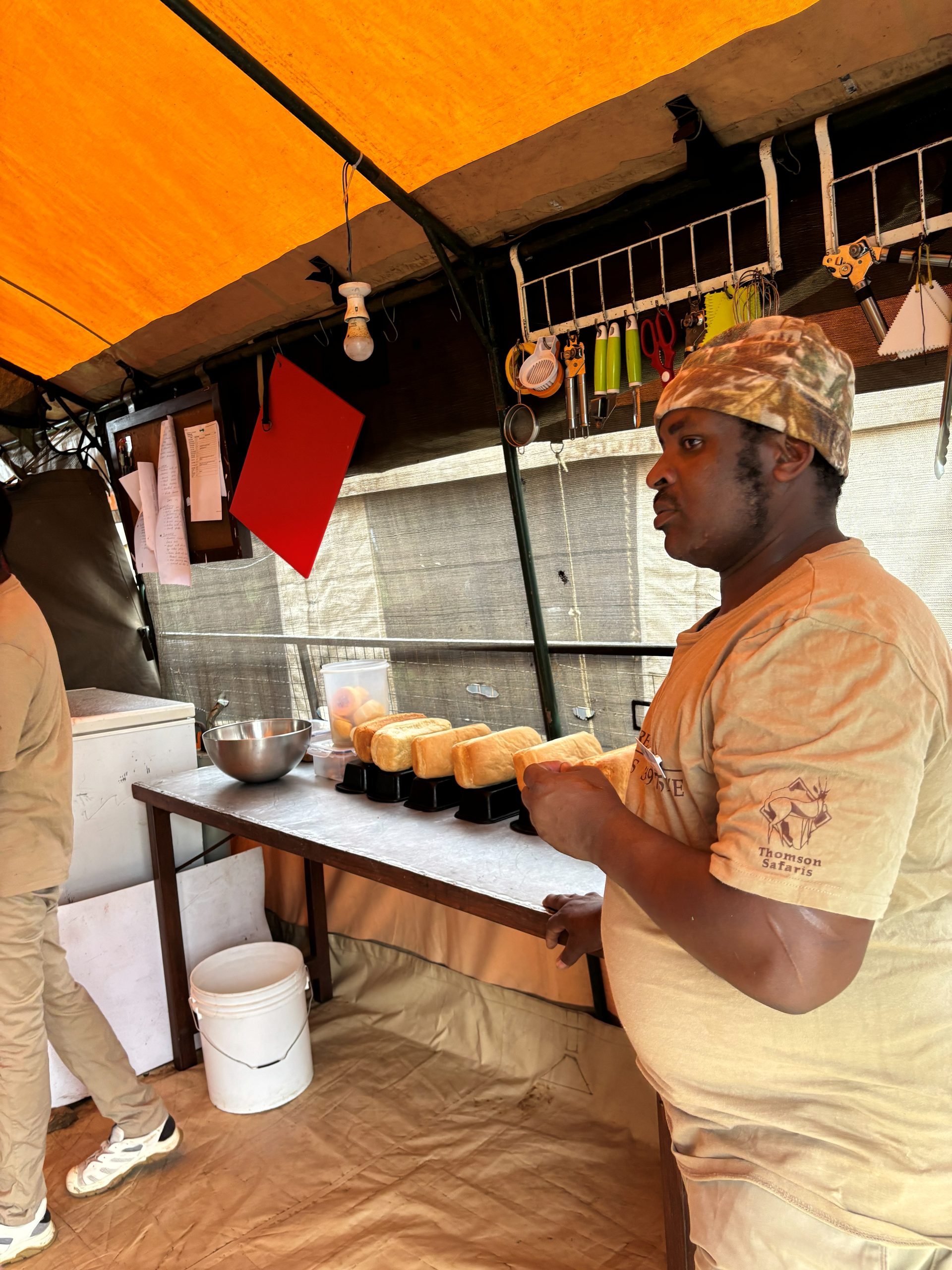
Fresh bread, baked in the bush — the camp baker lines up loaves for breakfast. In a tent. On the Serengeti. Every single morning.

The fruit shelf in the supply truck — pineapples, watermelons, oranges. Fresh fruit appeared at every meal. Nobody thought to ask how.

The vegetable store — courgettes, green bananas, carrots, onions. The camp carries a remarkable market's worth of produce across the Serengeti.
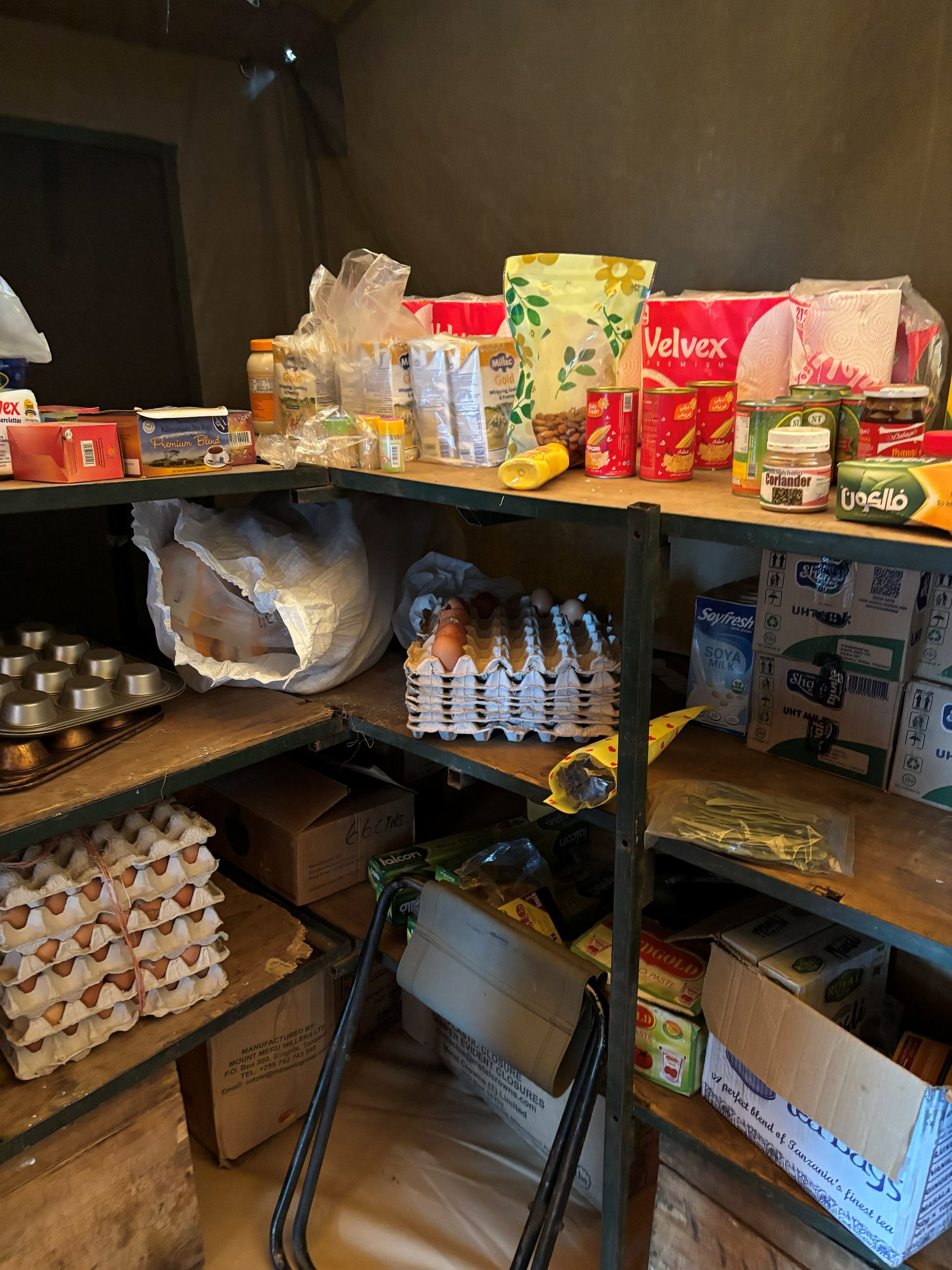
The camp pantry — stacked egg flats, Tanzania's finest tea, canned goods, spices. The supply chain for this mobile camp is its own quiet miracle.
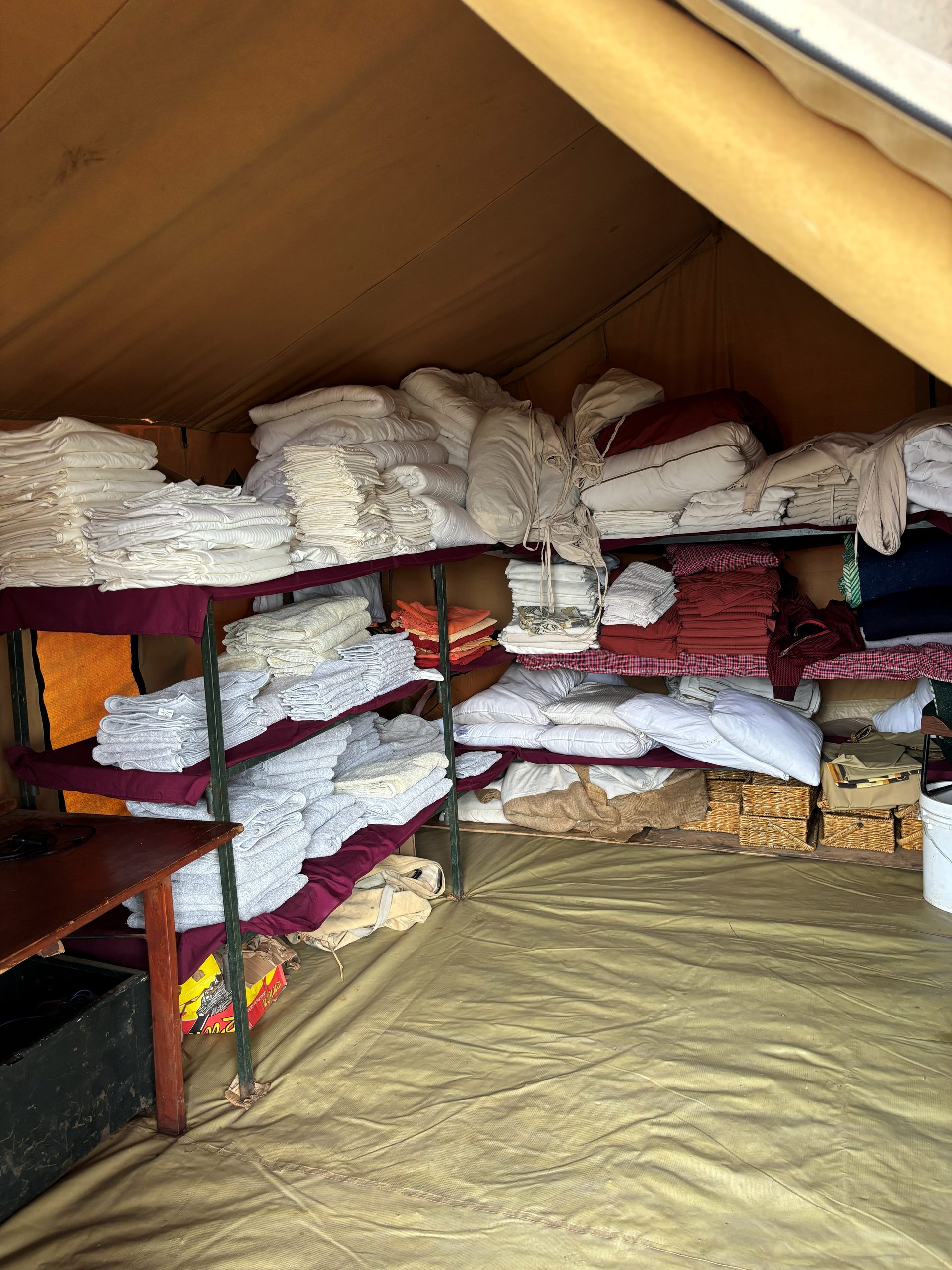
The linen tent — every sheet, pillowcase, towel, and blanket for eighteen beds, folded and stacked with military precision. It goes up and comes down with every camp move.
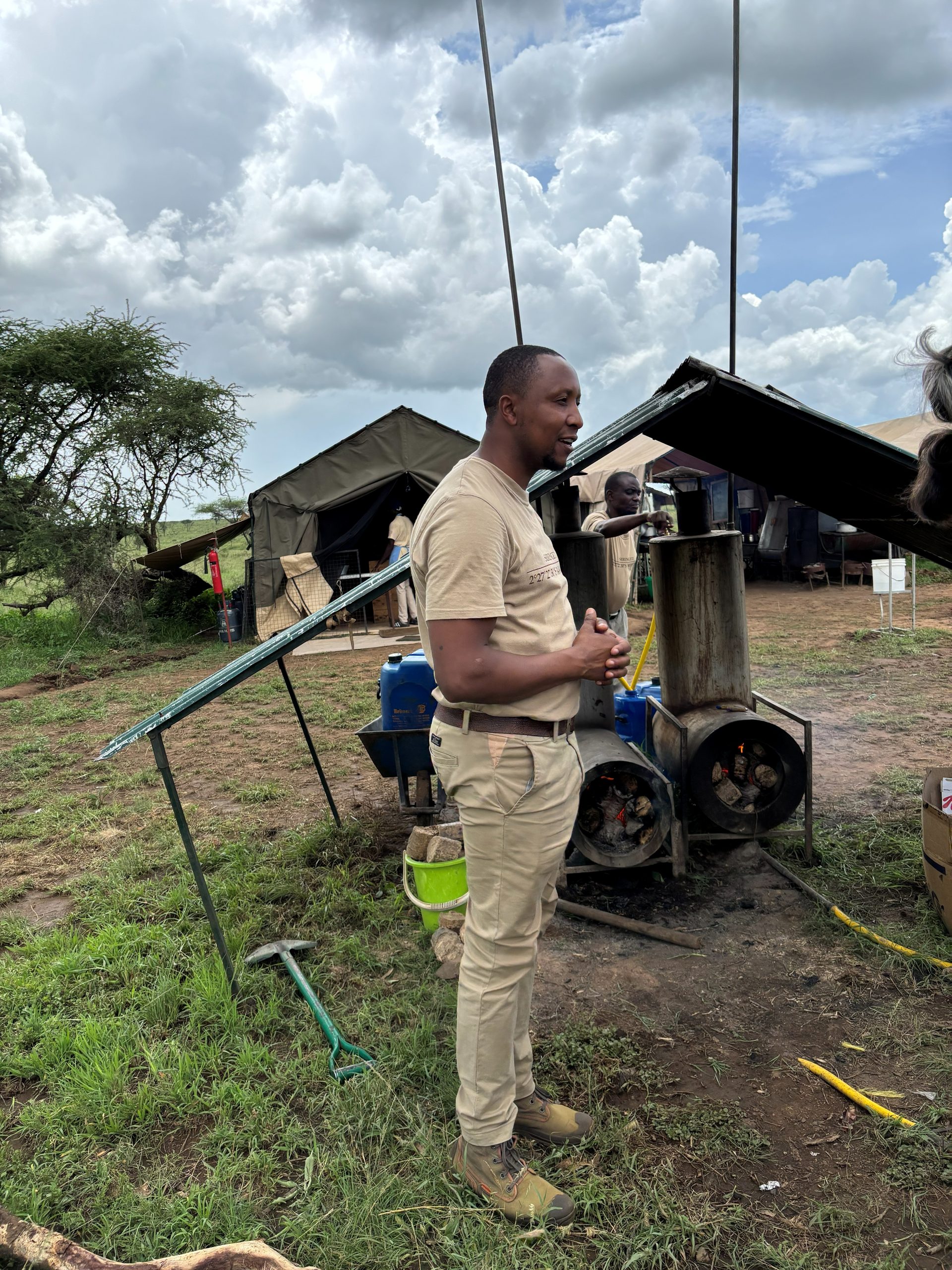
The water heating system — a wood-fired boiler feeds the hot water for bucket showers. The camp manager explains it on arrival. By the end of the trip you appreciate every detail.

Camp orientation — the group gathering near the water infrastructure on arrival, the sleeping tents visible behind, the storm clouds building over the plain
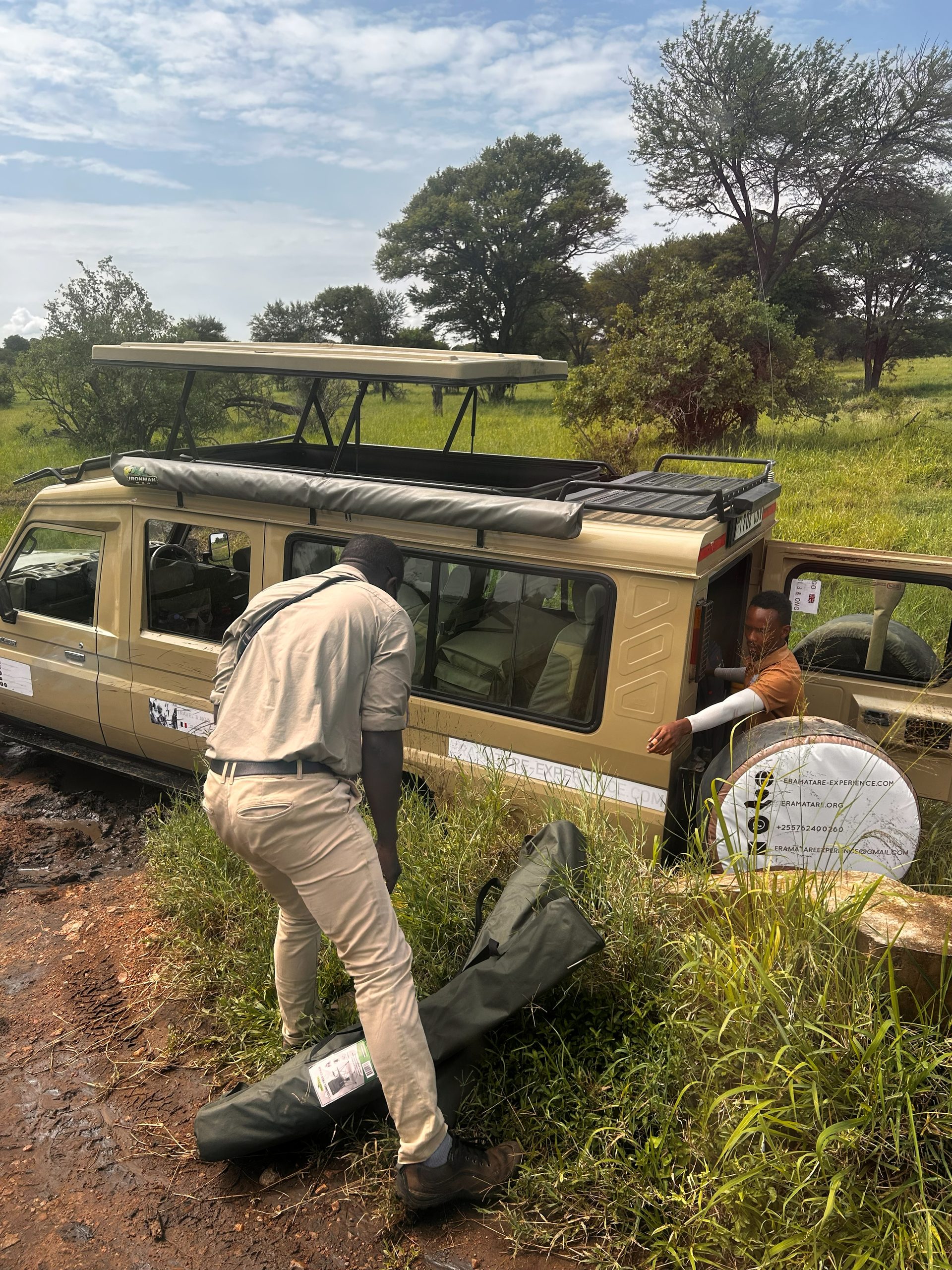
The mud tax — it rained, the track became a trap, and the guides handled it with the calm efficiency of people who have done this many times. We were underway again in minutes.
The first night in the Nyumba camp, I woke to a sound I had never heard in person. Low. Rolling. Reverberating through the canvas walls and across the plain like something ancient and unstoppable.
Lions.
I knew immediately what it was because one of our guides had demonstrated the call earlier that day — reproducing it with uncanny accuracy, the group laughing nervously at how realistic it was. Lying in a canvas tent in the dark, hearing the real version perhaps a few hundred meters away, the laugh felt very far off. It was thrilling in a way that is hard to describe — the knowledge that you are exactly where these animals live, separated from them by nothing more than canvas and the mutual understanding that the vehicles are not prey.
Hyenas called back. The night had its own conversation going, entirely independent of ours. I lay there and listened until I fell asleep.
"Lying in a canvas tent in the dark, hearing lions a few hundred meters away — thrilling in a way that is hard to describe."
The wake-up call came before the sun. Coffee appeared at the tent — a single white cup placed quietly outside the canvas, the steam rising into the cool morning air as the plain turned from black to gold. Director's chairs were arranged at the edge of the camp. Nobody spoke much. The Serengeti does something to conversation at that hour — it makes words feel inadequate, and silence feel exactly right.
Breakfast in the dining tent followed: eggs, toast, fruit, the full spread — the group slowly coming to life around the long table, swapping stories from the night before. The black-and-white wildlife portraits on the canvas walls. The beaded chandelier overhead. The extraordinary normality of sitting down to breakfast in the middle of the Serengeti.
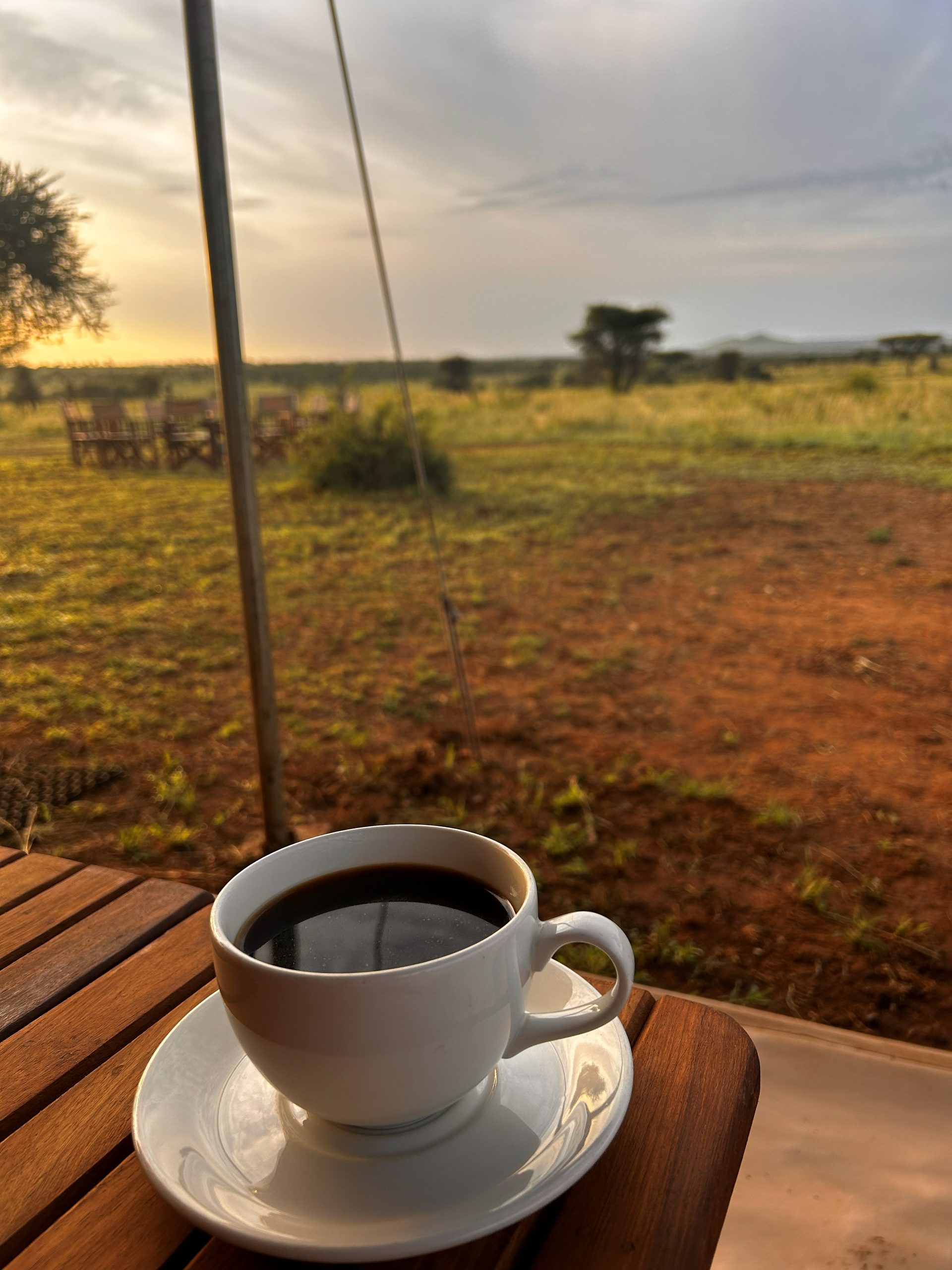
The best cup of coffee of the entire trip — on the tent porch at first light, the plain turning gold around the camp
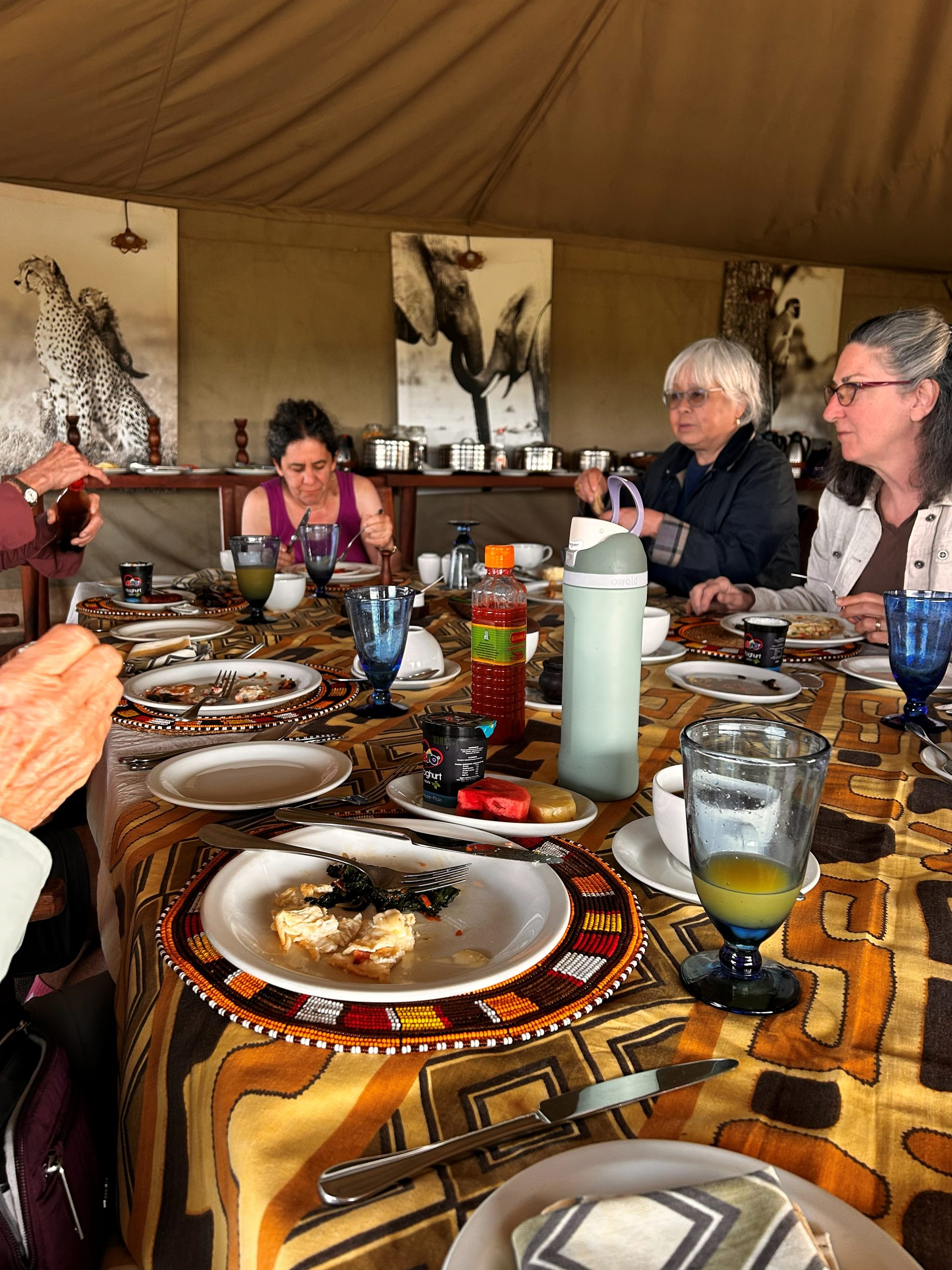
Breakfast in the Nyumba dining tent — Maasai-beaded placemats, cobalt glass, and a cheetah print watching from the wall
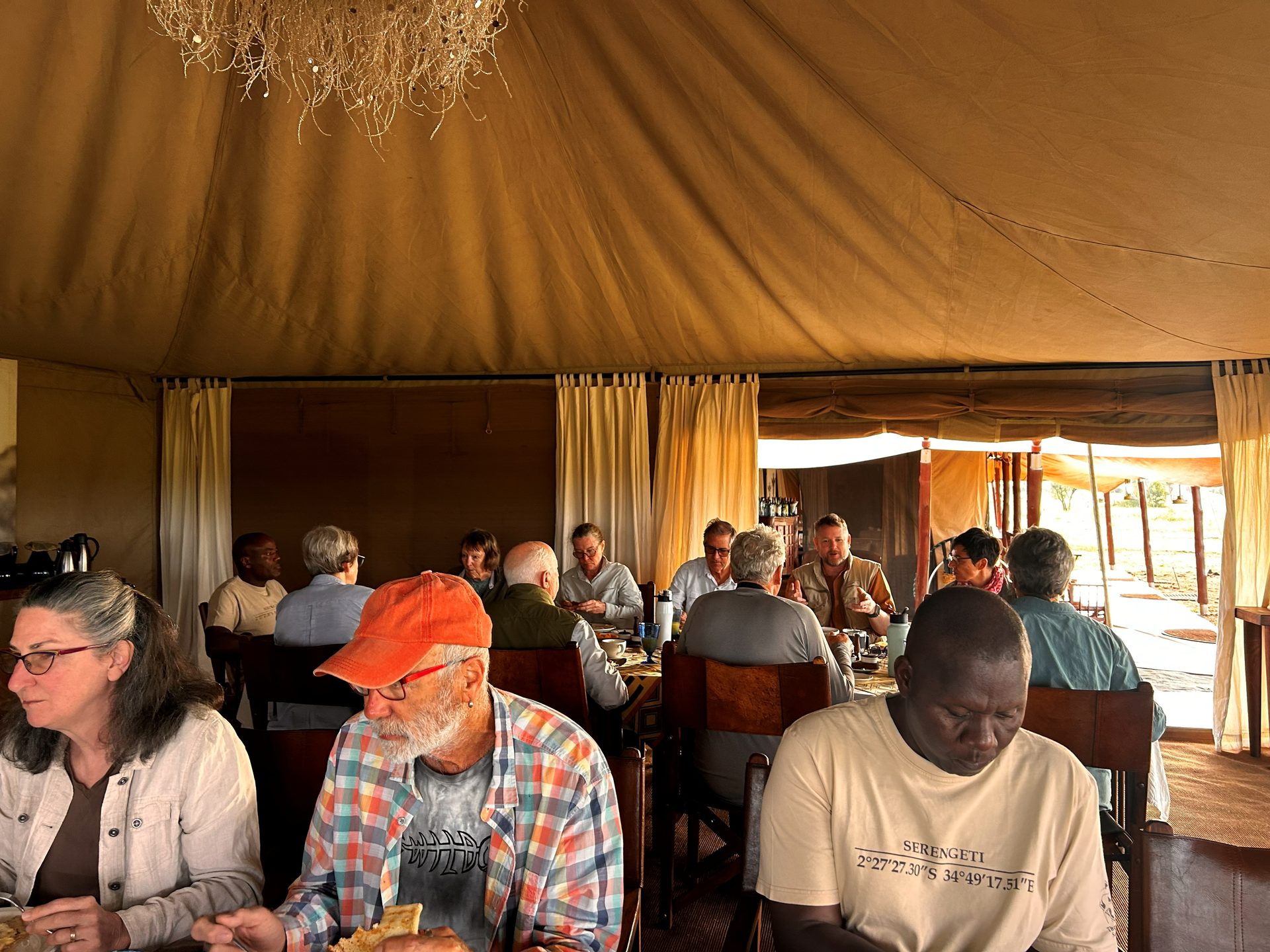
The whole group around the breakfast table — the camp guides in their Serengeti coordinates shirts, the day's game drive still ahead of us
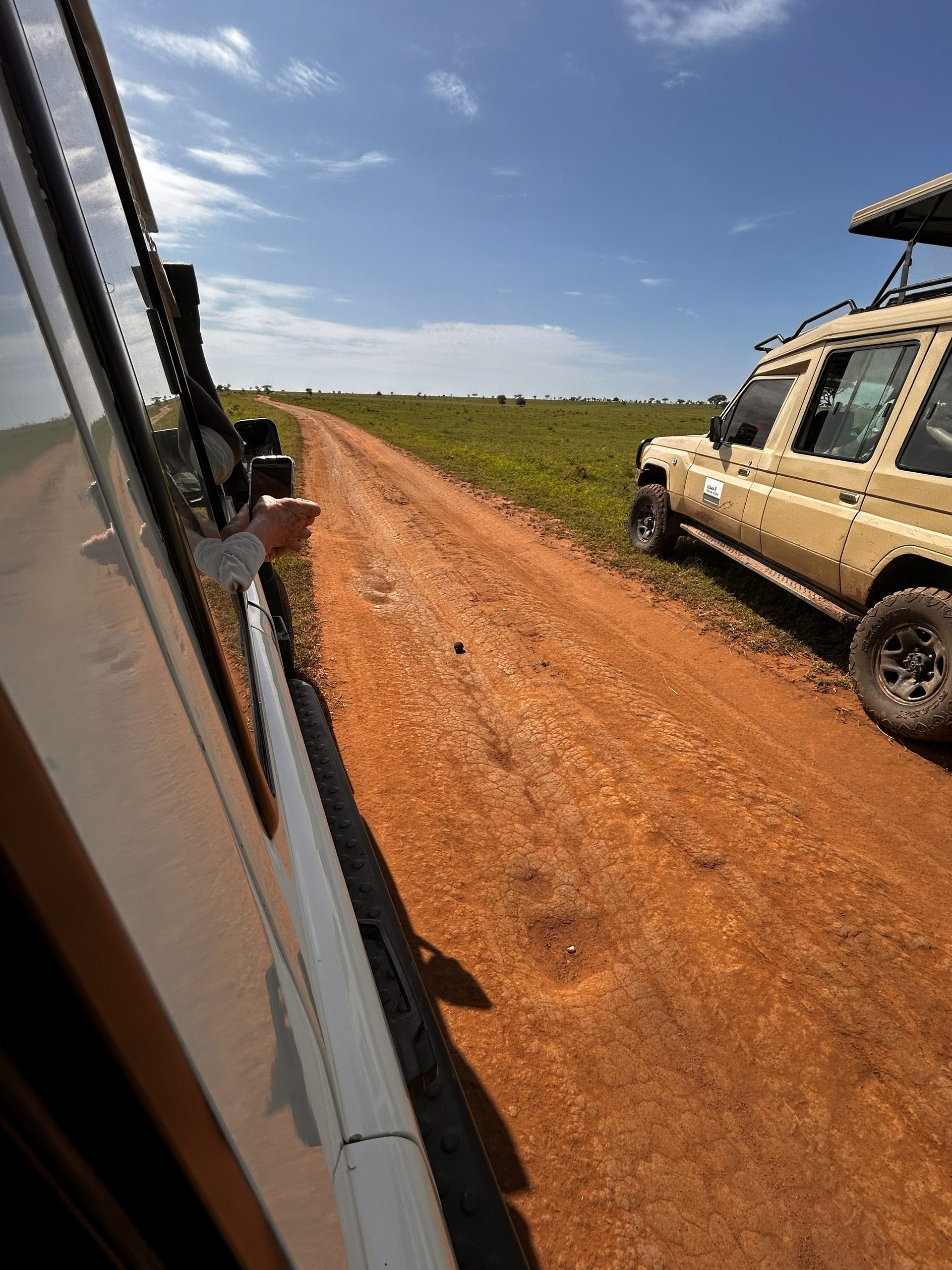
Out the window on the Serengeti tracks — convoy life on the red-dirt roads, the plain stretching flat in every direction
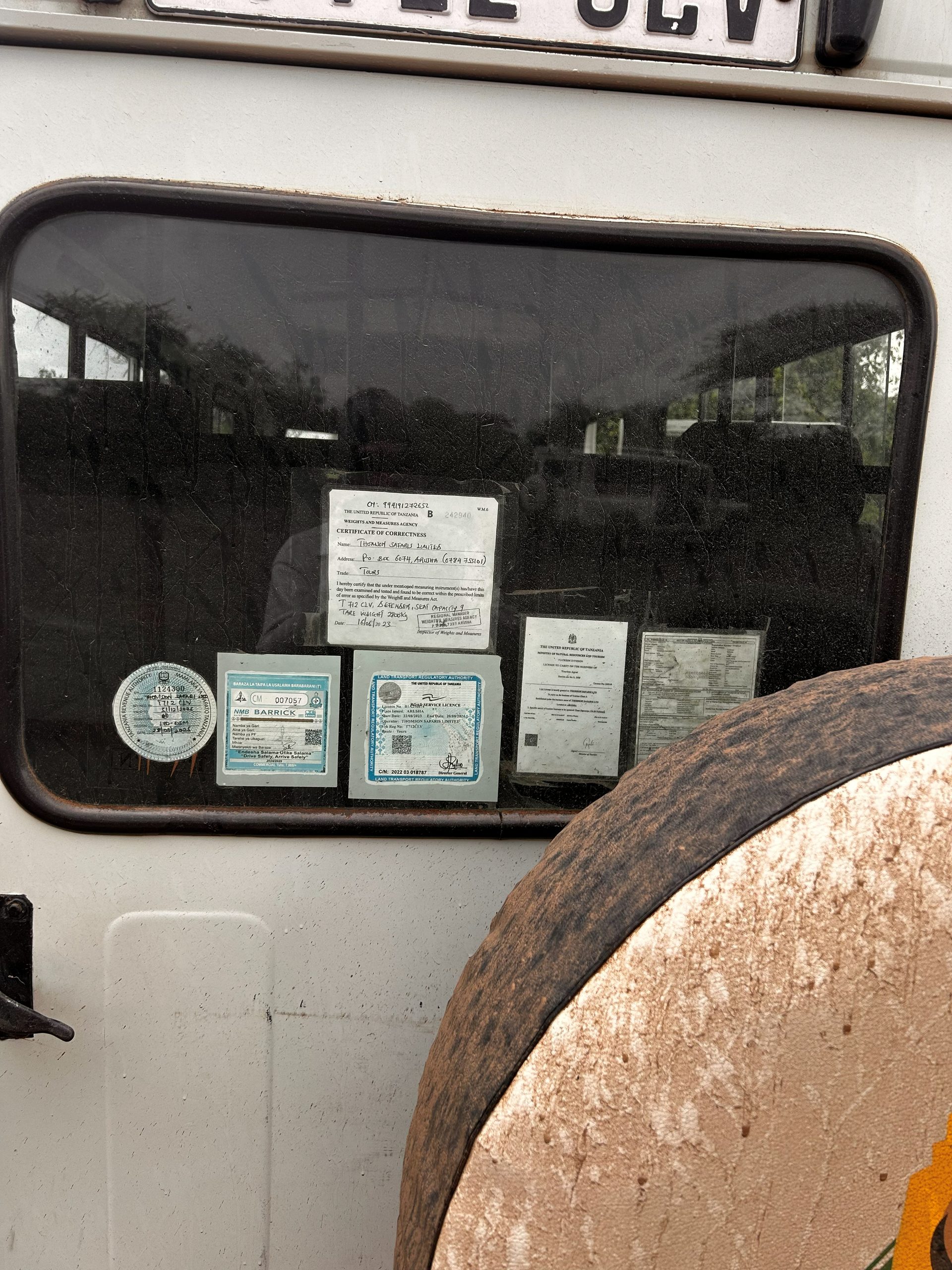
The permits — every vehicle carries a wall of Tanzanian park documentation. The bureaucracy of wildlife conservation, stuck to the glass
A Masai giraffe crossing the track — unhurried, indifferent, magnificent
Lions taking a break — not asleep, not moving, simply existing at the top of the food chain
The Serengeti delivered big cats in abundance. Lions and lionesses in various combinations — resting in shade, moving through grass, watching the vehicles with the calm indifference of animals that have never needed to fear anything. Cubs tumbled and played while their mothers watched. On one extraordinary afternoon, a male lion briefly mounted a lioness while the group watched in respectful silence — the raw biology of the place playing out without regard for its audience.
A leopard appeared in a tree. Cheetah were spotted on multiple occasions. And then, close to the road one morning, a sighting that had our guides visibly excited: a caracal. Medium-sized, tawny-colored, with distinctive black ear tufts — a wild cat rarely seen in daylight. It sat near the road, close enough that binoculars were unnecessary, regarding us with the cool assessment of an apex predator who has nothing to prove. The guides told us it was genuinely rare. We believed them.
Two cheetah cubs — perhaps nine months old — were spotted sitting in the grass when one suddenly launched itself in pursuit of a group of mongoose. The mongoose, faster and smarter than the young hunter anticipated, dove into holes in a nearby termite mound with impressive coordination. The cub sat outside, reconsidering its life choices. We watched and laughed quietly.
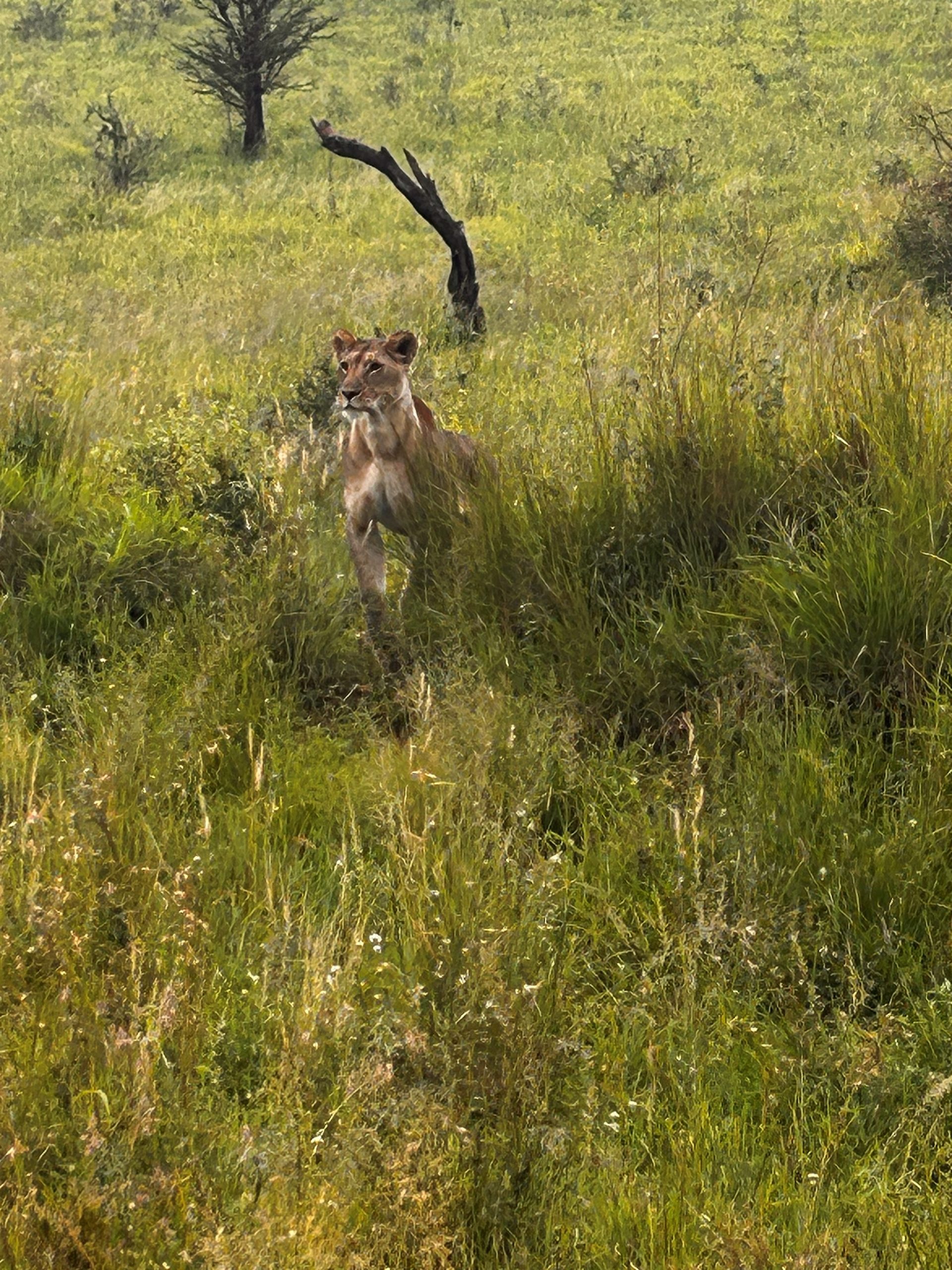
A lioness moving through the grass — calm, purposeful, absolutely aware of us and completely unimpressed
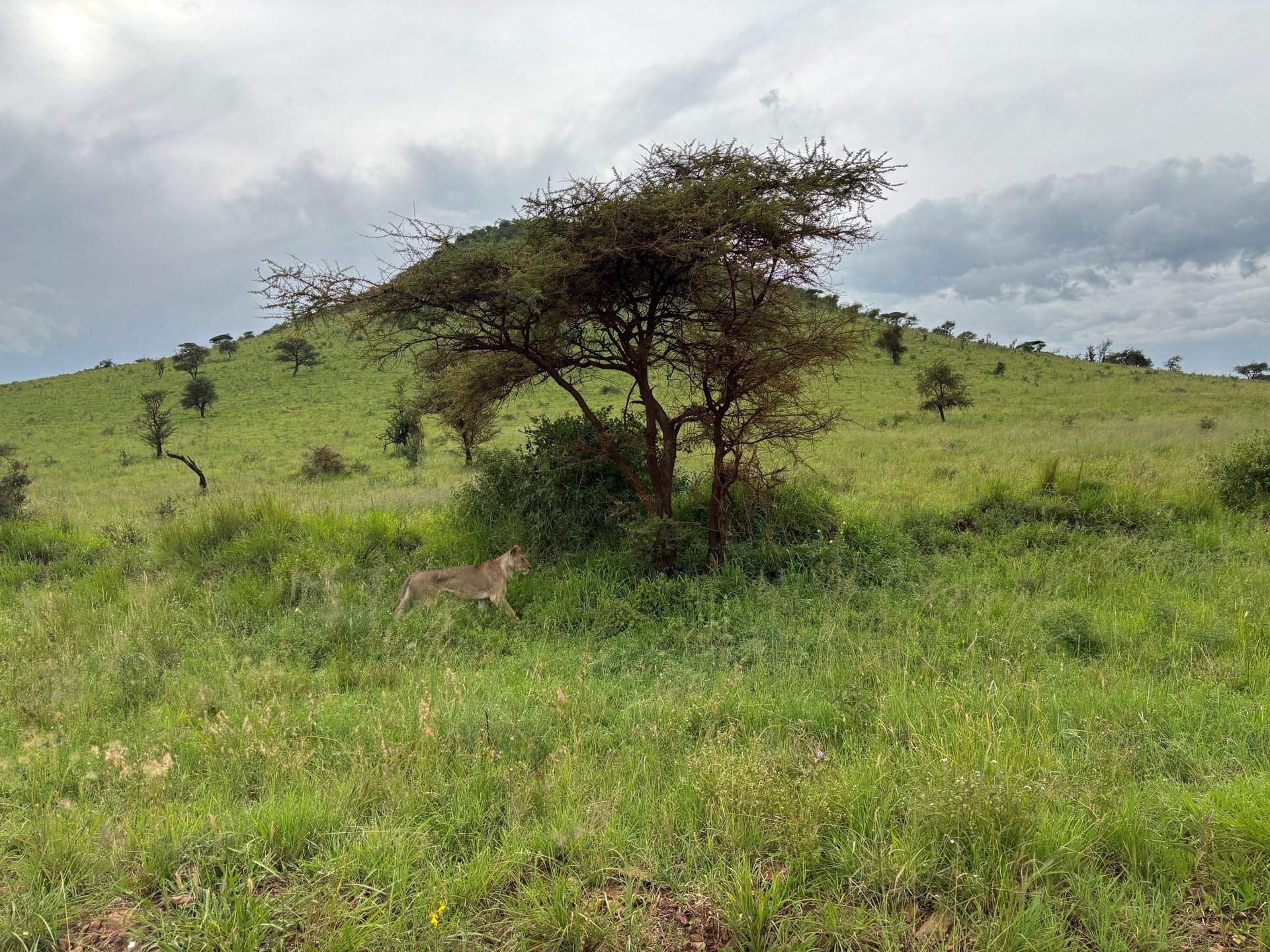
A second lioness crossing the open plain — the Serengeti's acacia-dotted hills rising behind her
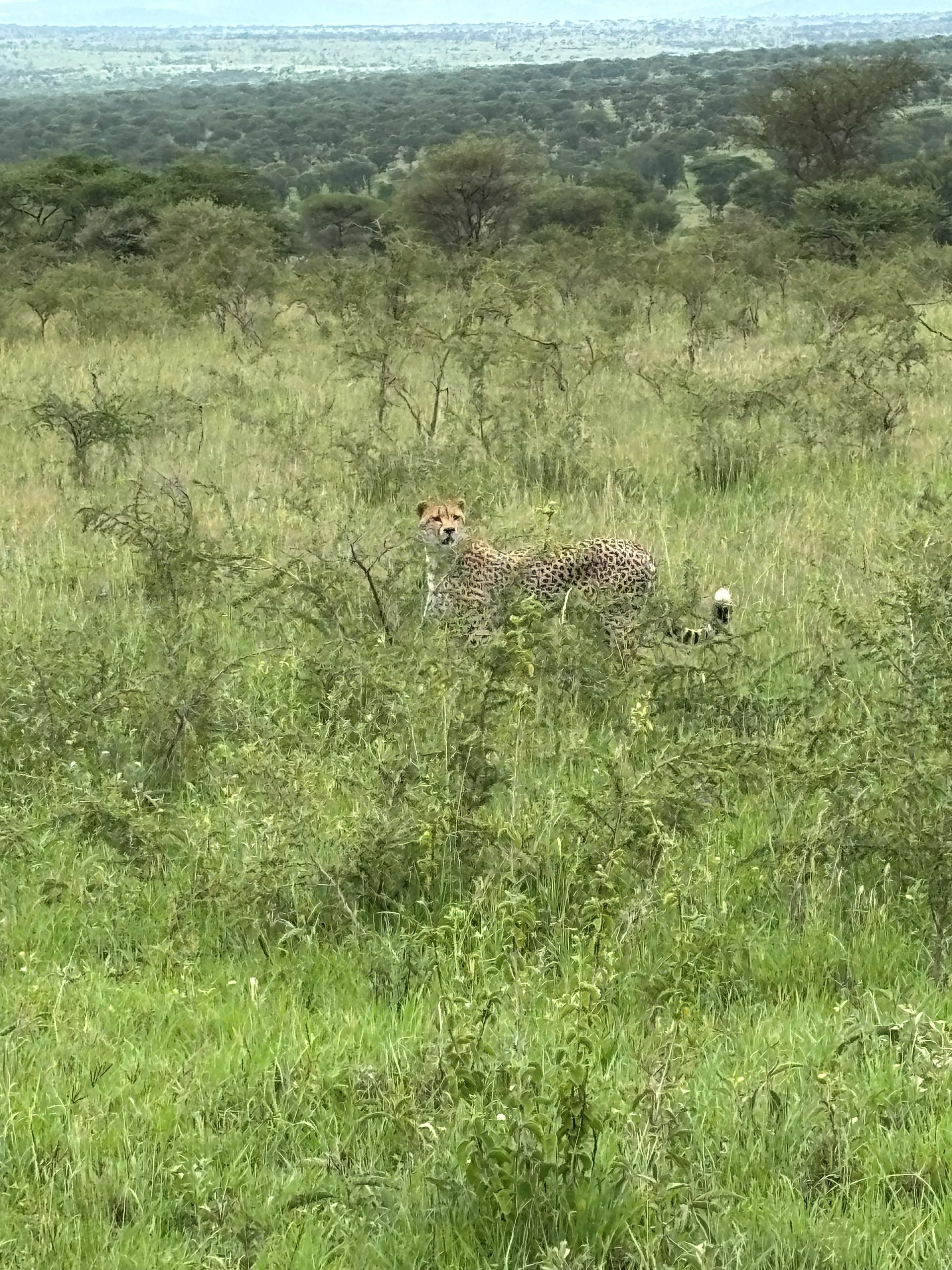
A cheetah holding its ground in the long grass — spotted, still, and entirely unimpressed by our presence
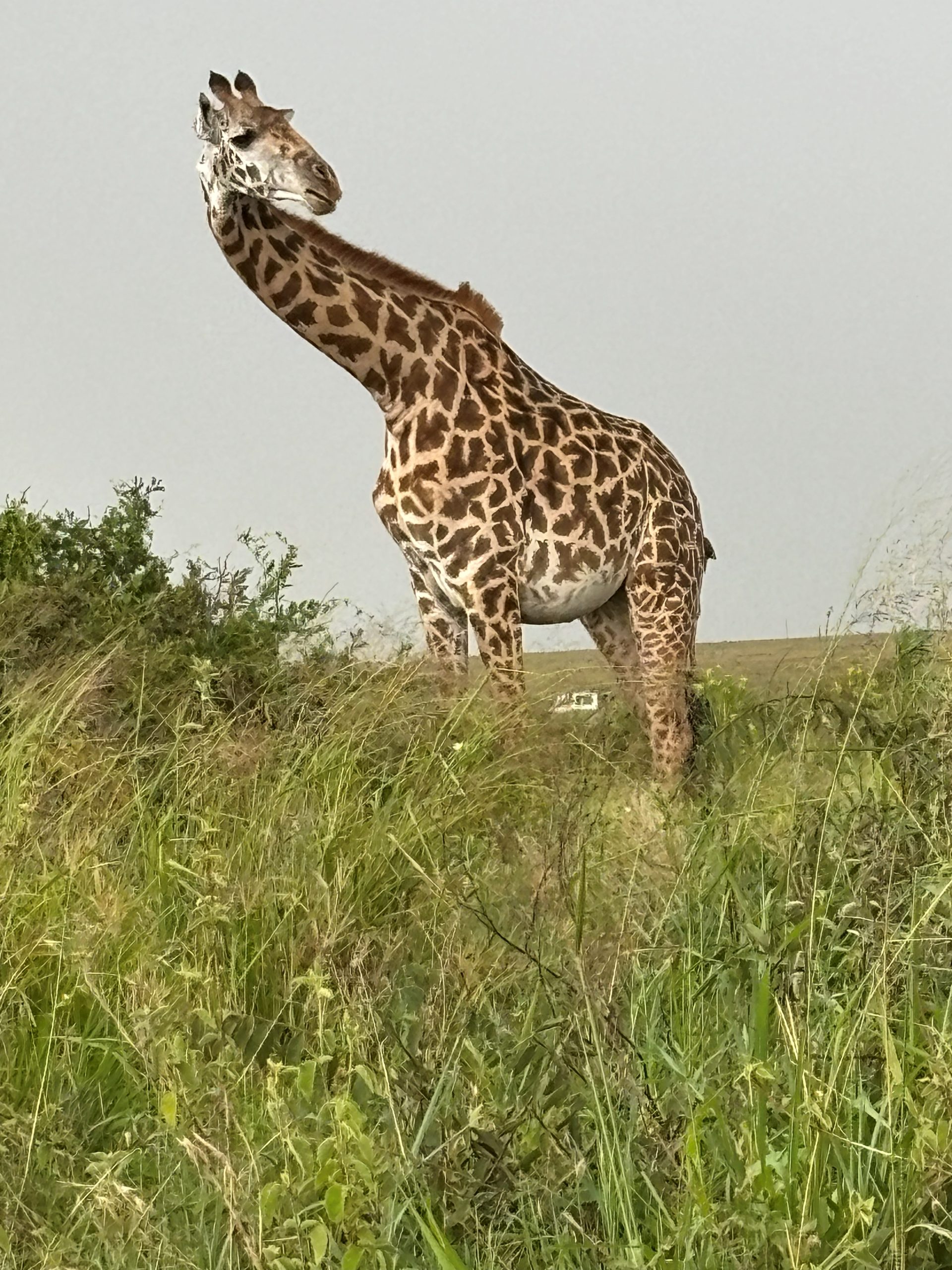
A Masai giraffe framed in the truck window — close enough that no zoom was needed, the stormy sky filling the frame behind it
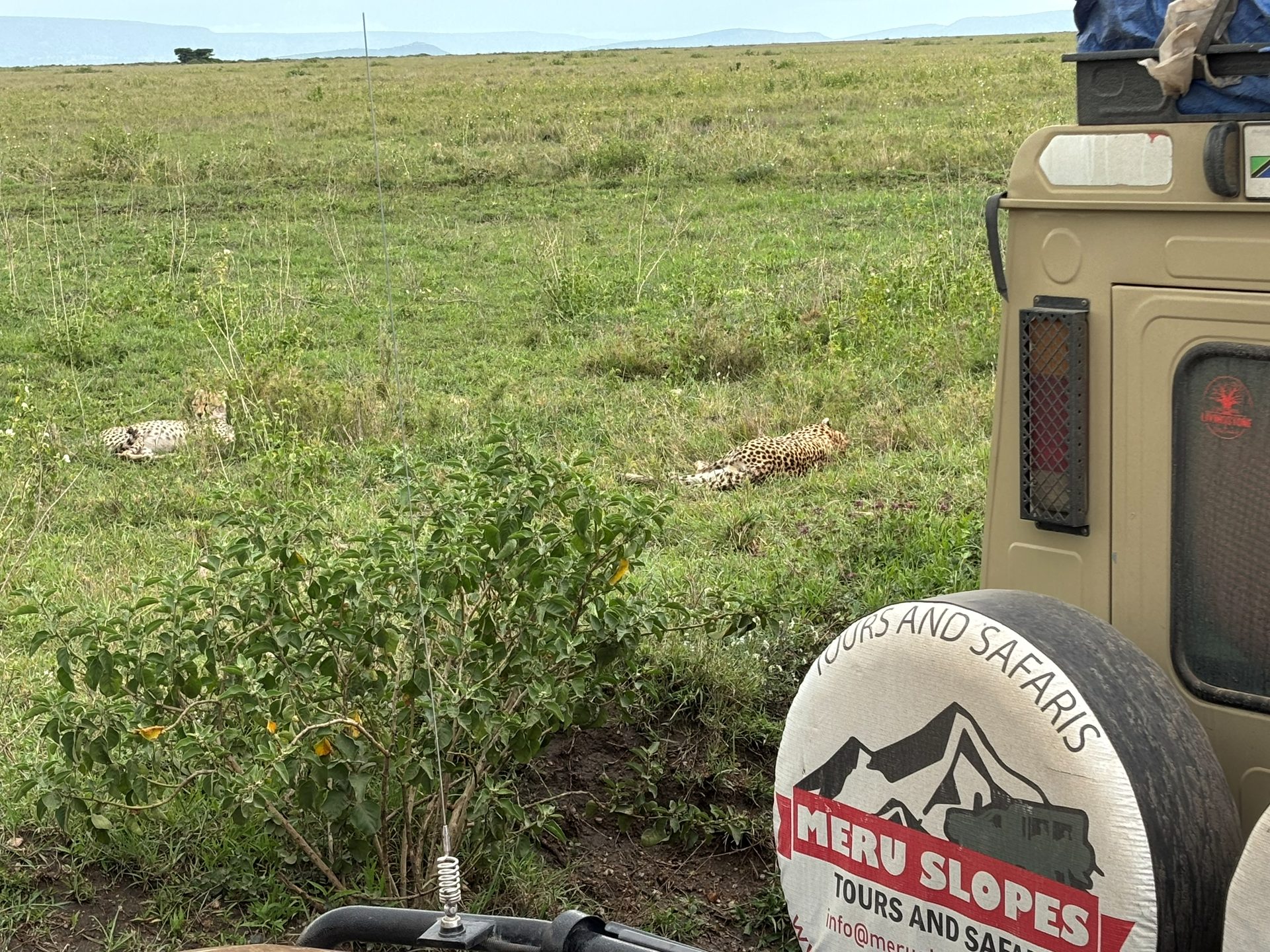
Two cheetahs resting alongside the road — close enough that no zoom was needed. They regarded the trucks with complete indifference.
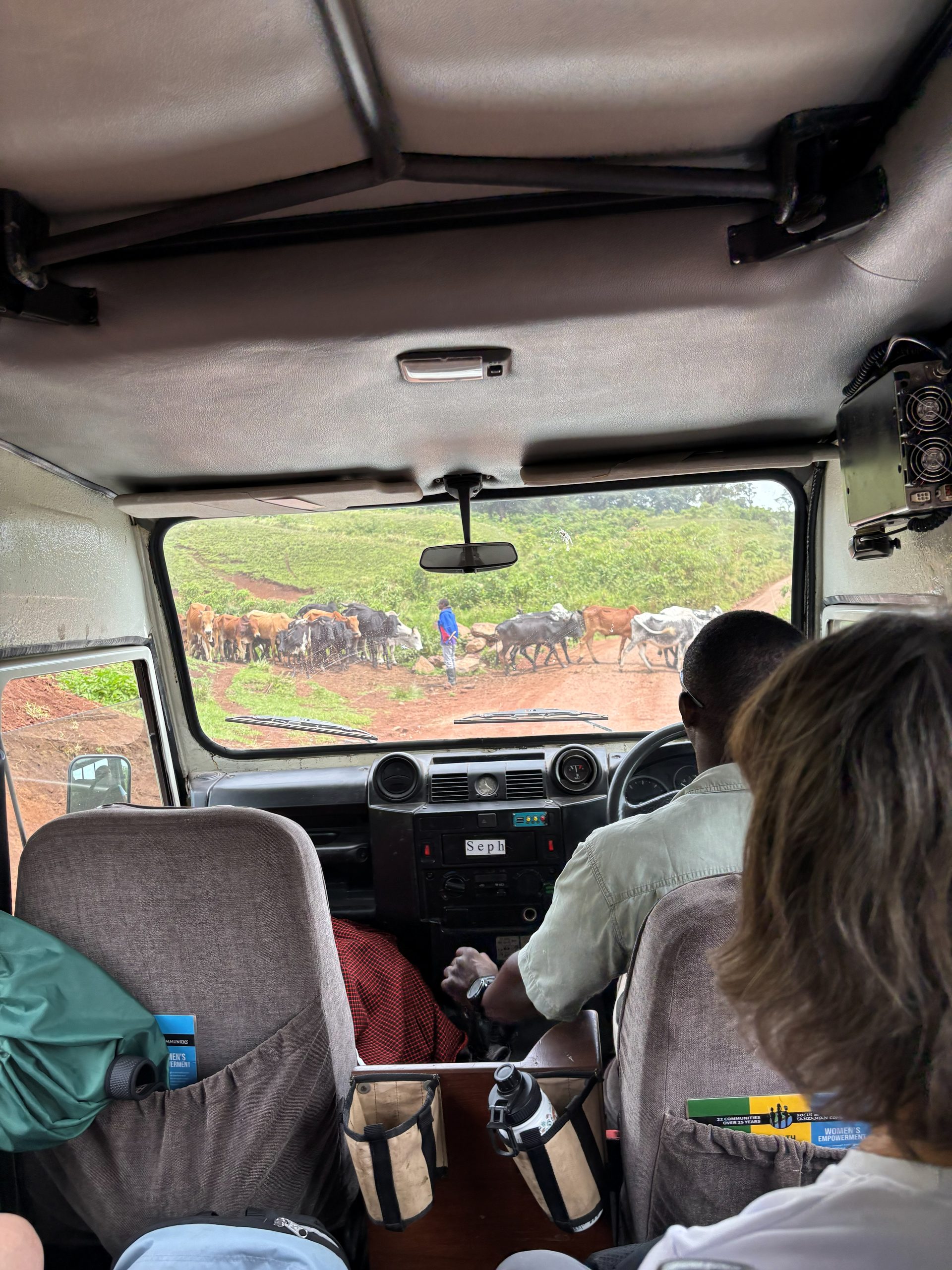
A Maasai herder moving cattle across the red-dirt road — a reminder that this landscape has been home to people for thousands of years, long before it became a national park
Hippos in the Ngorongoro river — the most dangerous animal in Africa, entirely unbothered by our presence
One stop on the game drive took us to the bank of the Grumeti River, where the water ran fast and brown after the rains. Below the bank, packed so closely they were nearly touching, was a pod of hippopotamus — forty, fifty, perhaps more. Their backs broke the surface like a fleet of grey submarines, pink-tinged where the skin caught the light. One enormous bull lifted his head, mouth slightly open, eye fixed on us with the particular hostility hippos reserve for anything that comes within range of their water. We kept a respectful distance. Nobody needed to be told twice.
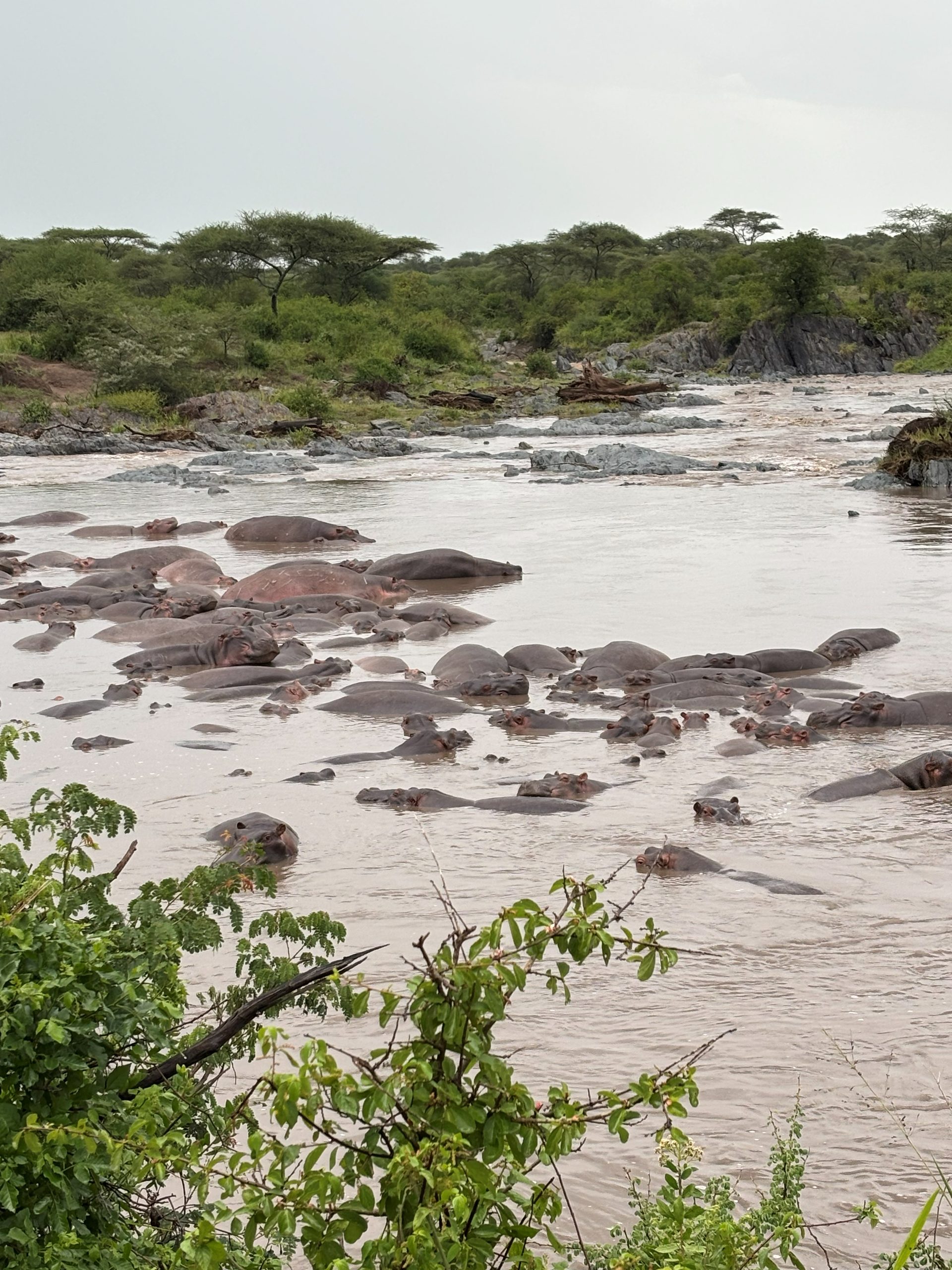
The hippo pool on the Grumeti — fifty or more packed into the bend, their backs barely clearing the waterline, the acacia woodland rising behind
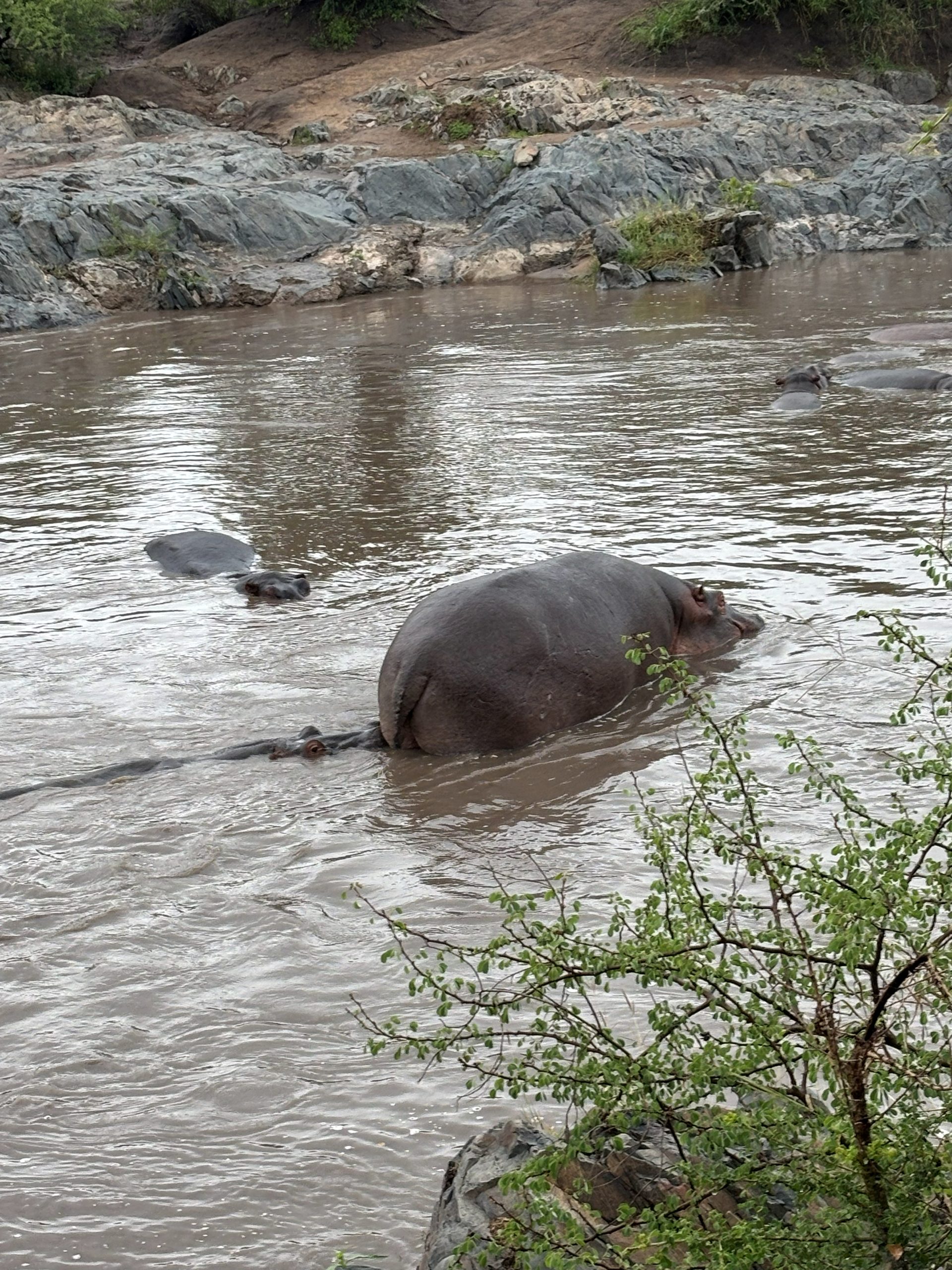
The boss of the pool — one eye on us, mouth cracked open in what may have been a yawn or a warning. We chose not to test which.
Between the big sightings, the Serengeti ran its quieter dramas constantly. Two male Grant's gazelles locked horns in the grass below a distant giraffe, their sparring carrying a seriousness that the surrounding herd ignored entirely. A vast herd of impala moved under the acacias in that rippling, nervous way herds have — the whole mass shifting as one organism, alert to threats no one else could see. Through the same trees, a troop of olive baboons moved with entirely different energy — loud, unhurried, and completely indifferent to the impala's anxiety, loping along fallen trunks and disappearing into the long grass at the kopje base as if they owned the place. A red-headed agama lizard held court on a boulder above them all, its flame-colored head blazing against the grey rock, performing push-ups at no one in particular. And then there was the question of the trees — several acacias pushed over and stripped bare in a radius that told a clear story. Elephants had been here. The destruction was total, and somehow beautiful.
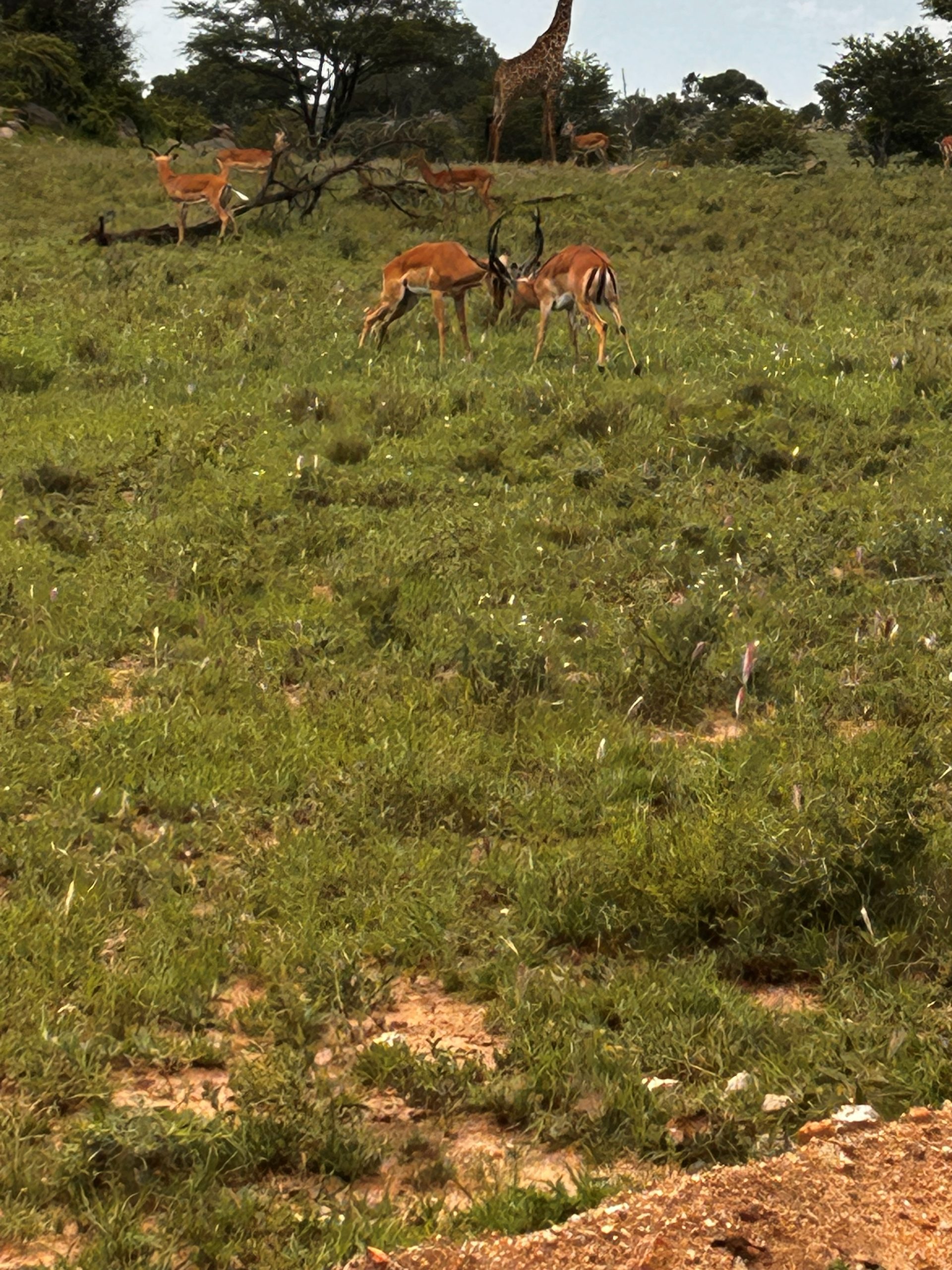
Two male gazelles settling something in the grass — a giraffe standing witness behind them, the herd grazing on regardless
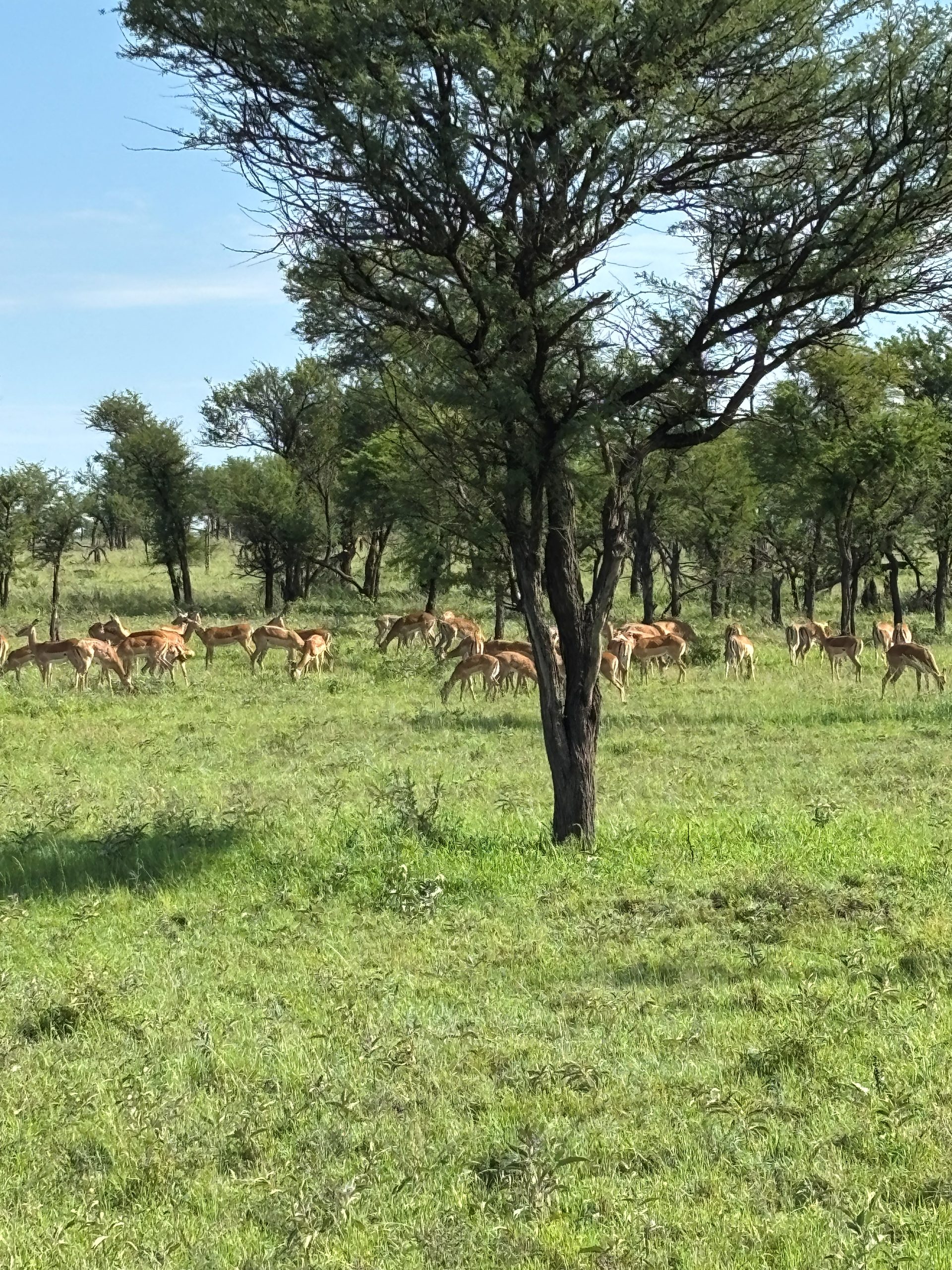
A herd of impala under the acacias — the constant background of the Serengeti, always there, always moving, always watching
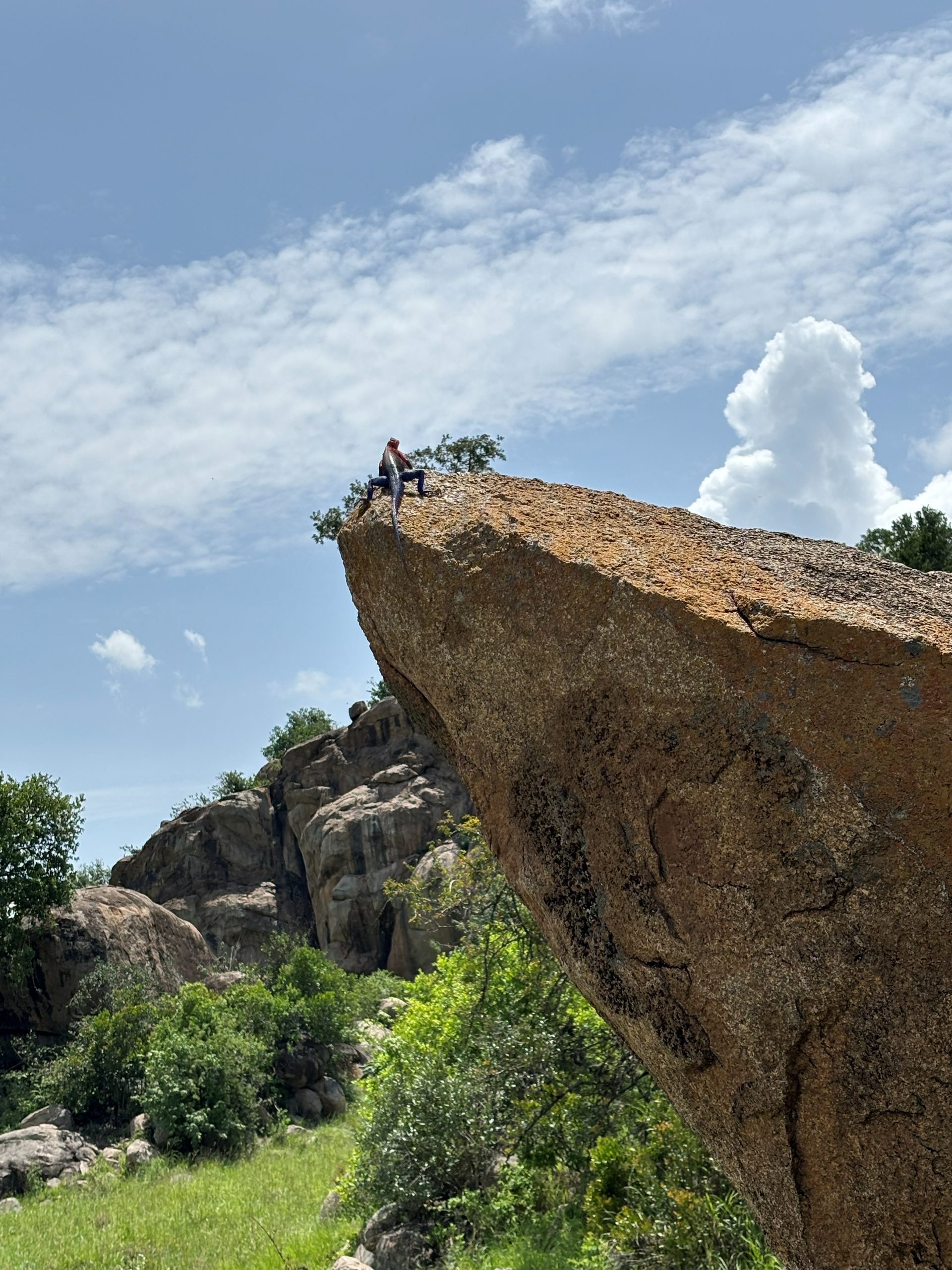
A male agama lizard on a kopje — that flame-red head is not camouflage. It is a declaration.
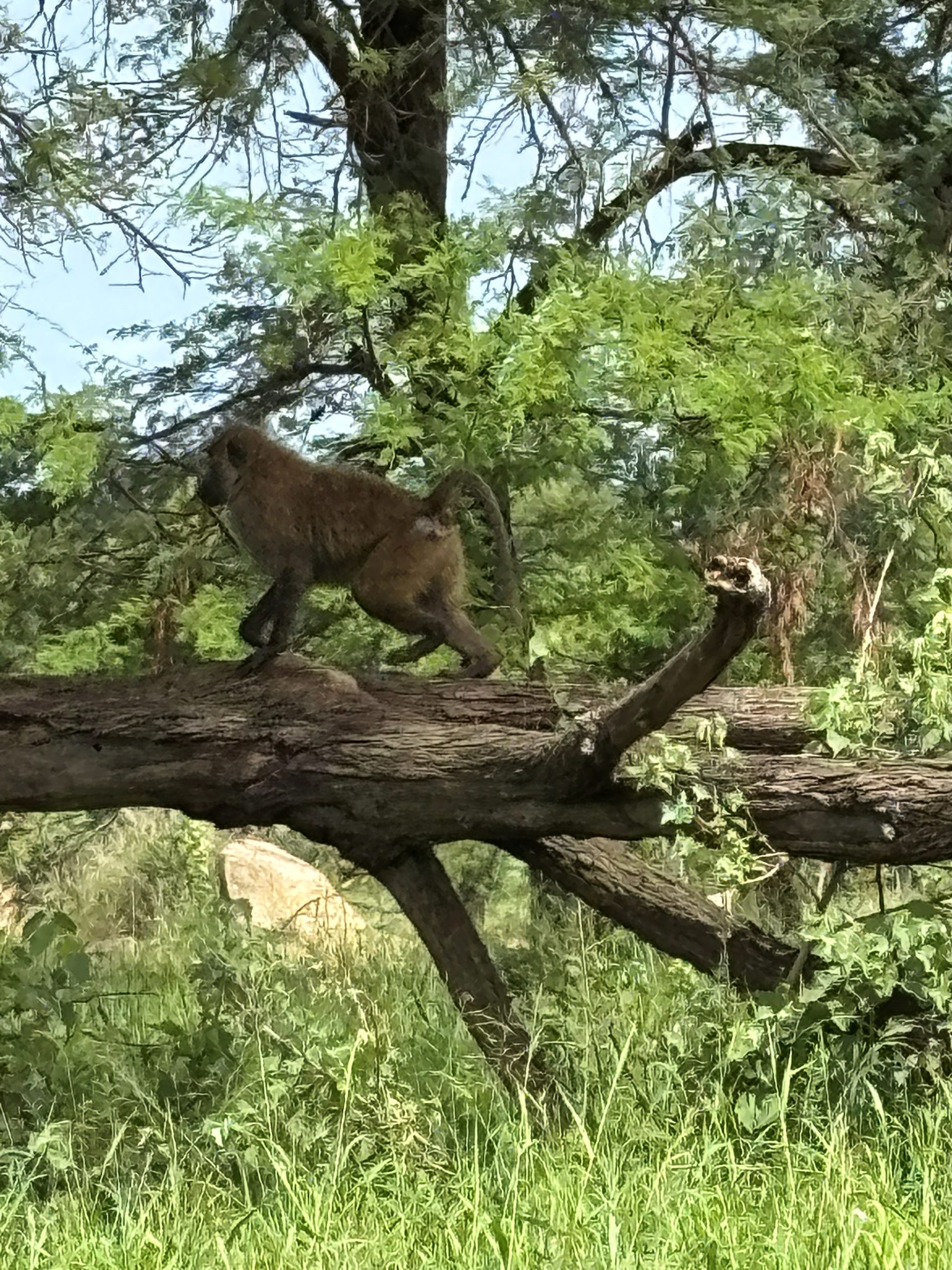
A baboon using a fallen acacia as a highway — the kopje rocks rising behind, the grass thick around the base. The kopjes belong to the baboons as much as anything else.
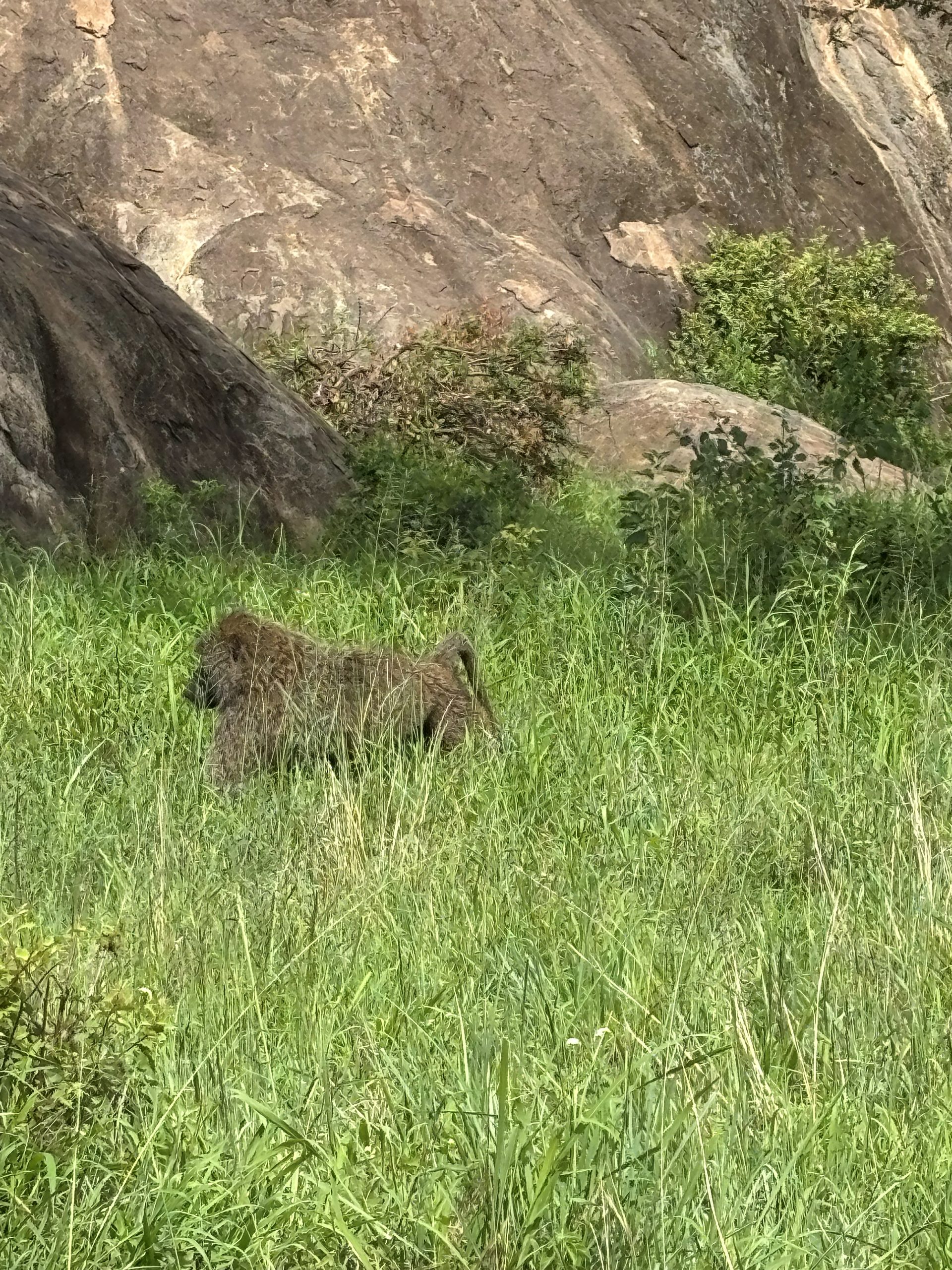
Half-hidden in the grass at the kopje base — baboons were everywhere at Moru, moving through the rocks and undergrowth with noisy confidence
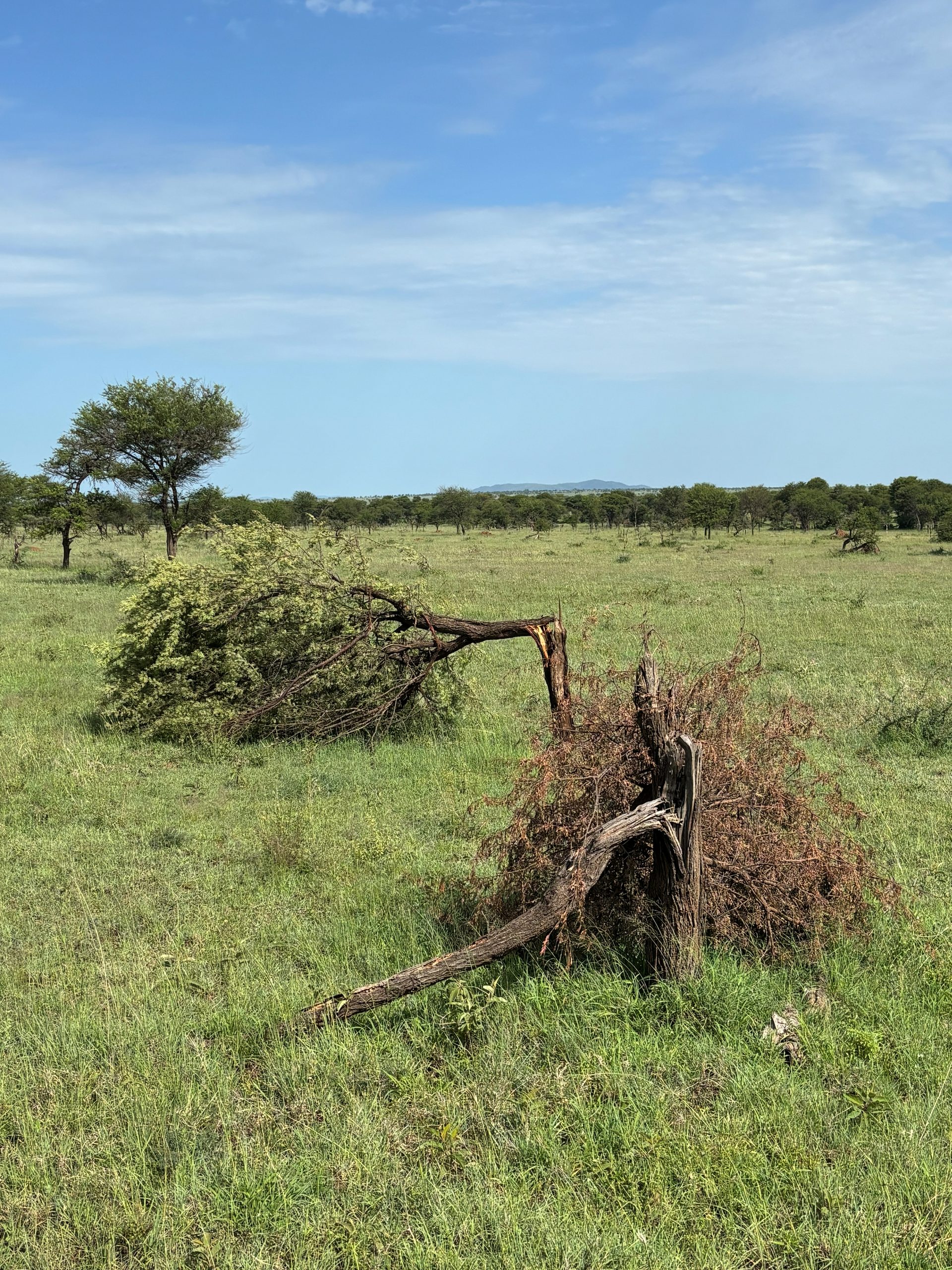
Elephant work — acacias pushed over and stripped bare. The Serengeti's top landscapers leave their mark everywhere.
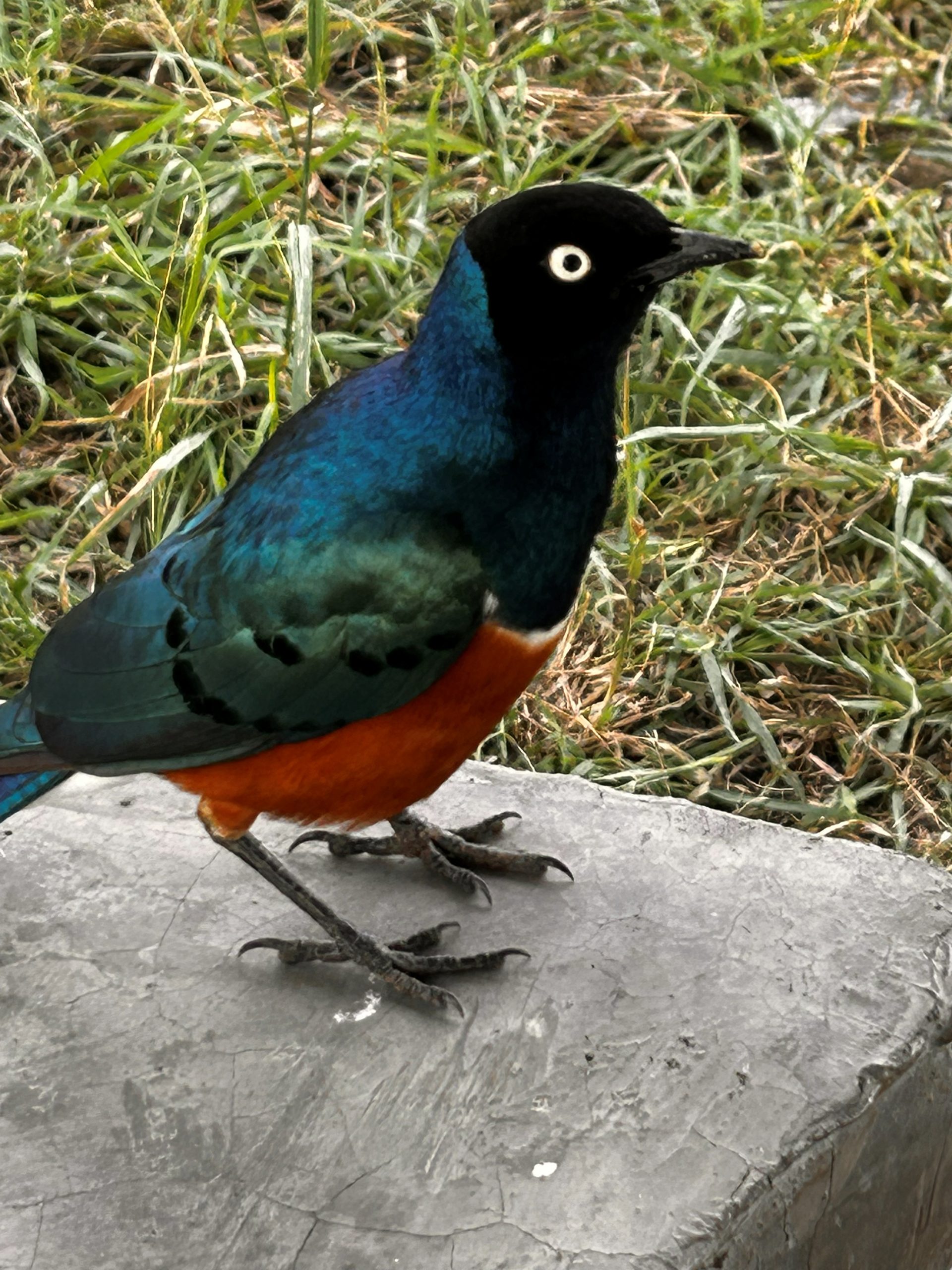
The Superb Starling — possibly the most well-named bird in Africa. Iridescent teal, rust orange, and a white eye that looks painted on. It visited camp regularly and accepted the attention as its due.
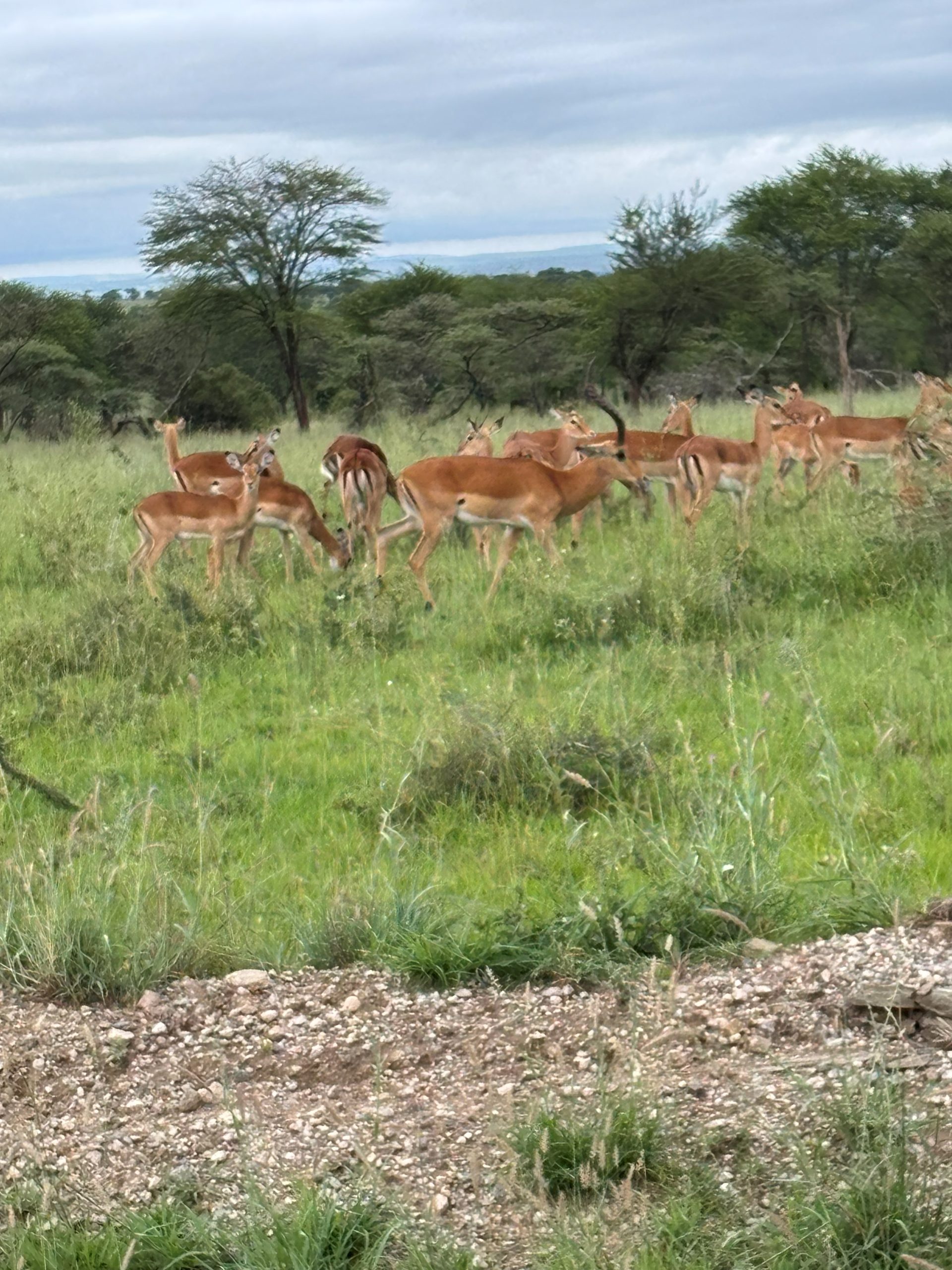
Impala at the roadside — there were always impala. Hundreds of them. Every single one still managed to look graceful doing it.
Sunset over the Serengeti — the sky on fire, the plains darkening below, acacia silhouettes against the horizon
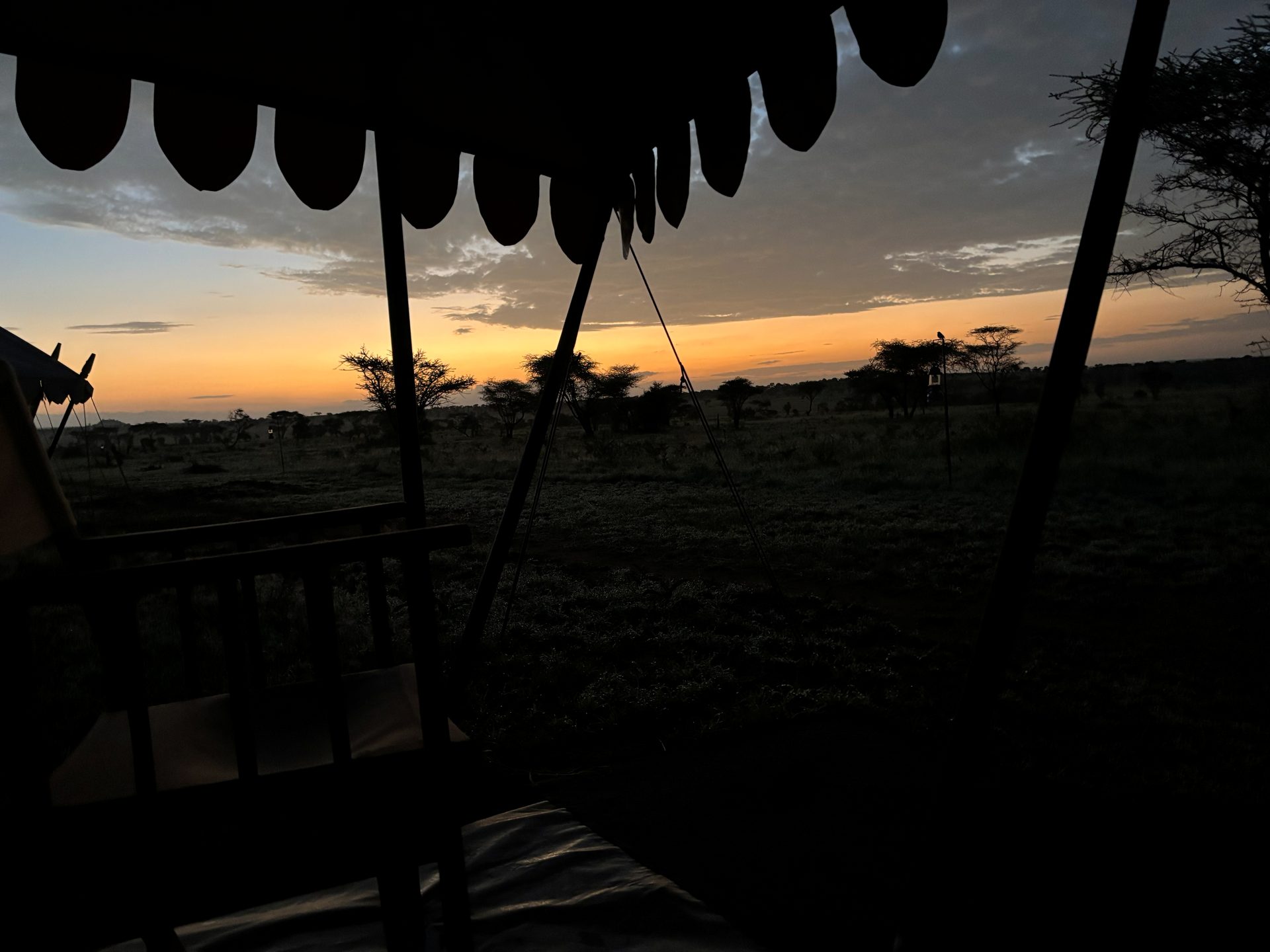
The last light from the tent porch — the orange scalloped awning in silhouette, the plain going dark below, a raptor perched in the distant acacia
One game drive took us to the Moru Kopjes — granite outcrops that rise from the Serengeti plain like the surfacing backs of something enormous and slow. The kopjes are among the oldest exposed rock formations in East Africa, and they are home to black rhino, agama lizards, rock hyrax, klipspringer, and a silence that feels different from the silence of the plain. It is older.
At the Gong Rock — a massive, flat-topped kopje where the granite rings like a bell when struck — we spent some quiet time for personal meditation as our senses absorbed all that surrounded us. Standing on the warm stone surface, looking out across the Serengeti, you understood something about permanence and scale that the game drive alone couldn't quite convey.
The kopjes also hold one of the Serengeti's quieter secrets: the rock paintings of the Dorobo people, descendants of the ancient San people who settled the Rift Valley around 1,000 AD. Painted in deep ochre on the granite walls — human figures, animals, scenes of ritual — the art has survived for centuries in the shelter of the rock overhangs. Standing in front of them, you are looking at what people saw and thought and cared about in this same landscape, in what feels like another time, but is really just a blink in the life of this place. Here we ate our lunch under the open sky, the painted map of the Moru area on the wall of the ranger post beside us.
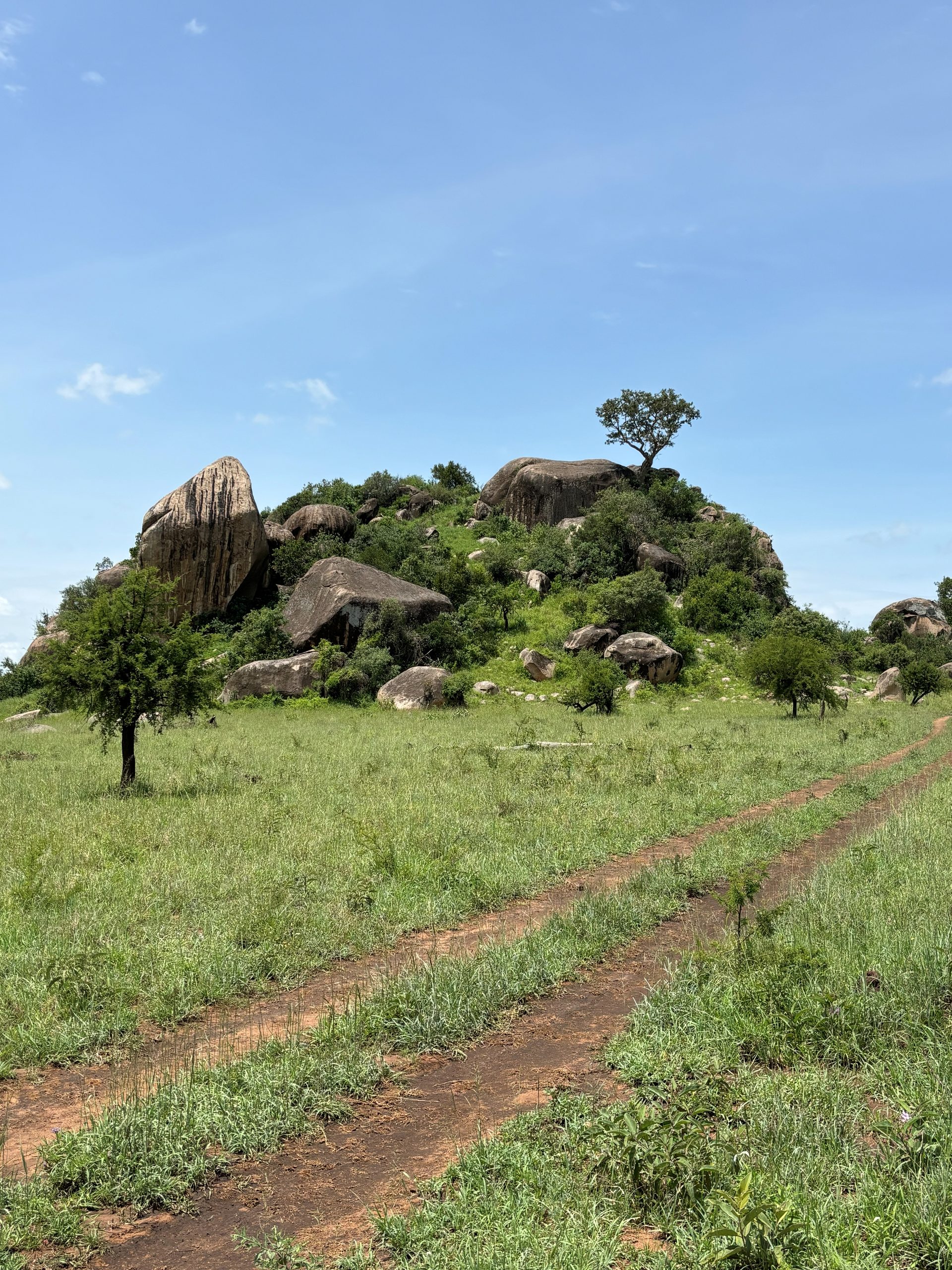
A Moru kopje from the track — the granite erupting from the plain, green with the rains, a lone acacia at the top. These outcrops are ancient islands in a grass sea.
The Moru Kopjes ranger post map — hand-painted, showing the kopje clusters, the game trails, Lake Magadi to the north, and the animals found in each zone
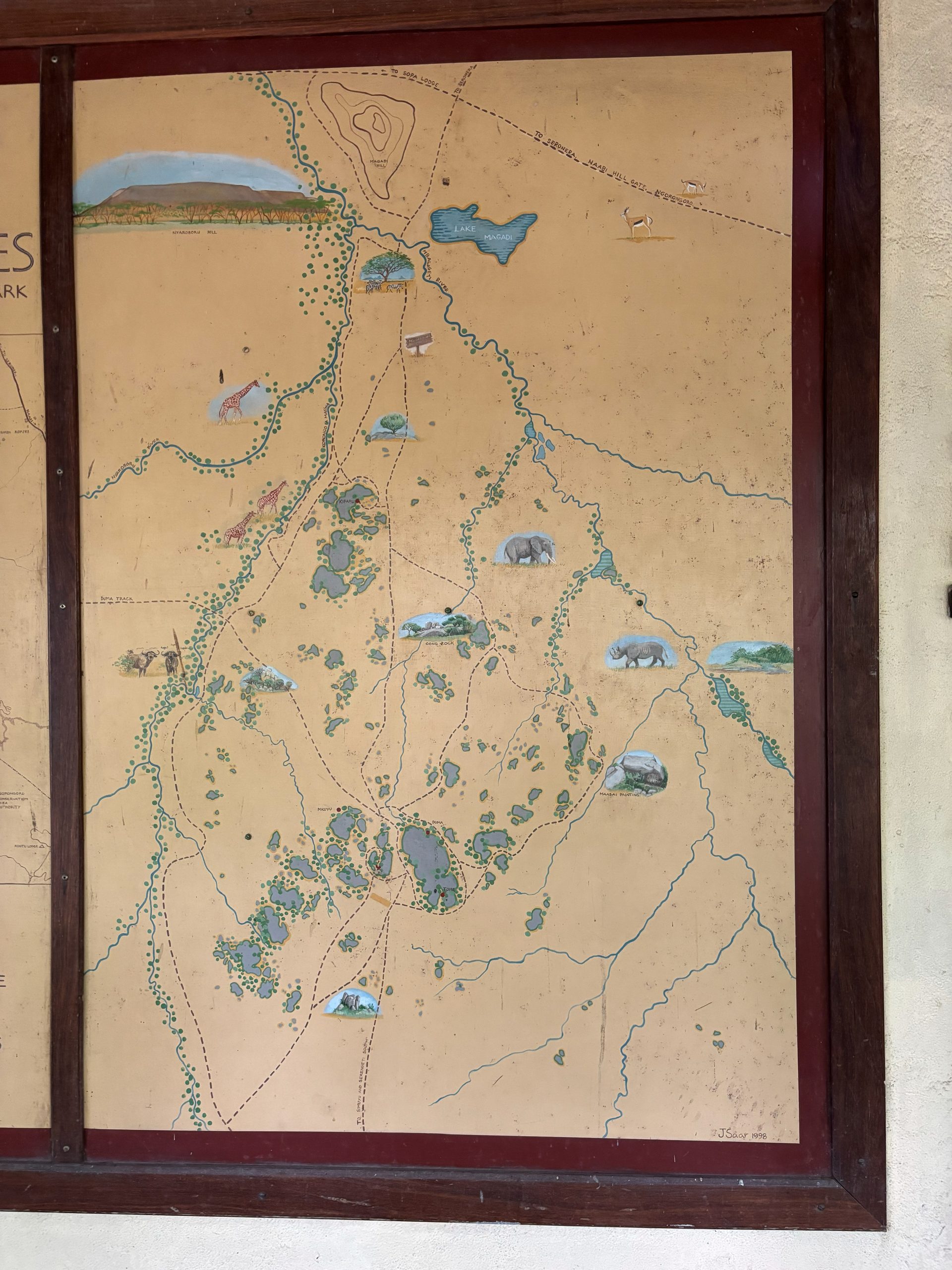
The Serengeti in miniature — a hand-painted map covering the Moru area, every kopje cluster labeled, every game trail marked in dashed red
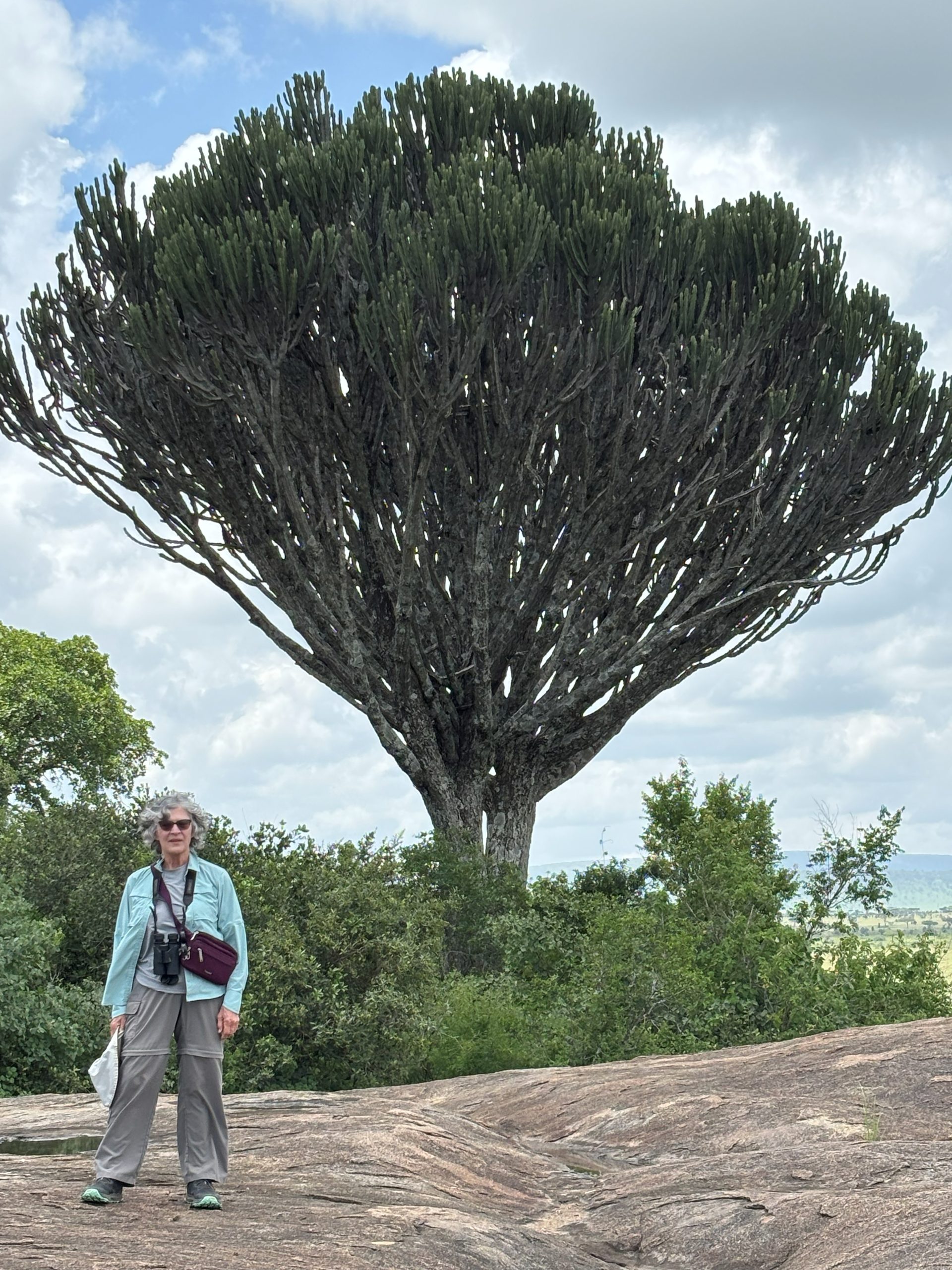
At the candelabra euphorbia on Gong Rock — a tree that looks like it was designed by someone who'd never seen a tree. The plain stretches away below.
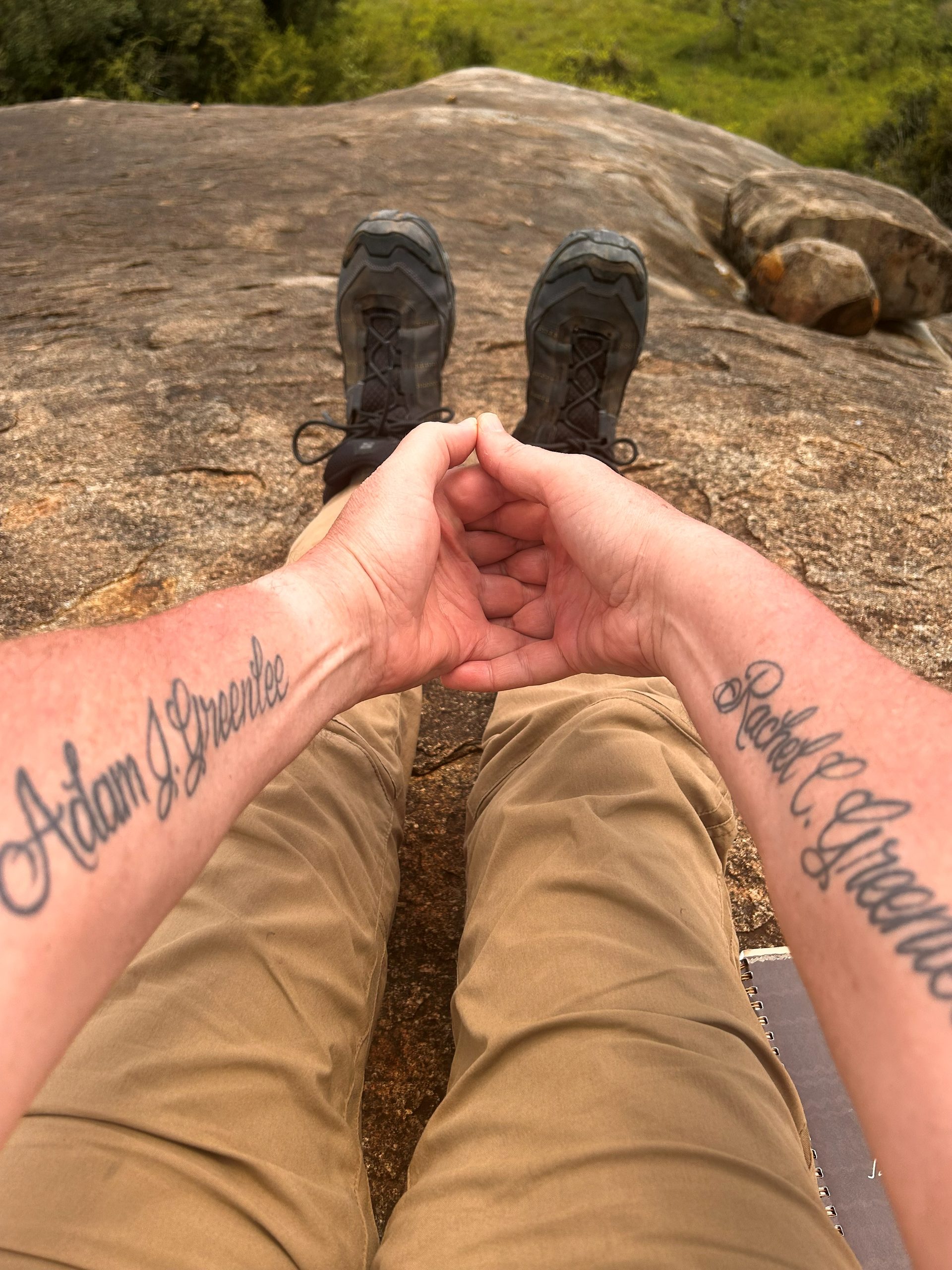
A moment of stillness on the oldest rock in the Serengeti — the names on the arms the reason for being here
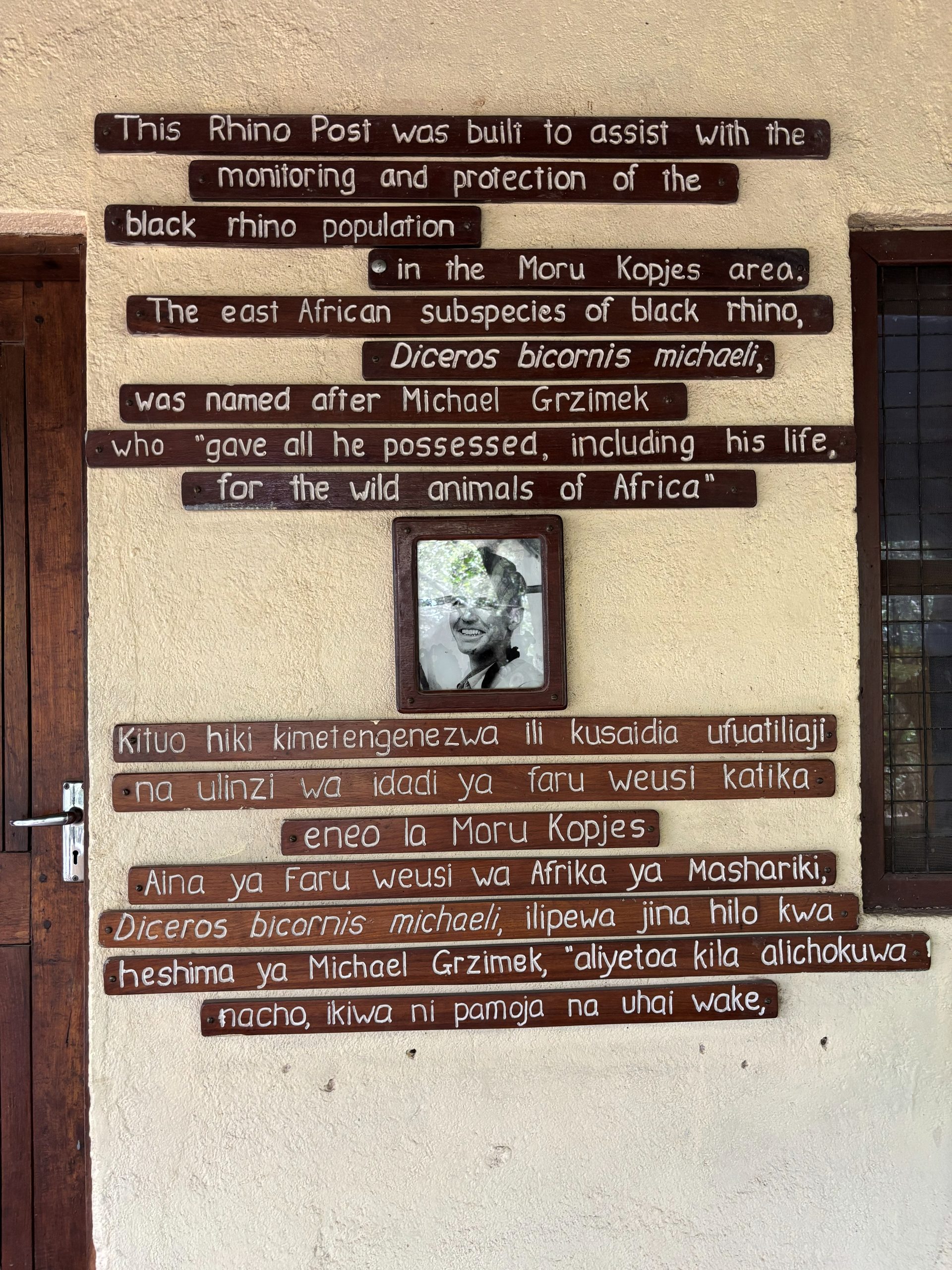
The black rhino monitoring post at Moru — dedicated to Michael Grzimek, who gave everything, including his life, for the wild animals of Africa. The east African black rhino subspecies carries his name.
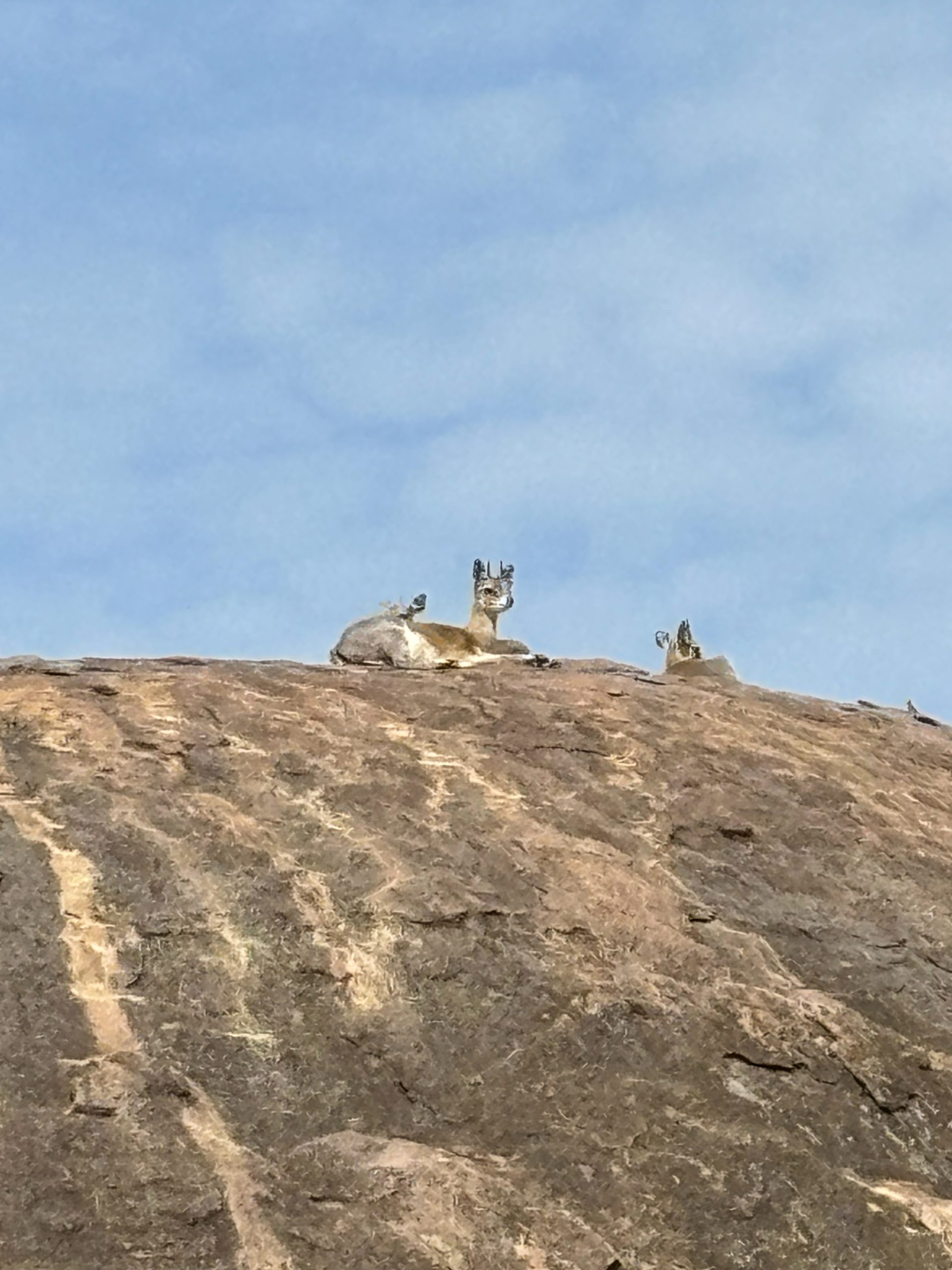
A klipspringer at the kopje summit — the small antelope that lives on sheer rock faces, balancing on the tips of its hooves. It regarded us from the highest point it could find and looked entirely comfortable.
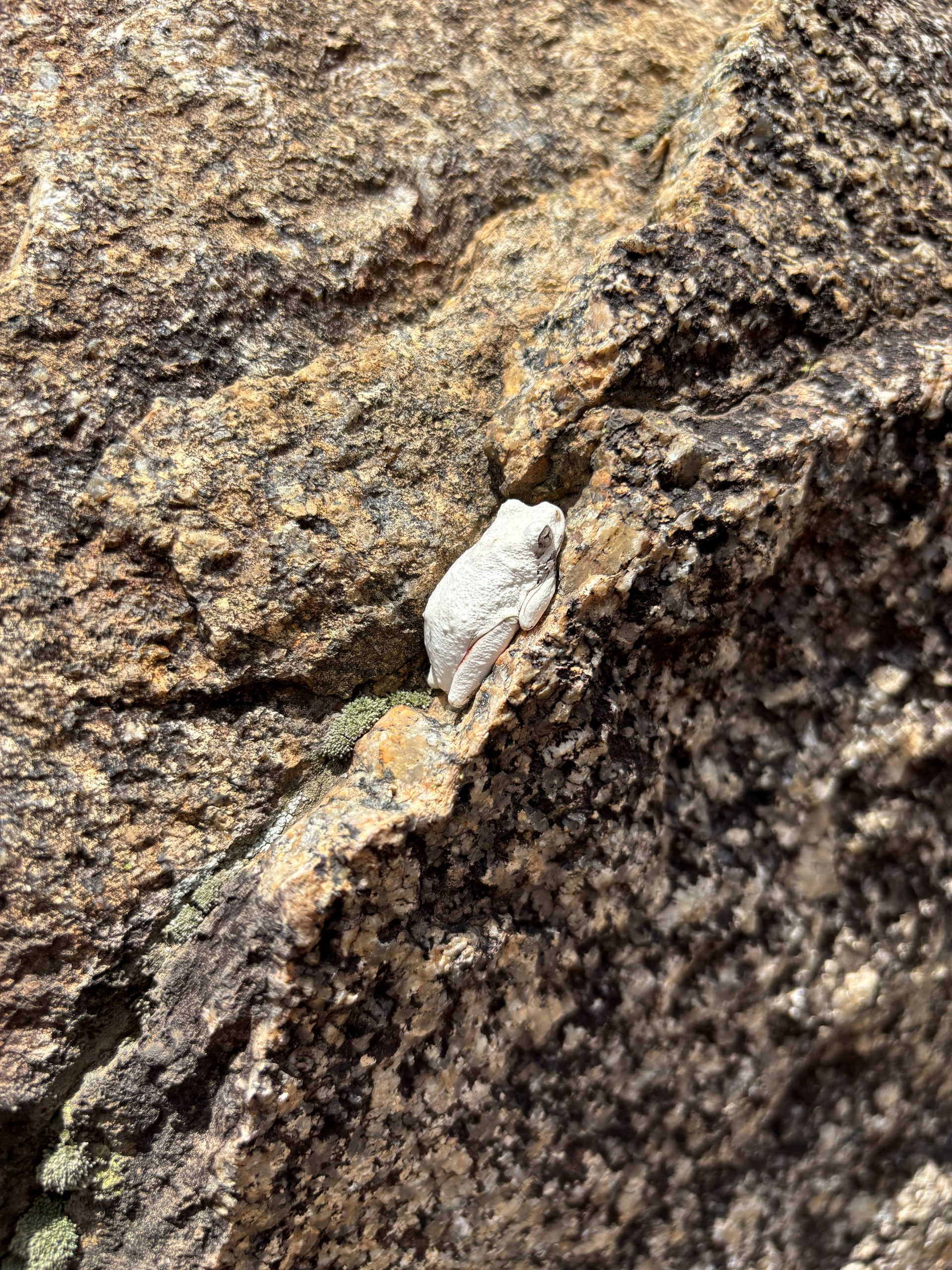
A foam-nest tree frog in a rock crevice on the kopje — pale as the granite, almost completely invisible, giving nothing away
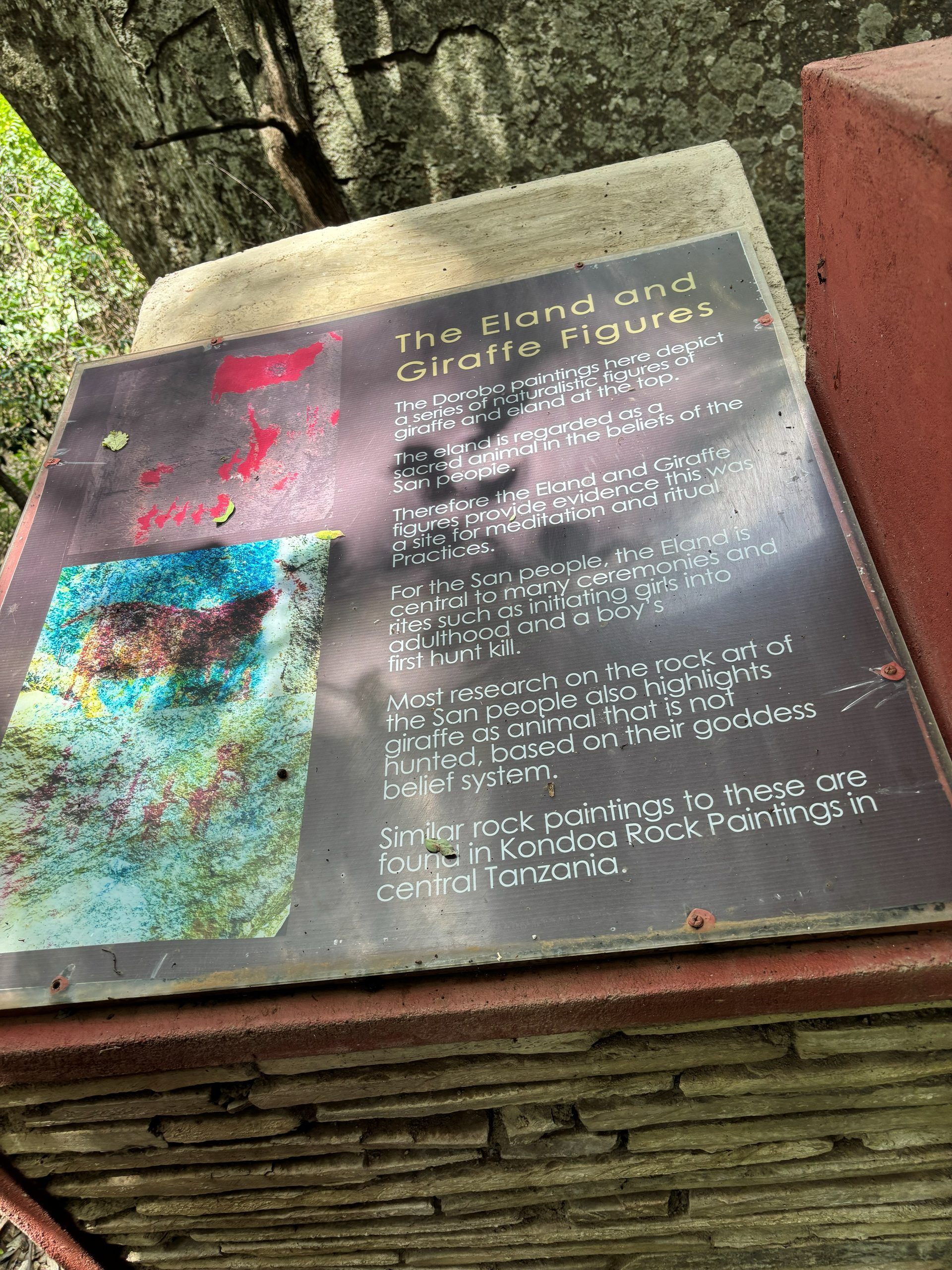
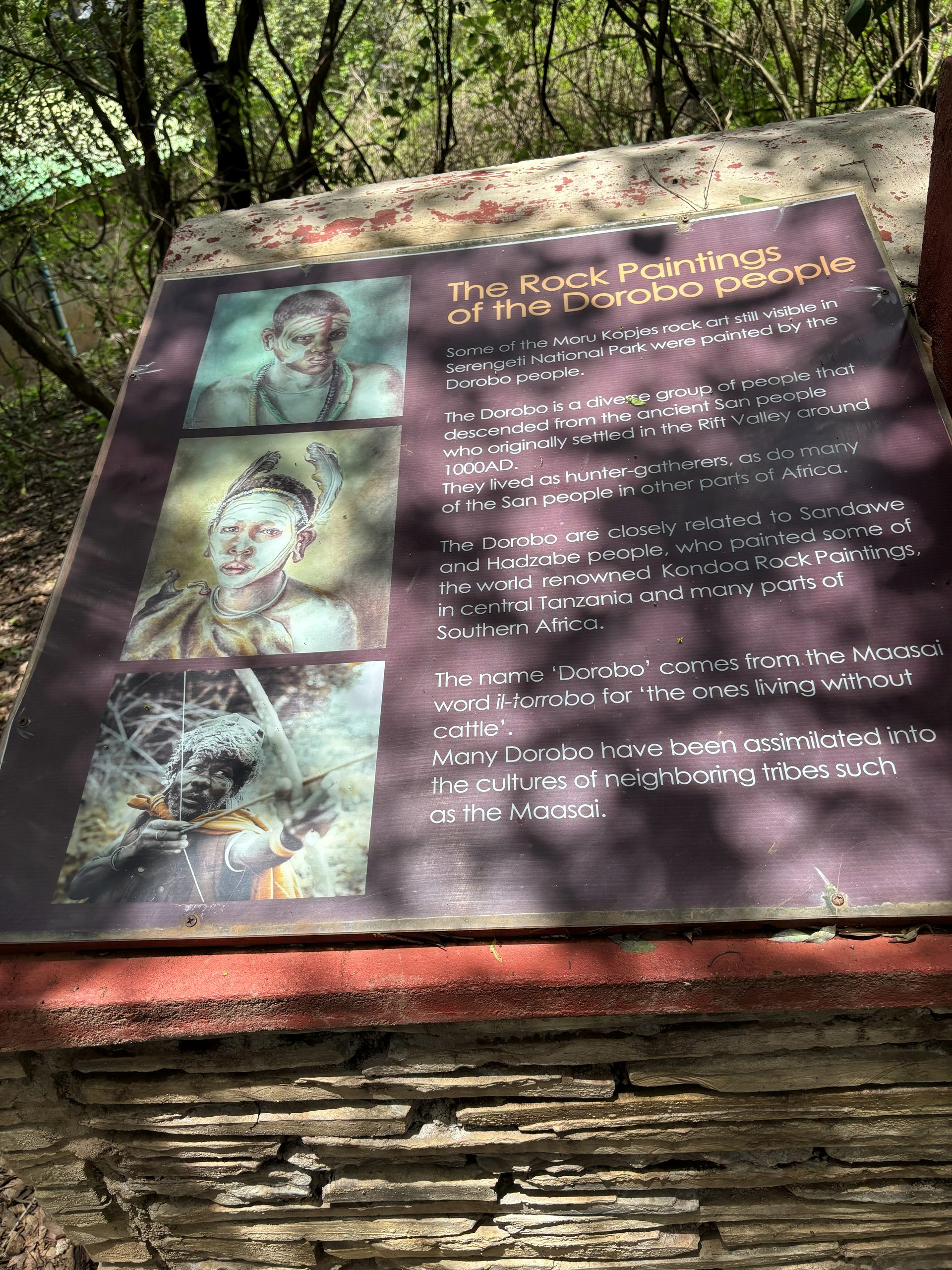
The Dorobo rock paintings at Moru — ochre figures on granite, perhaps a thousand years old, depicting the people who lived and hunted in this landscape long before it had a name
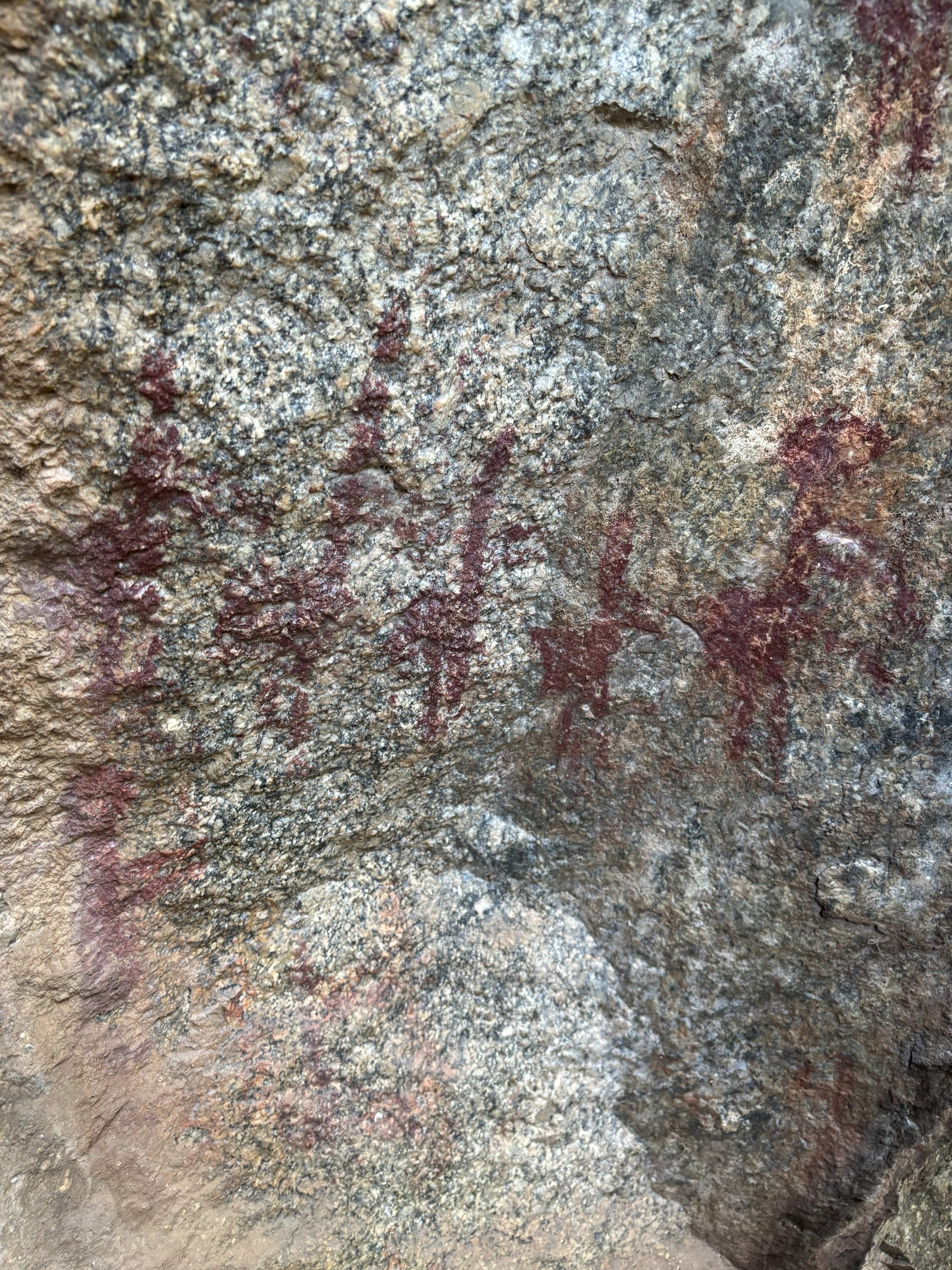
The interpretive panel at Moru — the Dorobo people, related to the ancient San, painted these kopje walls around 1,000 AD. The eland and giraffe figures marked a site of meditation and ritual.
The descent into the world's greatest wildlife arena.
After the Serengeti Nyumba camp, Ndutu Safari Lodge felt almost indulgent — proper stone buildings set among acacia woodland on the edge of Lake Ndutu, where the Serengeti ecosystem bleeds into the Ngorongoro Conservation Area. It is one of Africa's legendary lodges, a place where serious wildlife photographers and longtime safari travelers return year after year. The reason is simple: the wildlife here, especially during the calving season, is extraordinary.
The great wildebeest migration passes through Ndutu. So do lions following the wildebeest, cheetahs, hyenas, and jackals following the lions. The ecosystem at this time of year is functioning at full tilt — birth and death playing out across the plain in real time, no distance between the observer and the observed.
One of our last nights at Ndutu ended outdoors — a long table under the stars, white linen and candlelight and the darkness of the African bush stretching away in every direction, everyone wrapped in blankets against the cool night air. One of those evenings that becomes a reference point. The kind of dinner you'll tell people about.
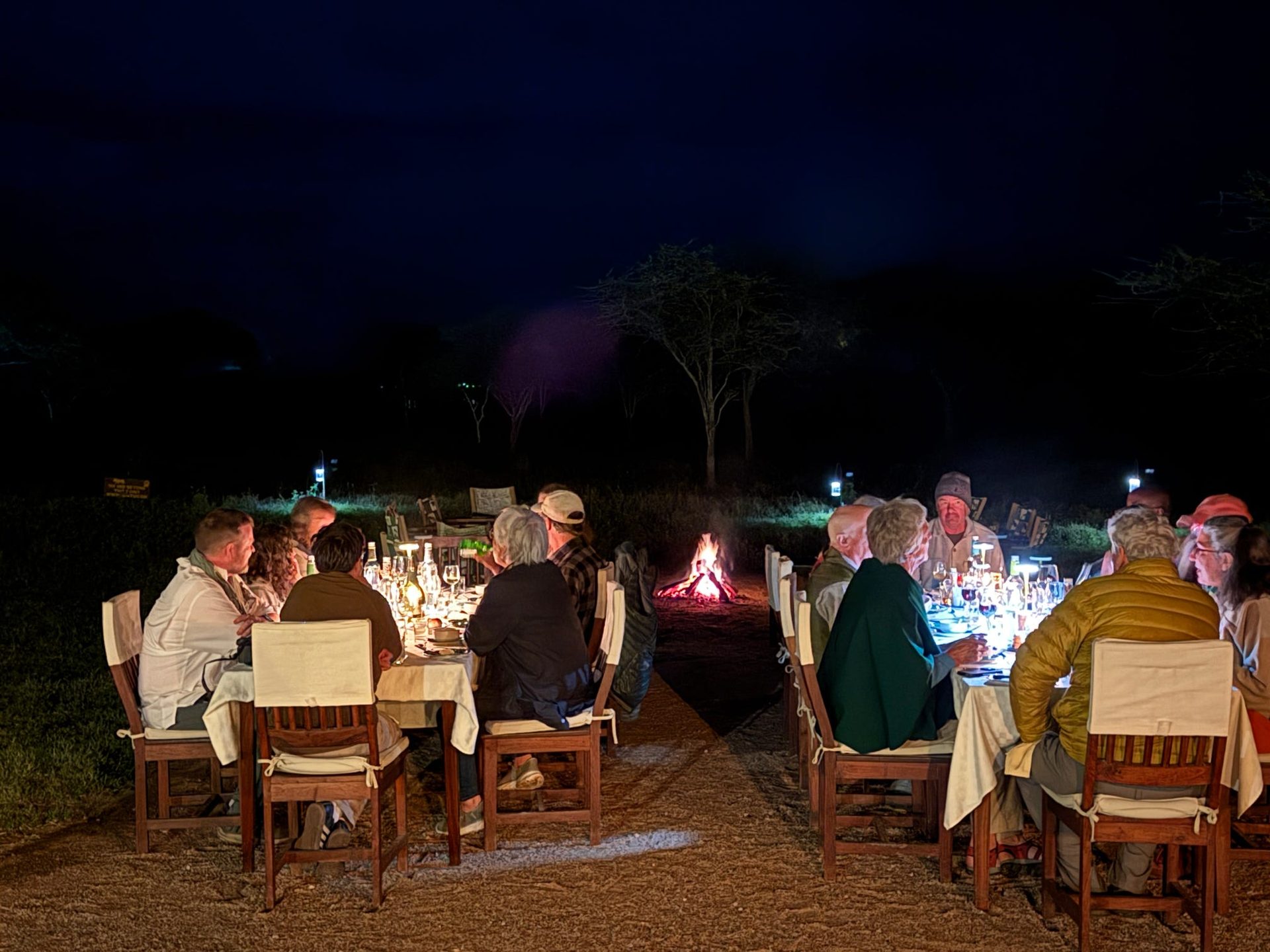
The last dinner at Ndutu — outdoors, by candlelight, the bush dark around the table. Someone has acquired a Maasai blanket. Everyone is staying later than they planned.

The group at the boundary sign — "No One Beyond This Point." We had gone considerably beyond this point. The sign approved.
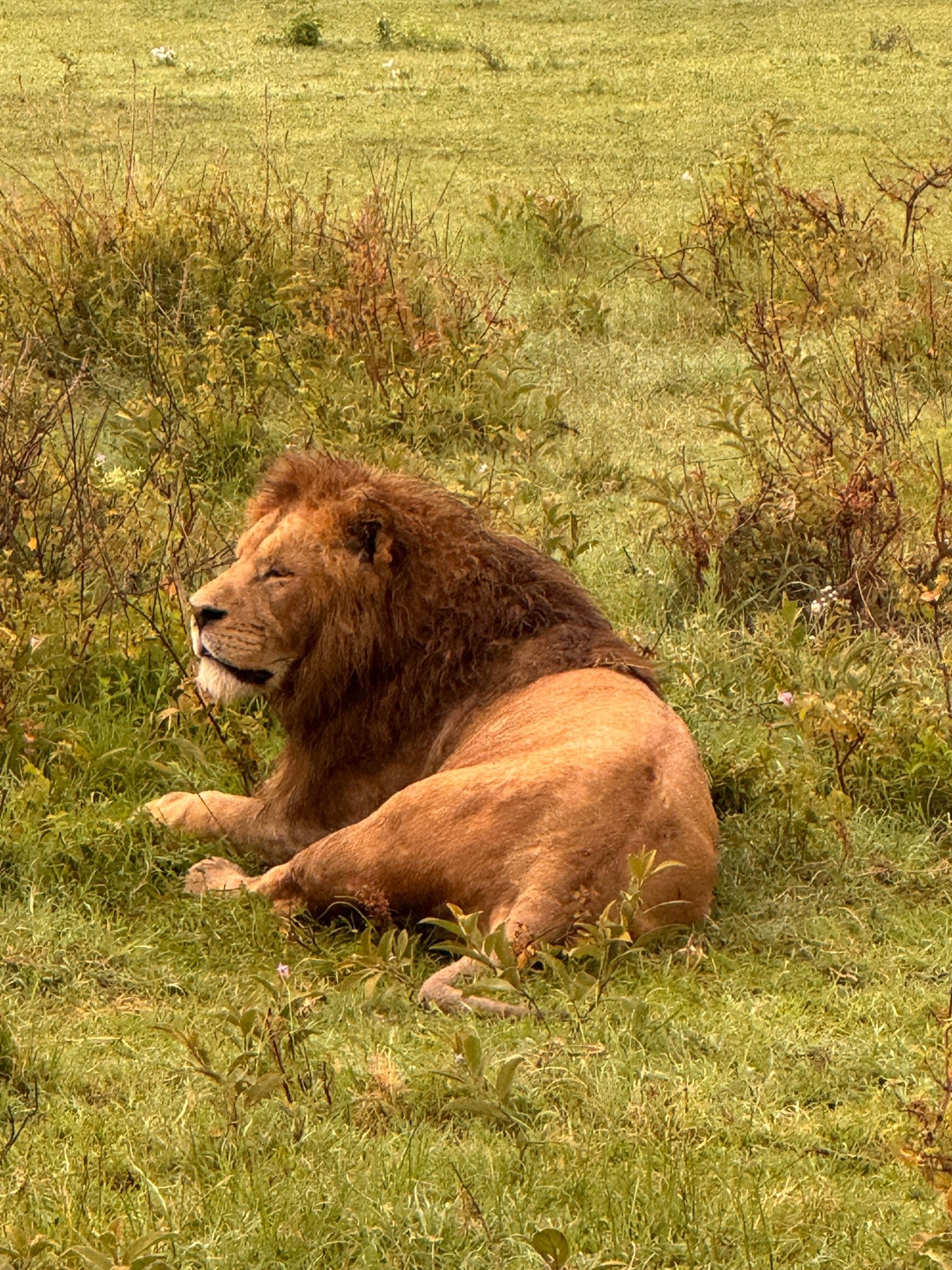
A Ndutu male — full dark mane, eyes half-closed, the grass bending in the breeze around him. He had nowhere to be. Neither did we.
Standing on the lip of the Ngorongoro Crater — the caldera floor 2,000 feet below, the scale almost impossible to process
This morning we left Ndutu Safari Lodge and passed through Olduvai Gorge again, this time stopping at the museum. The vista of the gorge from the viewing area, stunning. One can almost imagine the Leakeys digging away.
The drive from the Serengeti toward Ngorongoro takes you through a landscape that keeps building — the plains giving way to highland forest, the air cooling, the road climbing. And then, at the rim, the world drops away.
The Ngorongoro Crater is the largest intact volcanic caldera on earth — roughly 260 square kilometers of floor that functions as its own enclosed ecosystem. Lions, elephants, hippos, flamingos, rhinos, and wildebeest all live within its walls, sustained by the permanent water of Lake Magadi at the center. The animals don't leave because they don't need to. Everything they need is here.
Standing at the rim for the first time, you understand immediately why this place is singular. The crater floor lay 600 meters below us, green and hazy, the lake glinting silver in the middle distance. Wildlife moved across it in slow patterns that were visible even from this height. It looked like a world made in miniature — but the scale was the opposite of small.
We camped on the crater rim — the Ngorongoro Nyumba camp set among forest at high elevation, the air noticeably cooler and damper, the trees pressing in from every side. The view from the tents at sunset was the kind that stops conversation completely.
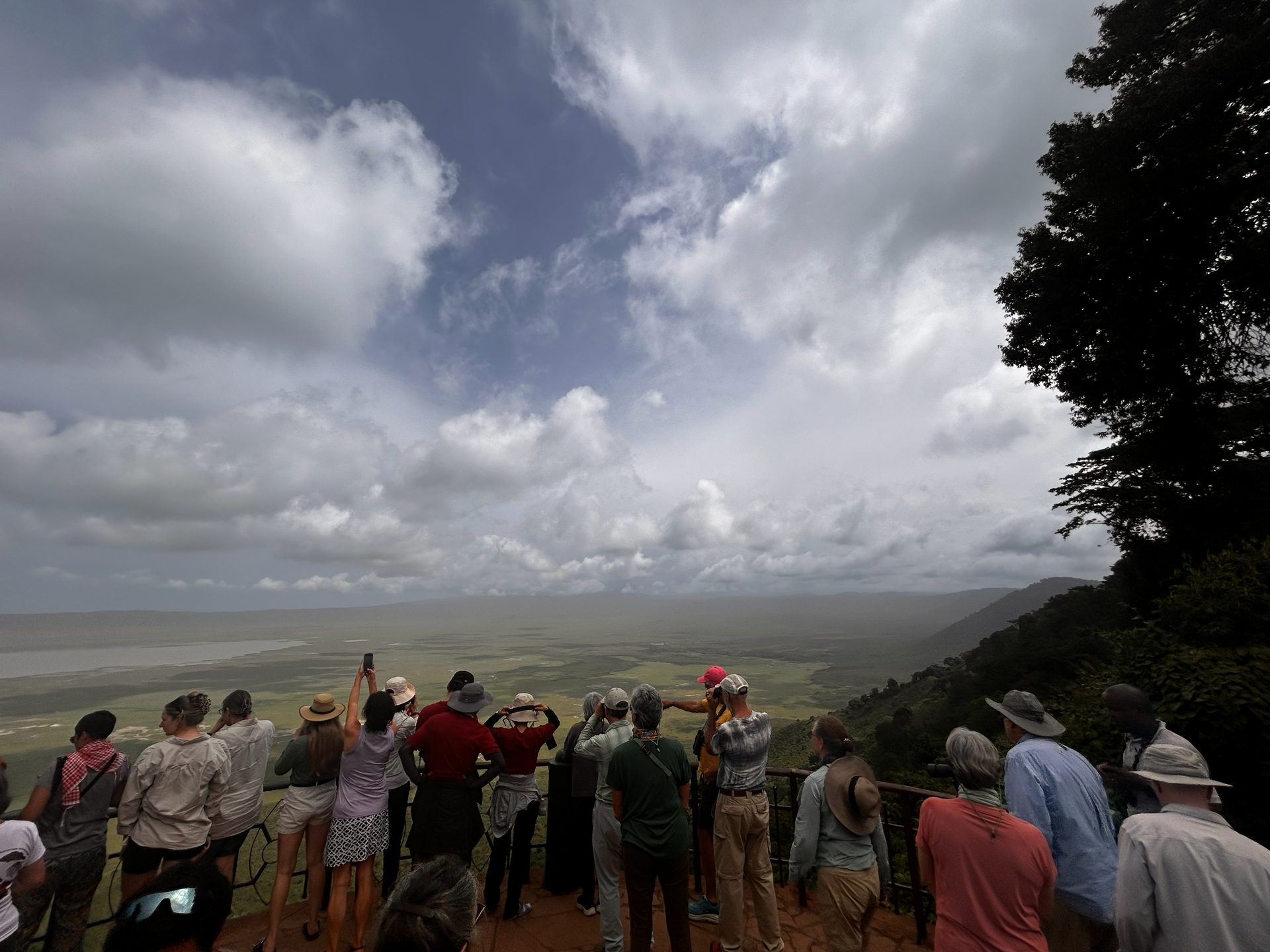
The whole group at the crater rim — every single person reaching for their camera at the same moment. The crater floor 600 meters below, the lake glinting beyond.
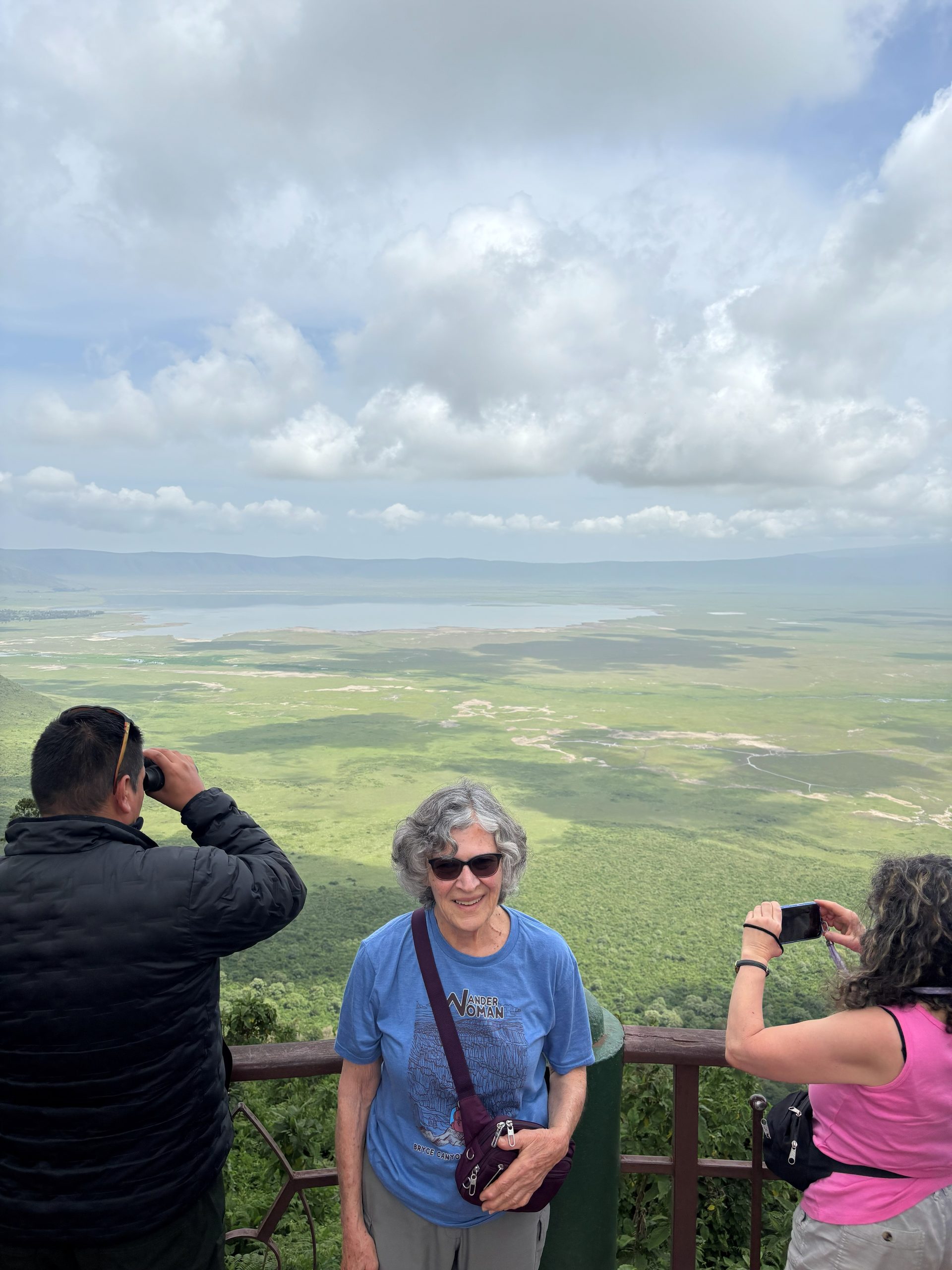
Jo at the rim — the entire Ngorongoro Crater behind her, Lake Magadi visible on the crater floor, clouds building over the far wall
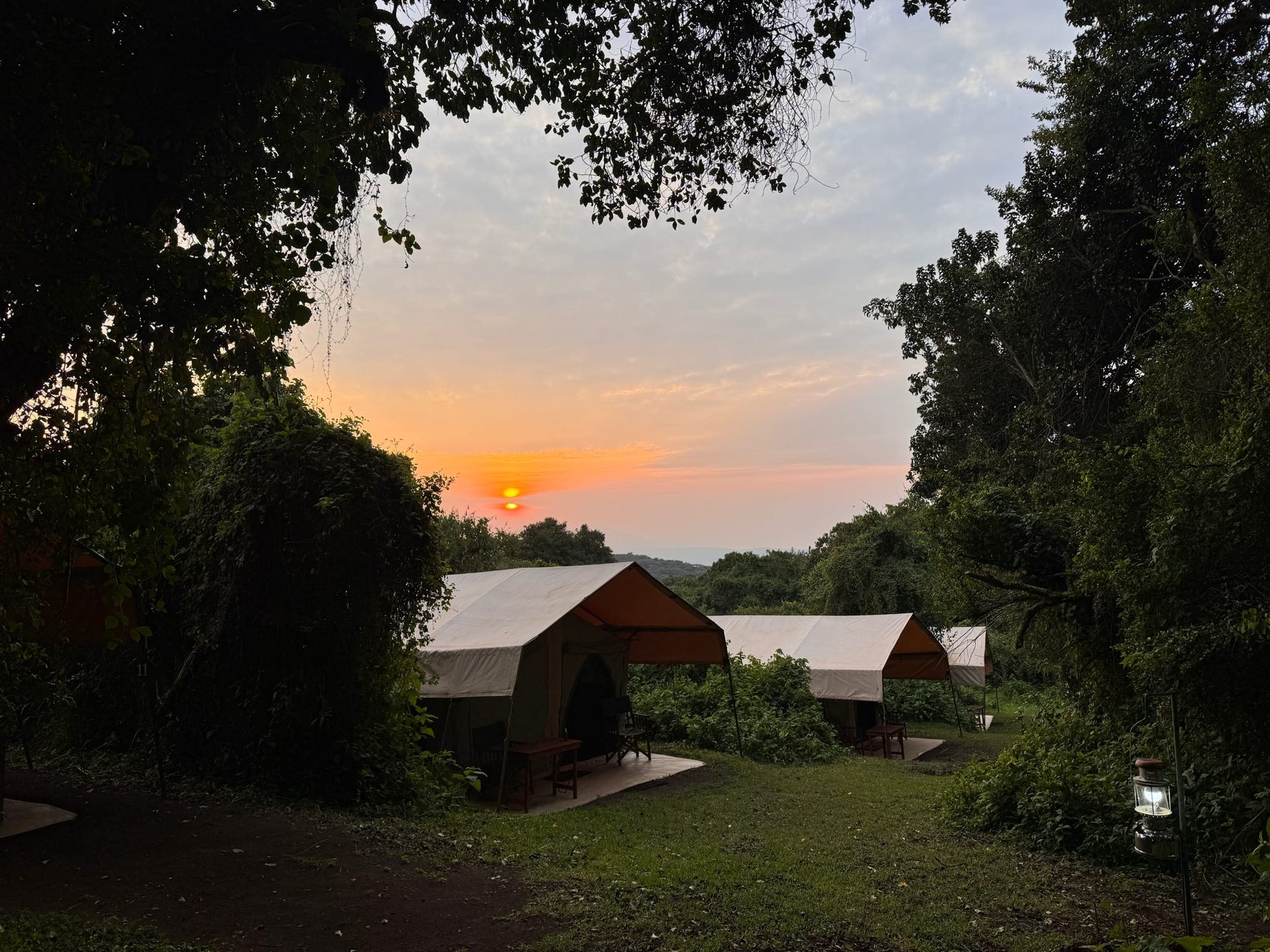
The Ngorongoro Nyumba camp at sunset — forest closing in on every side, the sun going down through the trees, a lantern already lit. The crater 600 metres below. Everything very still.
The wildebeest migration moving across the crater floor — a river of animals that never quite stops
A lion and lioness on the crater road — blocking traffic with complete authority
On the crater floor, in the morning mist, the guides spotted it first — a shape moving slowly through the green, too large and too deliberate to be anything else. A black rhino. One of perhaps 30 remaining individuals in the Ngorongoro Crater, among the most critically endangered animals on the planet.
We watched through binoculars as it grazed in the haze, the crater walls rising behind it. The guides explained its history — the Moru Kopjes monitoring post had been dedicated to tracking exactly these animals. The rhino was too far for a sharp photograph but close enough to see clearly: that heavy prehistoric silhouette, the double horns, the slow, purposeful movement of an animal that has nothing to fear inside these walls. It was one of the great sightings of the trip.
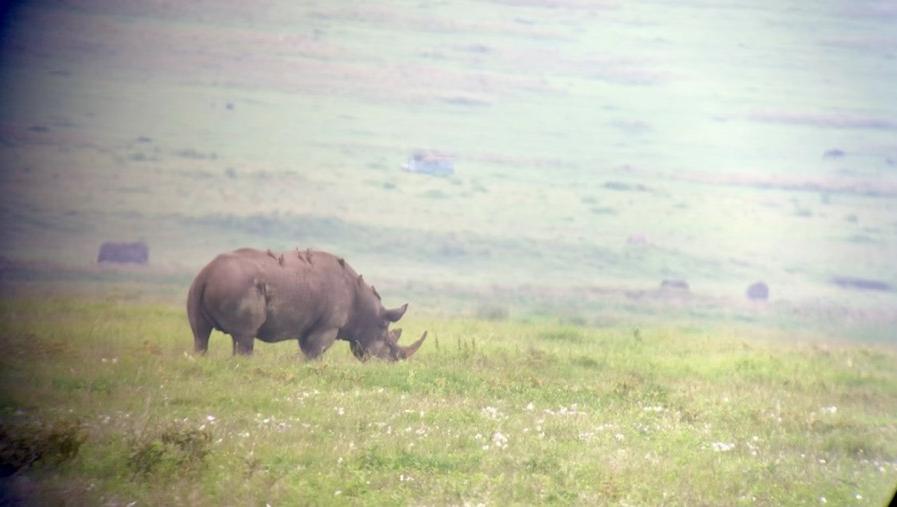
The black rhino on the crater floor — one of perhaps 30 remaining in the Ngorongoro ecosystem. Too far for a sharp shot; close enough that it didn't matter. We just watched.
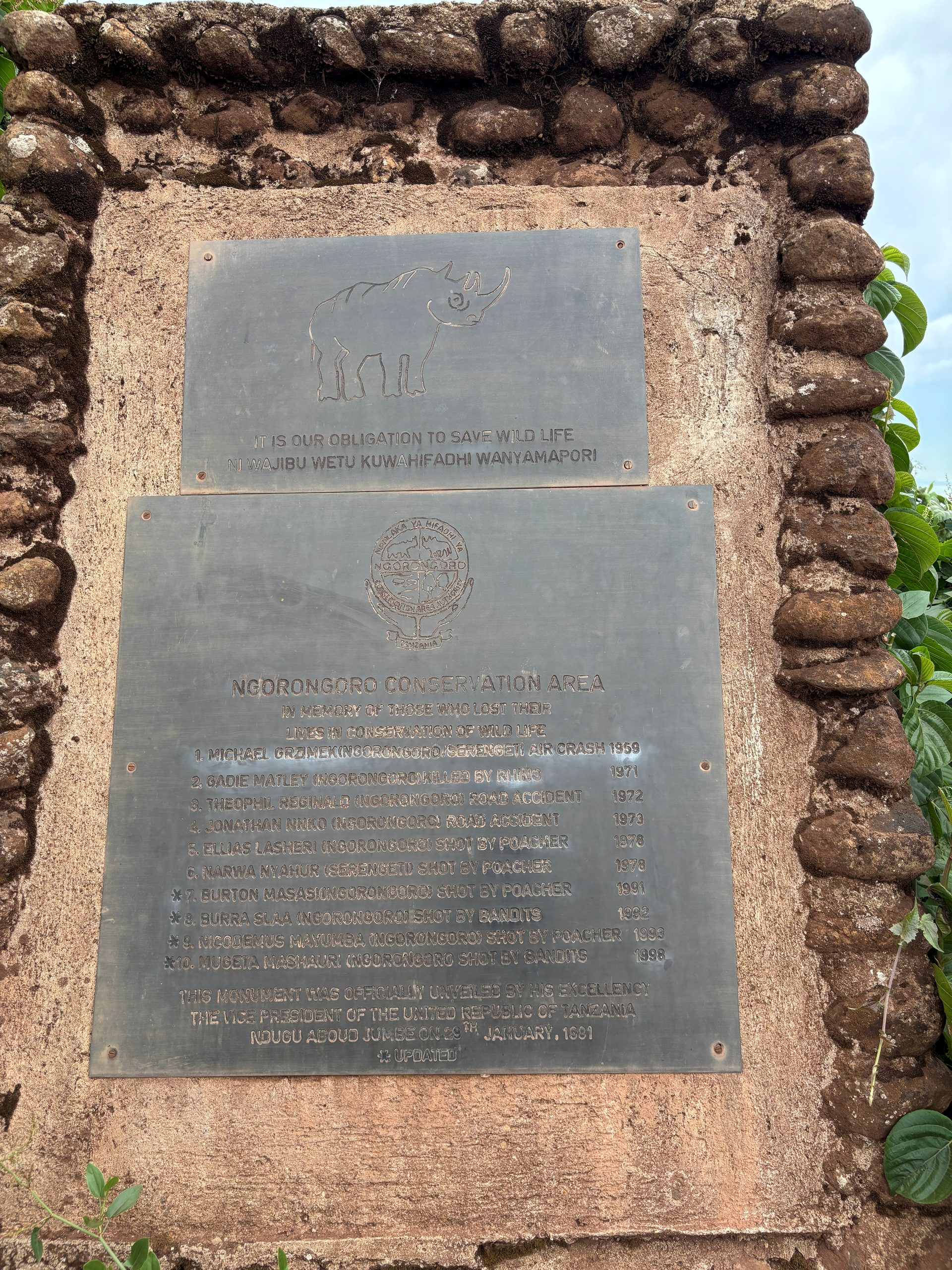
The Ngorongoro Conservation Area memorial — honoring rangers and conservationists who lost their lives protecting this place. It is our obligation to save wildlife.
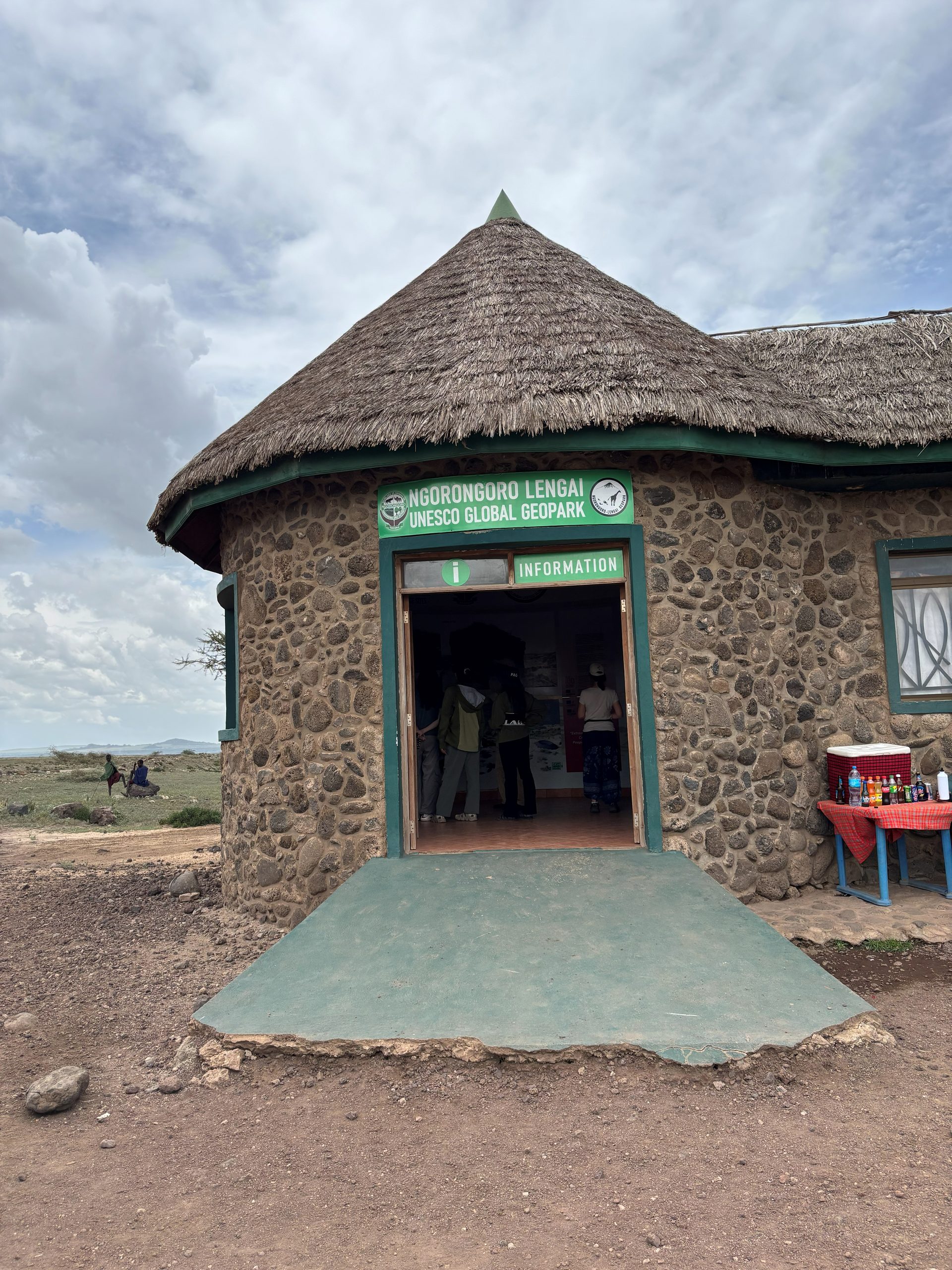
The Ngorongoro Lengai UNESCO Global Geopark information stop — a round stone hut at the edge of the conservation area, the Serengeti visible on the horizon behind it
One final night. Stone walls, a working farm, and a choir in the garden.
After twelve days in the bush — bucket showers, canvas tents, red-dirt roads, and the deep, sustained intensity of the Serengeti and Ngorongoro — arriving at Gibb's Farm felt like stepping into a different world entirely. Not a lesser one. A different one. One with stone walls, hardwood floors, a working organic garden, and the kind of quiet that comes not from emptiness but from intention.
Gibb's Farm sits at 1,500 meters in the Ngorongoro Highlands above Karatu — cool, lush, improbably green after the dusty plains below. The property began as a coffee farm in the 1930s, and you feel that history in every building: the rough-cut stone, the heavy timber beams, the wide verandas, the sense that this place was built to last and has been doing exactly that. It is now widely regarded as one of the finest lodges in East Africa. After two weeks on safari, arriving here was less like checking in to a hotel and more like being welcomed into a home that happened to be very, very good at hospitality.
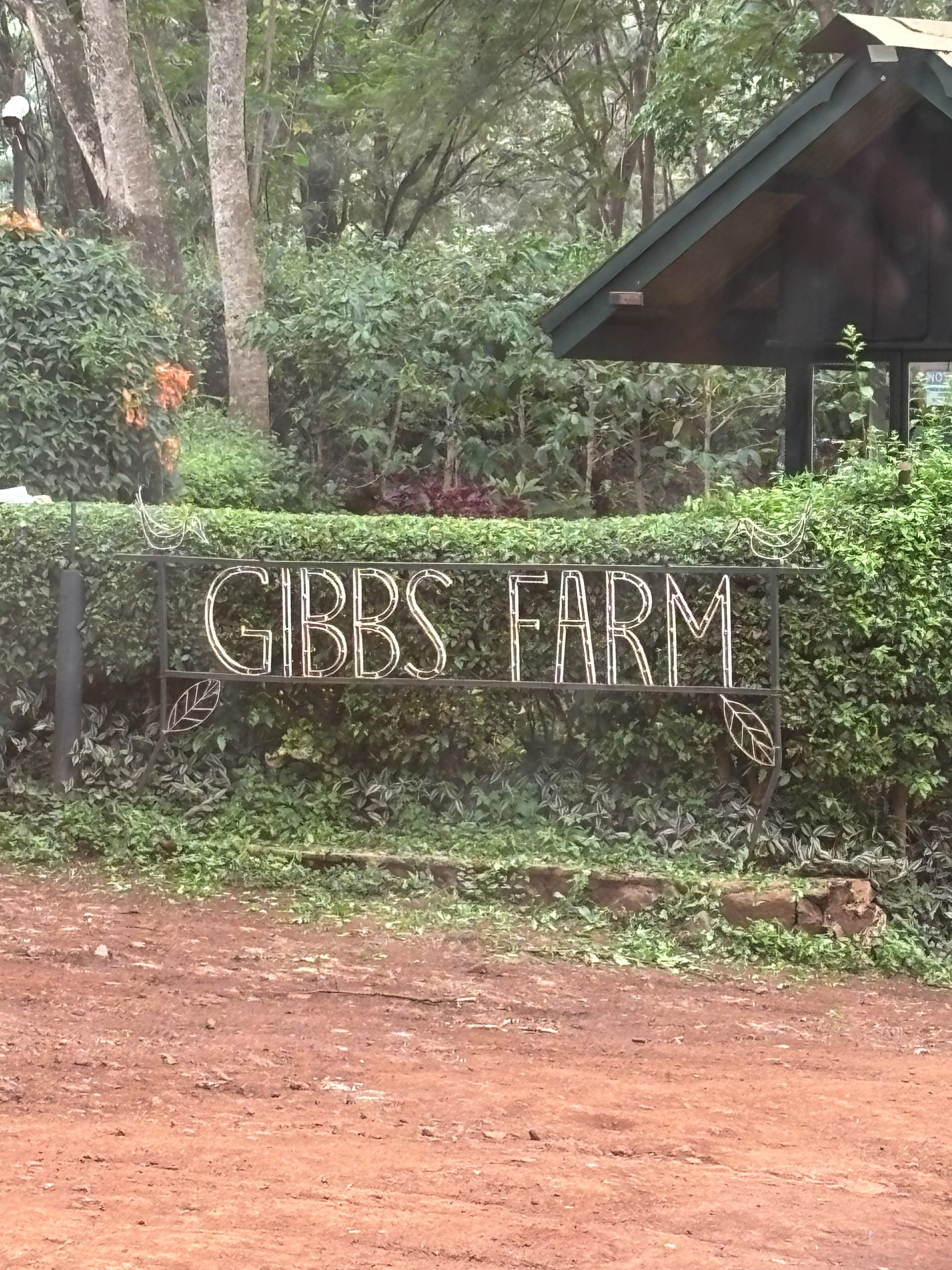
The entrance sign — wire letters spelling GIBBS FARM against a clipped green hedge, the highland forest rising behind. After two weeks of dust and canvas, it felt like a different country.
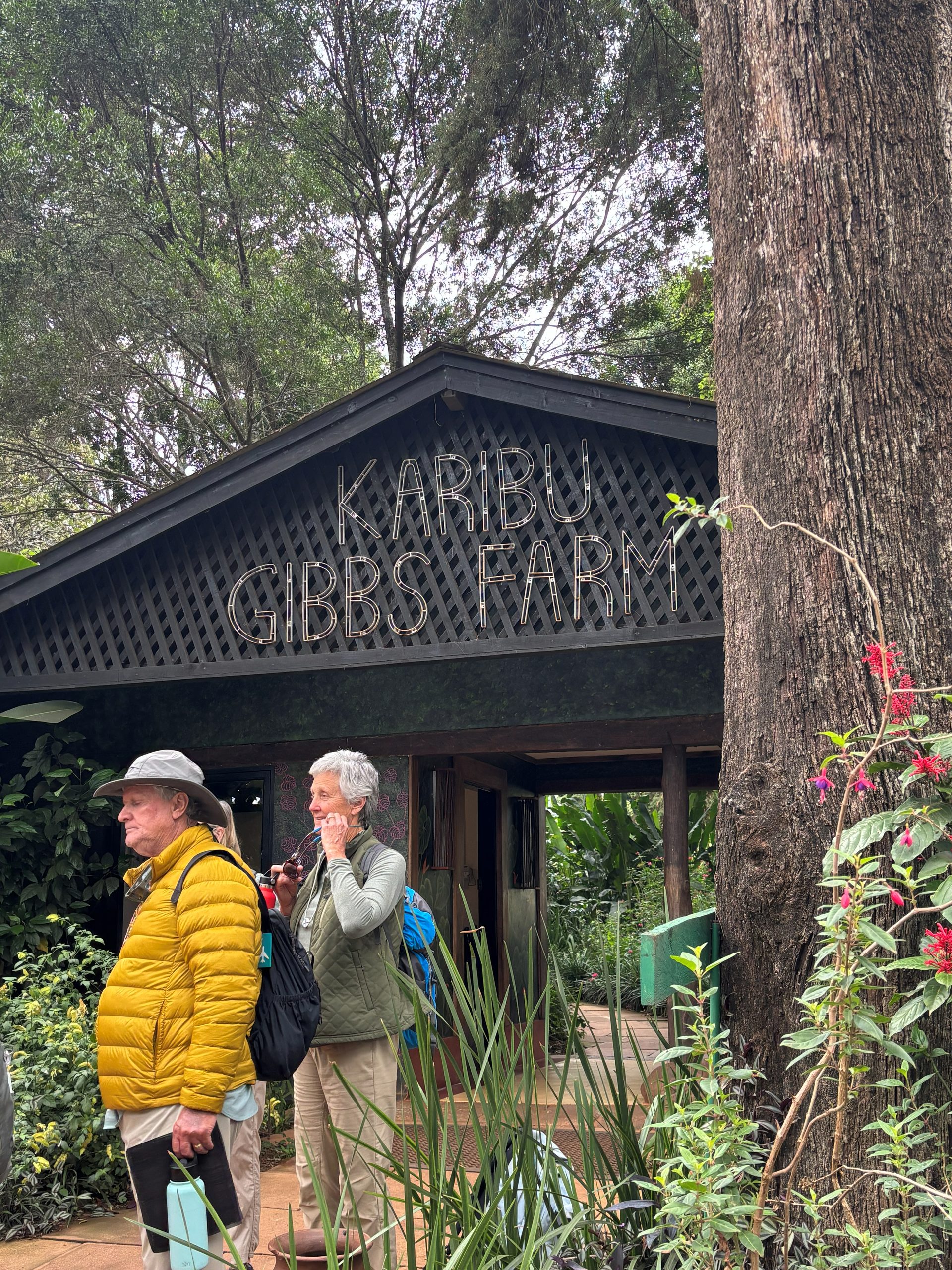
Karibu Gibbs Farm — the welcome pavilion tucked into an explosion of tropical color, the highland forest enormous behind it
The Tloma Village Choir performing at Gibb's Farm — voices rising through the highland garden
We pulled through the gate and the trucks came to a stop in the red-dirt courtyard, and the group tumbled out — dusty, tired in the best way, carrying two weeks of Africa in our clothes and hair and sun-creased faces. The Gibb's Farm staff were waiting. Not in a line, not with a script — just there, warm and present, the kind of welcome that feels personal even the first time.
The welcome at Gibb's Farm — Michael thanking our guides and presenting their tips, the highland garden all around
The Tloma Village Choir on the march through the Gibb's Farm gardens — a moment nobody was prepared for
"Voices rising in the highland afternoon, the farm garden green and perfect all around, the safari over and somehow still happening."
Cottage 10 at Gibb's Farm — the Tloma Cottage — was the finest room of the entire trip, and after the progression of tents and lodges that preceded it, the effect was considerable. Stone walls, dark hardwood floors worn smooth by decades of foot traffic, timber ceiling beams, and a bed dressed in white linen with feather-print pillows. The mosquito net hung from a ceiling frame like something from a novel set in colonial East Africa.
It was also, unquestionably, the most lived-in-looking room of the trip — safari bags piled on the bench at the foot of the bed, gear from two weeks in the field spread across every surface. The room absorbed it all without complaint. Stone walls have seen worse.
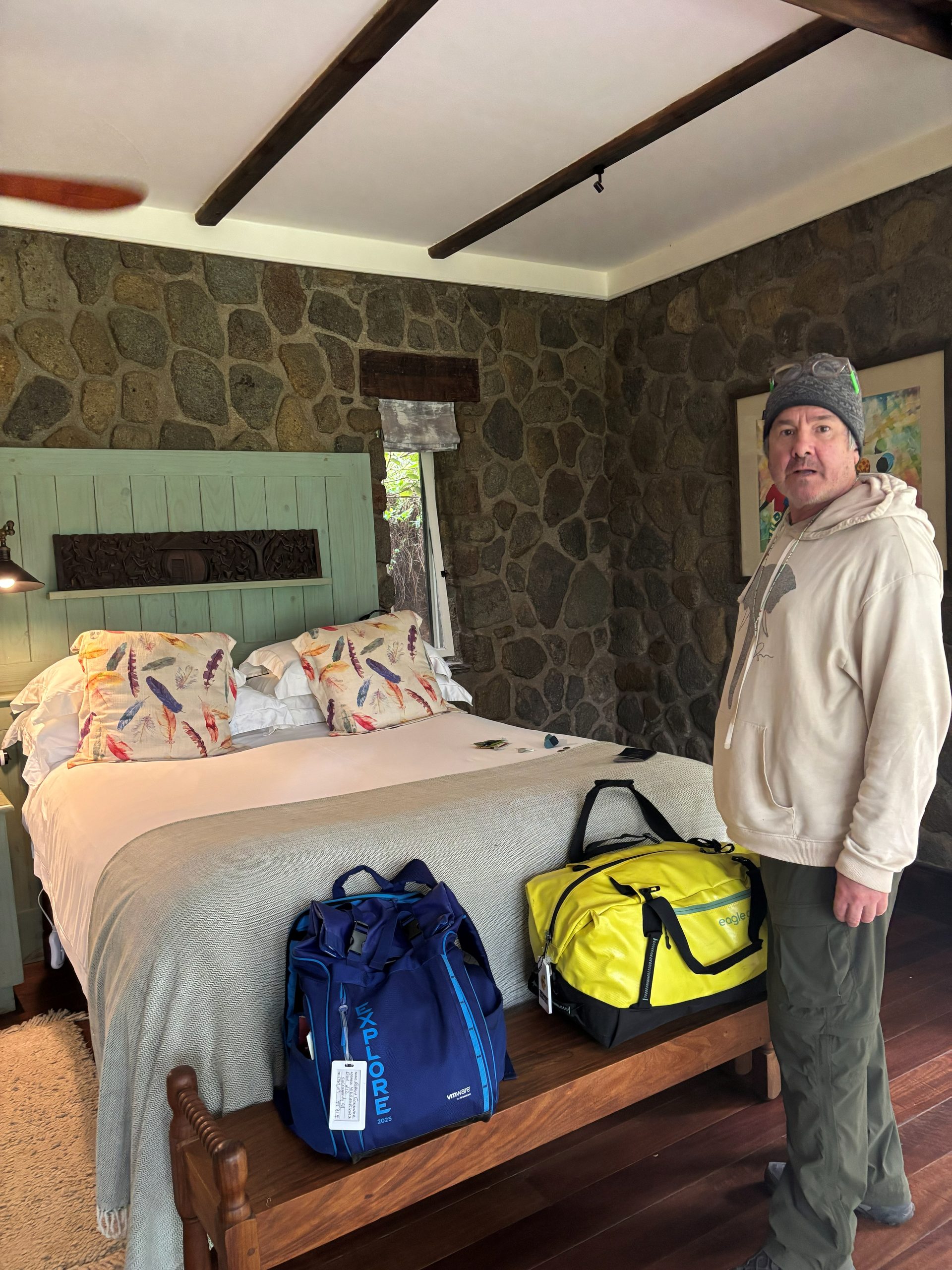
Room 10, Tloma Cottage — stone walls, timber beams, sage-green headboard, and two weeks of safari luggage on the bench. The beanie stays on. It's cold up here.
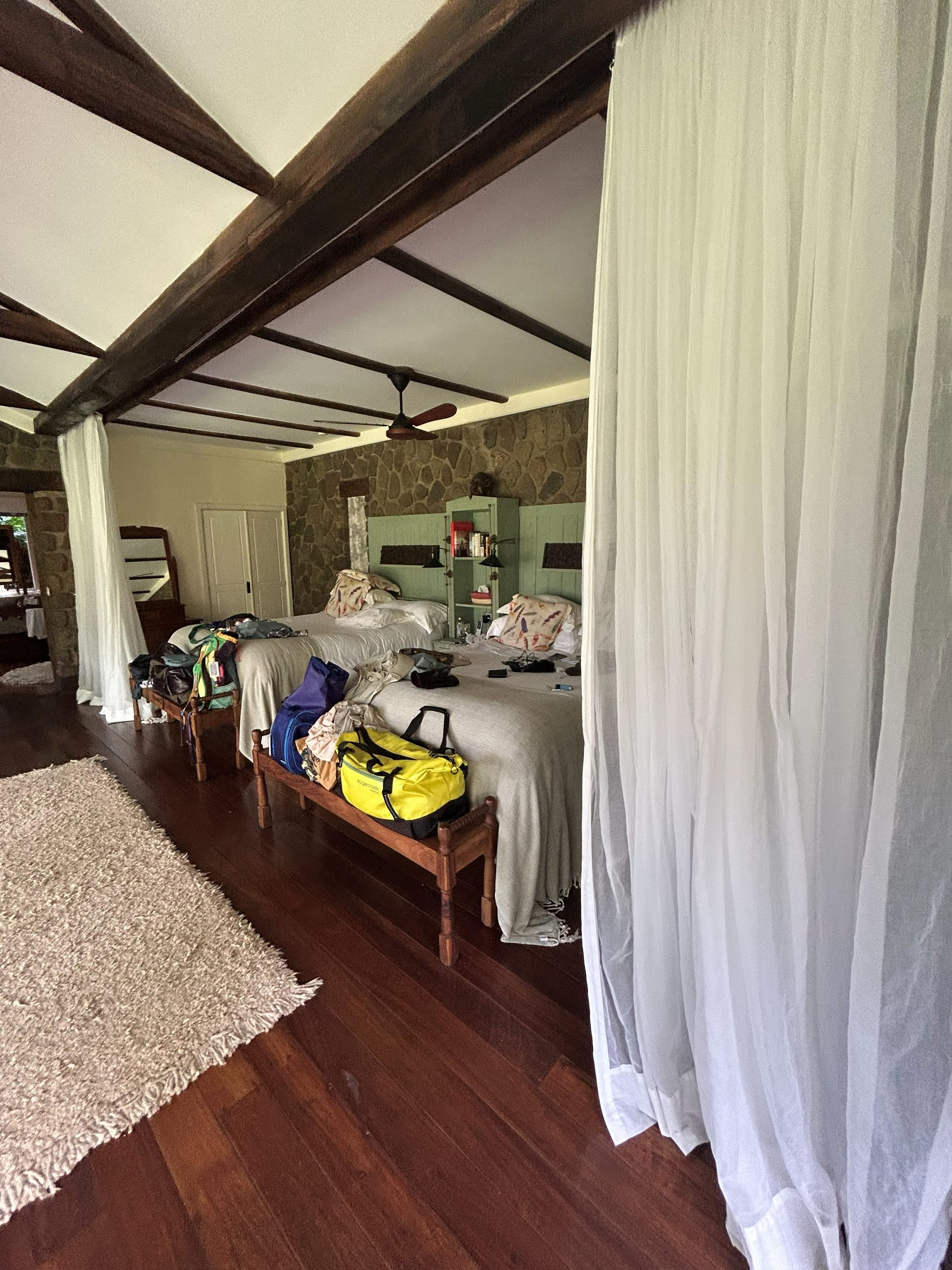
The full room — mosquito net curtains, twin beds, hardwood floors, stone walls, and the comfortable chaos of the last night of a two-week safari
The main house at Gibb's Farm contains one of the most quietly beautiful rooms I encountered anywhere in Tanzania. A curved bank of tall white-framed windows looks directly into the garden — green so intense it seems almost to press through the glass. Two dark leather armchairs sit on a round sisal rug on the hardwood floor, angled toward the view. A wooden sideboard holds a carved wooden figure, a green thermos, and a tray of small tasting dishes. Exposed timber beams run overhead. A single pendant light hangs from the center.
Nobody designs a room like this accidentally. It is the result of decades of attention and care — the kind of space that makes you want to sit down and never stand up again.
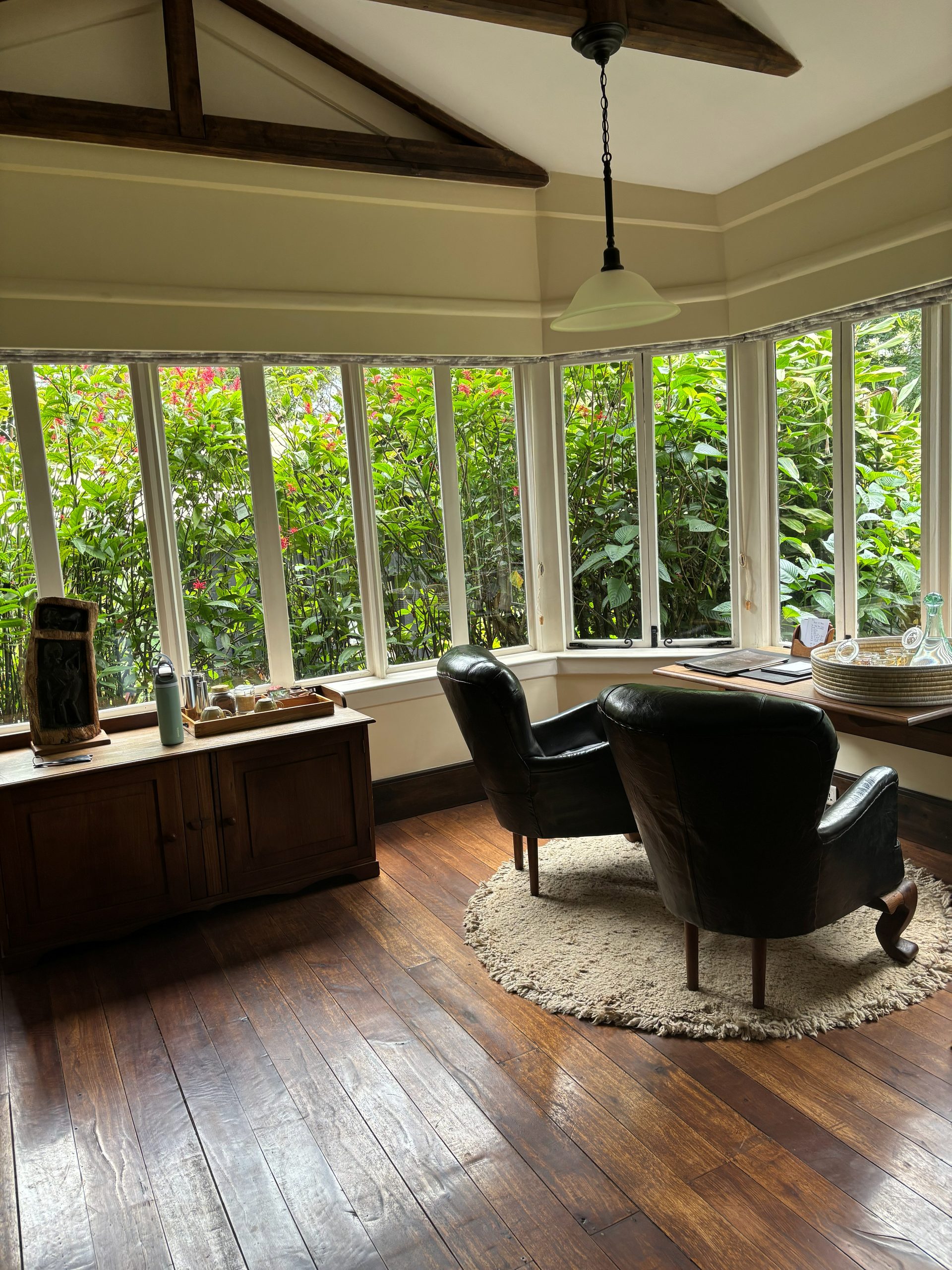
The sitting room — dark leather, hardwood, timber beams, and a curved wall of windows looking directly into the garden. The most civilized room of the entire trip.
Gibb's Farm is not just a lodge that happens to have a garden. It is a working farm — a productive, intentional agricultural operation that grows a remarkable proportion of what ends up on your plate. The activity chalkboard outside the main reception listed everything on offer: coffee roasting at 7am, bird watching, cow milking at 7:30am and 4pm, vegetable harvesting, pig feeding at 11:30am, yoga, a medicinal walk, a village walk, bike riding, a flower garden tour, egg collection, and a story-telling session running all the way to 5:30pm. The evening event: the Tloma Village Choir, poolside at 5:30pm.
The organic vegetable garden board read like a very ambitious menu at a Michelin-starred restaurant: mushrooms, carrots, leeks, turnips, aubergine, cauliflower, tomato, zucchini, pumpkin, broccoli, artichoke, beetroot, lettuce, cabbage, tatsoi, pak choi, apple, citrus, rhubarb — and on the herb and spice side: coriander, chives, garlic shoot, horseradish, parsley, wild rocket, lemon balm, green and red sorrel, lemon thyme, mint, French tarragon, marjoram, fennel, basil, dill, arugula, rosemary, turmeric, lavender, celery. All of it growing in the rich volcanic soil of the Ngorongoro highlands, 1,500 meters above sea level.
At the bottom of the board, in chalk: You're Welcome.
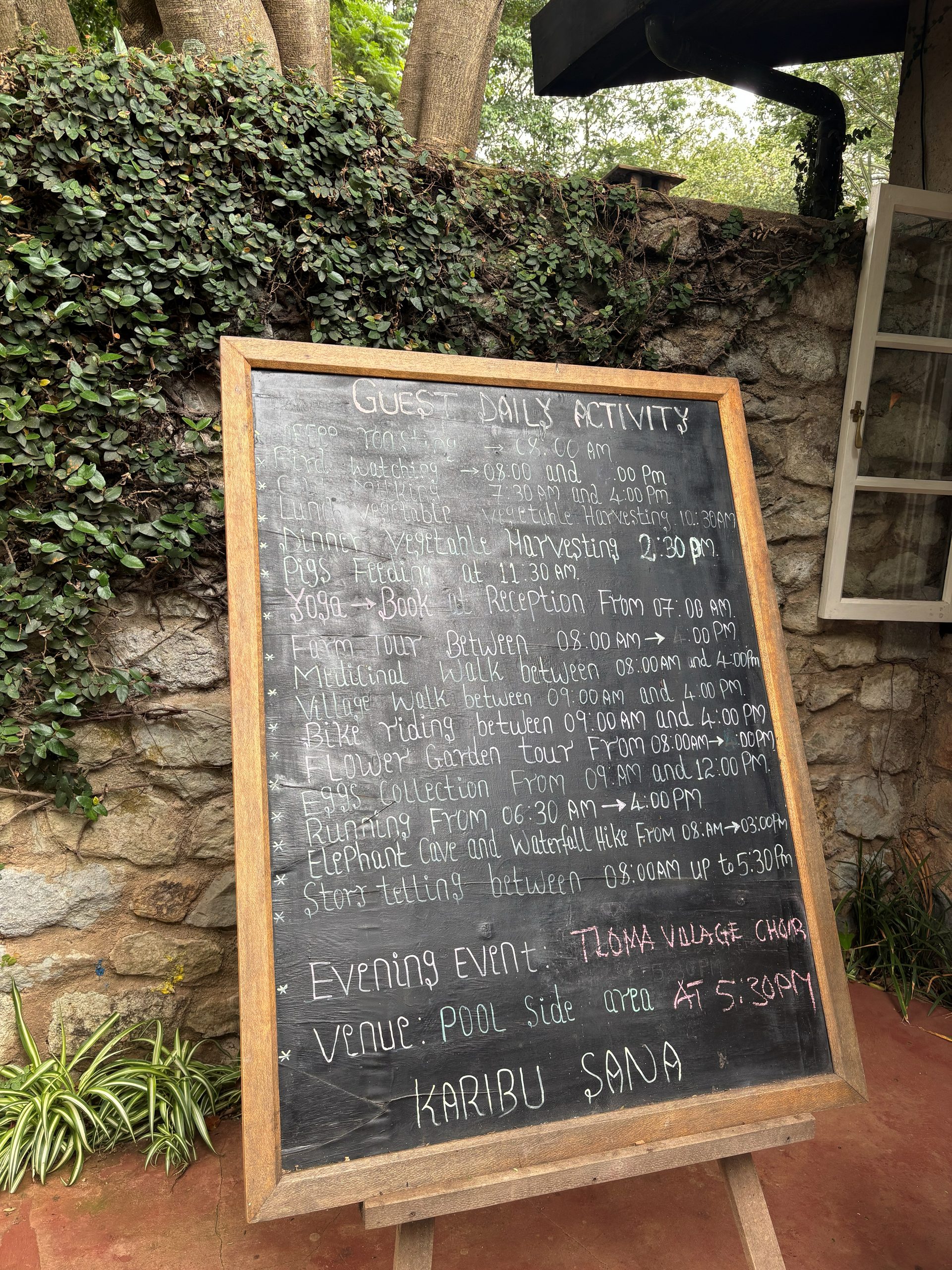
The daily activity board — coffee roasting at 7am through story-telling at 5:30pm, with the Tloma Village Choir in the evening. Karibu Sana — you are very welcome indeed.
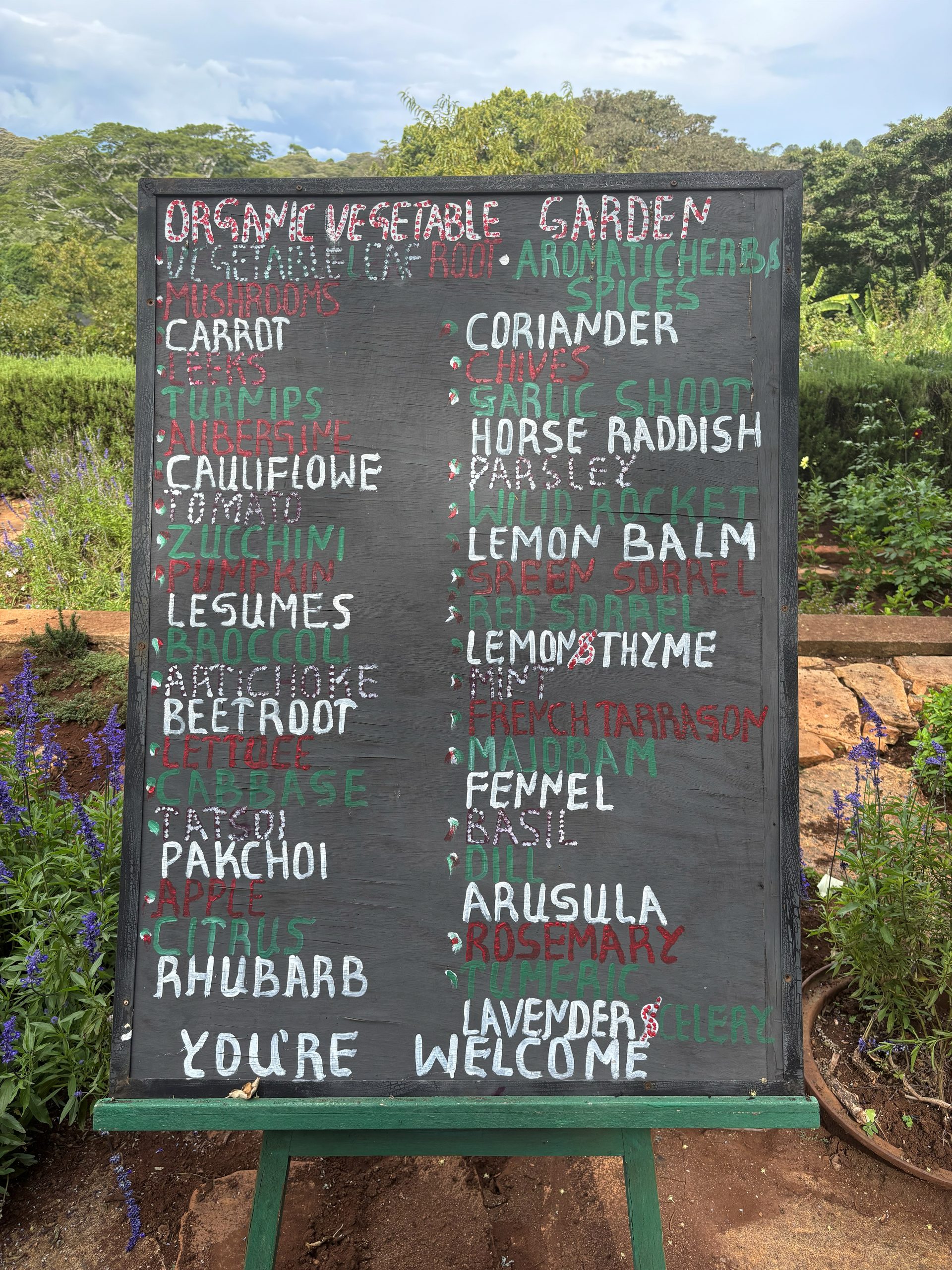
The organic garden board — an extraordinary list of what this farm grows in the volcanic highlands soil. The lavender in the foreground is not decoration. It's on the list.
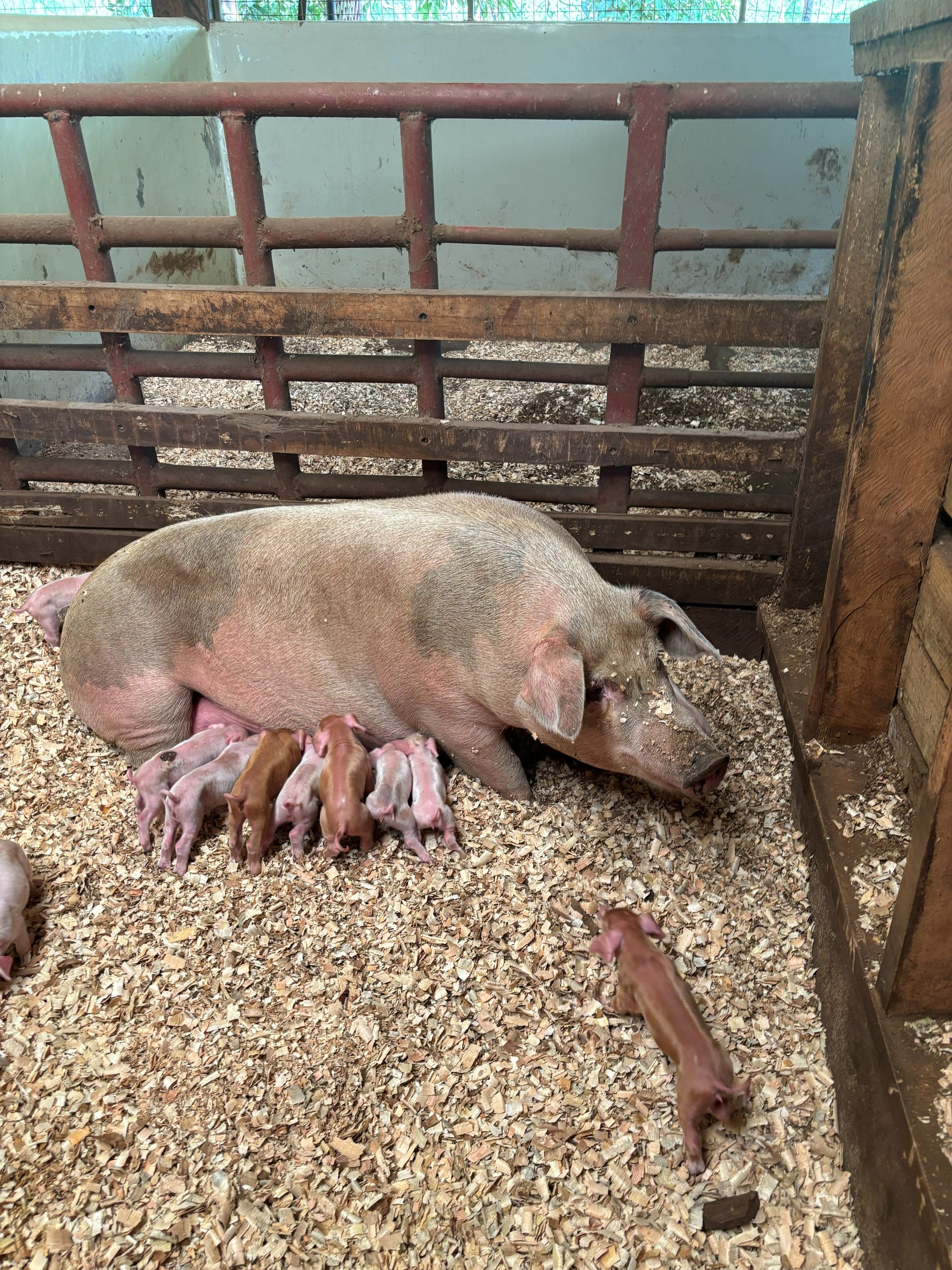
New arrivals at the Gibb's Farm pigsty — a sow nursing her litter of newborns, one late arrival still working out the logistics. The farm produces its own pork. The irony is not lost on guests who just watched warthogs for two weeks.
The Tloma Village Choir — a group of local singers from the nearby community — performs regularly at Gibb's Farm. It was one of those moments the itinerary doesn't account for but the memory holds onto longest. Voices rising in the highland afternoon, the farm garden green and perfect all around, the safari over and somehow still happening.
The goodbyes happened in the red-dirt courtyard, beside the Thomson Safaris Land Rovers, under the trees. The four Tanzanian game driver-guides — the men who had spent twelve days pointing out animals we couldn't see, explaining track signs, naming every bird, navigating the Serengeti mud, changing flat tires in the rain, and generally making the whole thing possible — stood together one last time for photographs.
They were smiling. So was everyone else. There is a particular quality to goodbyes at the end of a journey like this — not sad, exactly, but weighted. You know you have just spent twelve days with people who have given you something you could not have found alone, and you will probably never see them again, and they have done this hundreds of times with hundreds of different groups and will do it hundreds more. But for this group, on this trip, they were irreplaceable. We tried to say that. I'm not sure words were adequate to the task.
And then the trucks pulled away, and the gate of Gibb's Farm receded in the rear window, and Tanzania was behind us.
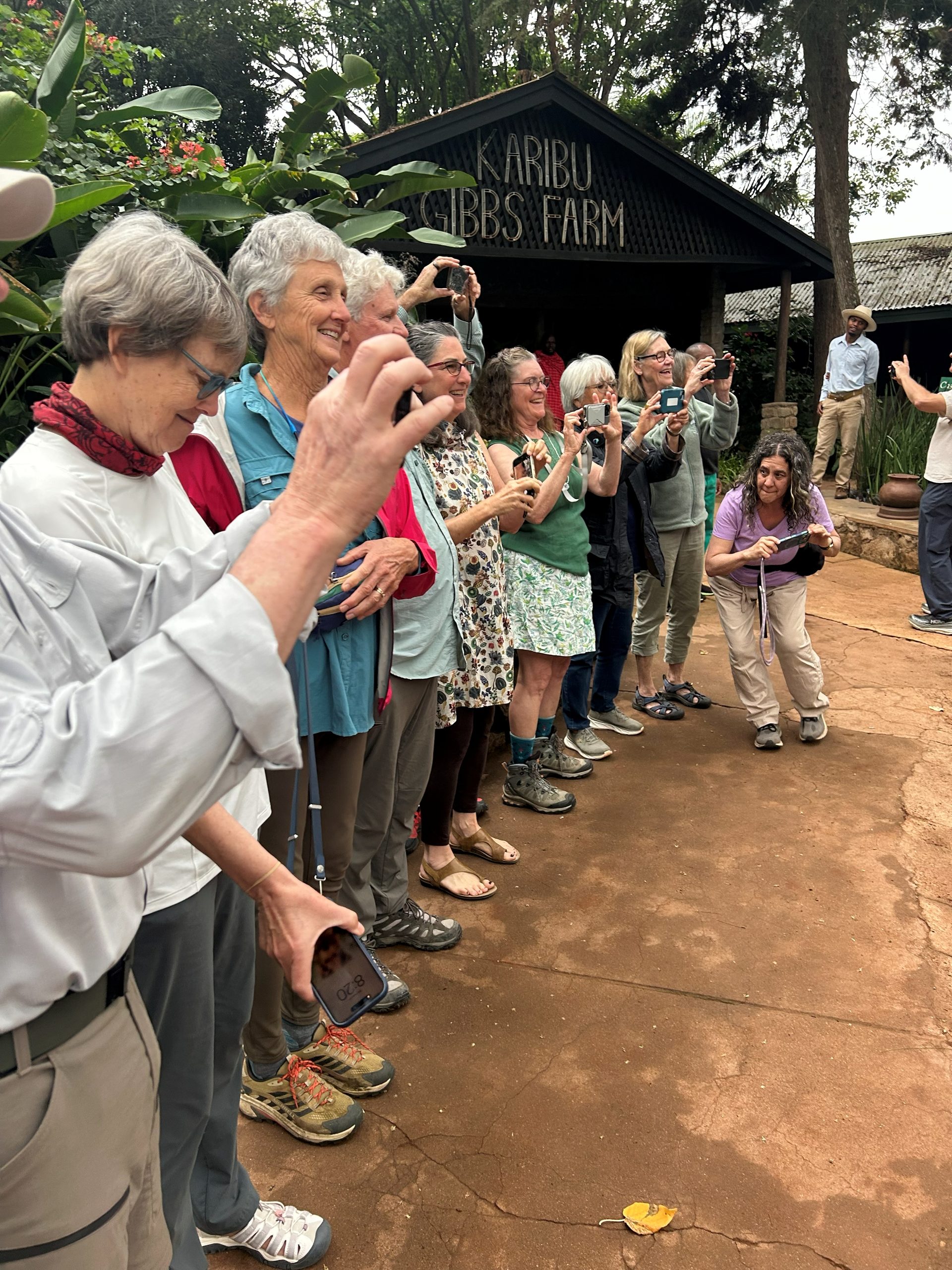
Every single phone up — the group on the terrace, capturing the heartfelt goodbye to the guides. Some things you just have to try to hold on to.
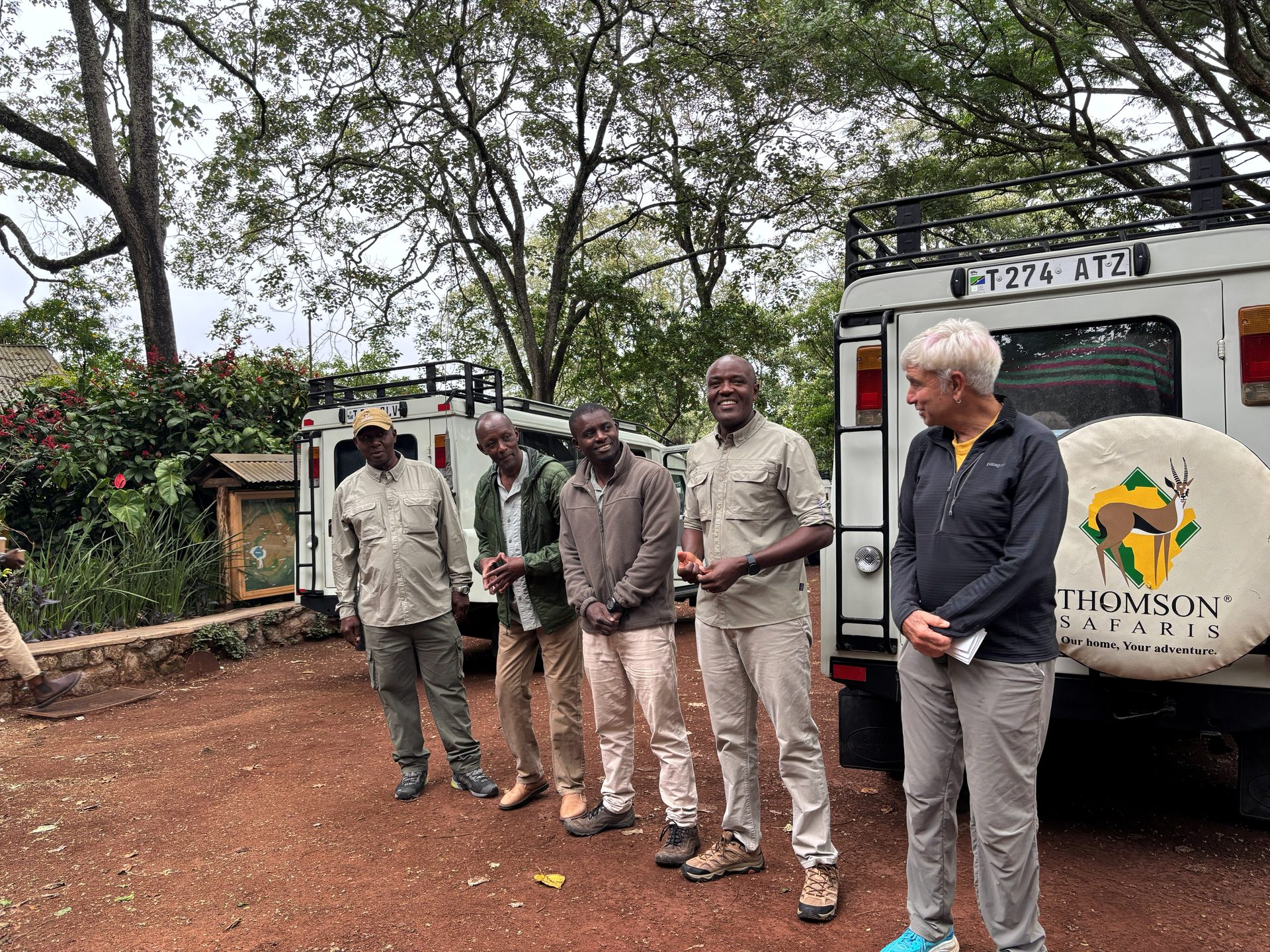
The guides at the goodbye — Michael and the four game drivers who spent twelve days teaching us to see Africa. Their home. Our adventure. Exactly as the spare tire promised.
"You know you have just spent twelve days with people who gave you something you couldn't have found alone — and words were inadequate to say so."
Two weeks. Six lodges. Four national parks. One volcanic crater. One chorus of village singers. Sixteen travelers. Five Tanzanian guides. Approximately 120 photographs. An unknowable number of animals spotted, sunsets watched, and cups of coffee drunk on tent porches at first light.
Tanzania does not leave you. It becomes a reference point — a place you measure other experiences against, a landscape that stays with you long after the dust has come out of your clothes.
The main blog tells the story. The Full Reel shows everything else — the moments between the moments, the wildlife that didn't make the edit, and the sounds of Africa that no photograph can capture. Over 200 video clips organized by park, coming soon.